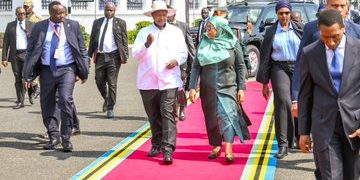



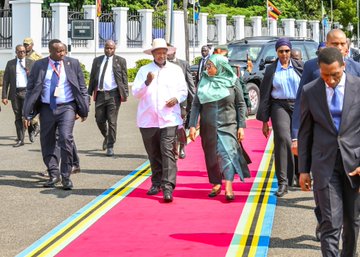
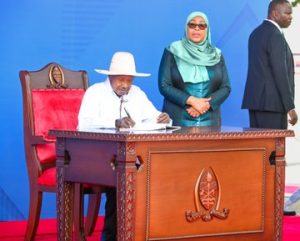
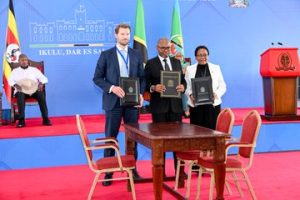
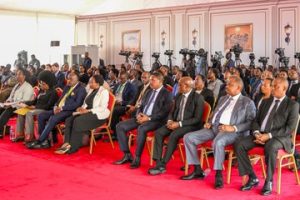
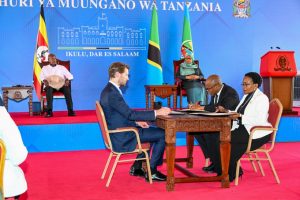
DAR ES SALAAM — President Yoweri Kaguta Museveni and Tanzanian President Dr Samia Suluhu Hassan have launched a new phase of Uganda–Tanzania energy cooperation after witnessing the signing of a landmark Memorandum of Understanding (MoU) to jointly develop the Tanga Regional Energy Hub.
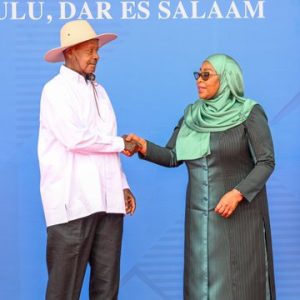
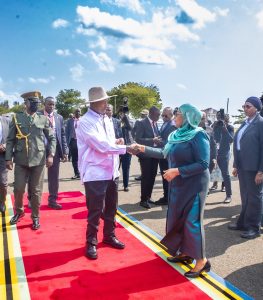
President Museveni, who is on a two-day working visit to Tanzania, was received by President Samia at State House in Dar es Salaam, where the two leaders held bilateral talks on strengthening cooperation before overseeing the signing ceremony.
The MoU brings together the Uganda National Oil Company (UNOC), the Tanzania Petroleum Development Corporation (TPDC), and Vitol Bahrain E.C. to develop the regional energy hub, which will build on the East African Crude Oil Pipeline (EACOP).
The project is expected to position Tanga as a regional centre for petroleum storage, refining, logistics, trading and distribution, while complementing Uganda’s planned Hoima refinery and expanding energy trade across East and Central Africa.
Uganda’s Minister of Energy and Mineral Development, Dr Monica Musenero, described the agreement as a major milestone in regional integration and a practical demonstration of the two countries’ commitment to shared economic development.
“For a long time, Your Excellencies have advocated for a united Africa driven by common interests and shared trade. Today, we are witnessing a giant step towards joint development with our sister nation,” she said.
Dr Musenero said the partnership extends beyond infrastructure, describing it as a strategic investment in industrialisation, job creation and regional trade.
“These are not merely infrastructure projects. They are strategic investments that will create jobs for our young people, deepen regional trade and strengthen the logistics systems that support our economies,” she said.
She stressed that Uganda intends to maximise value from its petroleum resources by investing in downstream industries instead of exporting raw commodities.
“We need to extract greater value by developing secondary and tertiary industries, building the knowledge economy and creating high-skilled jobs in engineering, operations, maintenance, laboratory analysis and management,” she said.
Dr Musenero said feasibility and front-end engineering design studies for the proposed refined petroleum products pipeline and storage terminal are expected to be completed later this year, while feasibility studies for a proposed Uganda–Tanzania natural gas pipeline are scheduled for completion by October 2026.
She also highlighted progress on the planned Uganda–Tanzania 400kV electricity interconnector, revealing that Uganda secured US$250 million in World Bank financing in June after concluding negotiations earlier this year.
According to the minister, the transmission line will increase electricity trade between the two countries, strengthen the Eastern Africa Power Pool and open opportunities for power exports to Southern Africa.
She reaffirmed that Uganda’s planned 60,000-barrel-per-day Hoima refinery remains central to the country’s industrialisation strategy and complements the Tanga Regional Energy Hub.
“The hub is complementary. Together, these projects will strengthen regional energy security while enabling East Africa to retain more value from its petroleum resources,” she said.
Dr Musenero added that the successful implementation of EACOP has demonstrated Uganda’s and Tanzania’s capacity to deliver complex cross-border infrastructure, boosting investor confidence for future regional projects.
Tanzania’s Minister of Energy, Hon. Deo Ndejembi, described the agreement as another milestone in the growing energy partnership between the two countries.
“The story we celebrate today did not begin in 2026. It began several years ago when Tanzania and Uganda made the courageous decision to deepen cooperation in the petroleum sector,” he said.
He said while EACOP laid the foundation for regional collaboration, the Tanga Regional Energy Hub represents the next stage by creating value through refining, storage, logistics and industrialisation.
“As EACOP approaches completion, Tanzania and Uganda are not asking what comes next. Instead, we are answering that question together,” he said.
In one of the ceremony’s notable remarks, Hon. Ndejembi said, “EACOP transports molecules. The Tanga Regional Energy Hub transforms those molecules into prosperity.”
He said the proposed hub could attract more than US$20 billion in investment, making it one of the largest integrated energy infrastructure developments in Sub-Saharan Africa.
Addressing concerns over Uganda’s planned Hoima refinery, Hon. Ndejembi said the two projects are complementary rather than competitive.
“Uganda’s decision to develop the Hoima refinery reflects its sovereign objective of maximising value from its petroleum resources through domestic refining and industrial development. Tanzania fully supports that ambition,” he said.
He added that a proposed bidirectional multi-product pipeline between Uganda and Tanzania will allow refined petroleum products to move in either direction based on market demand, strengthening regional energy security and expanding export opportunities.
President Samia later hosted President Museveni at a state luncheon in honour of his visit.