



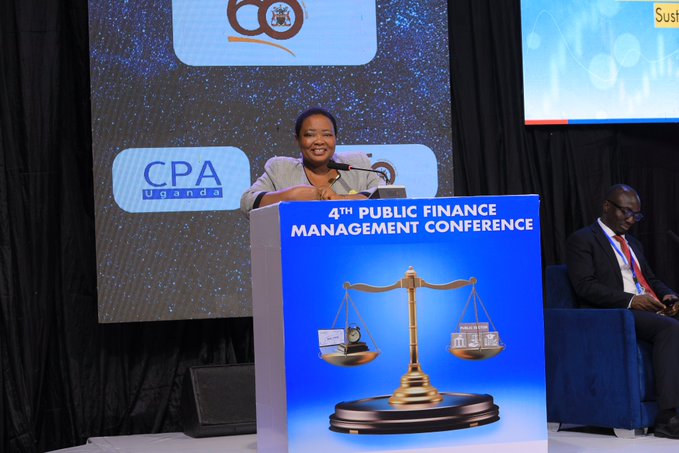
Entebbe – Uganda’s Prime Minister Robinah Nabbanja has called for stronger accountability, improved revenue mobilisation, and greater efficiency in public spending as the country intensifies preparations for its transition to the Fourth National Development Plan (NDP IV).
Speaking on May 6, 2026, while officiating the 4th Public Finance Management Conference at Imperial Resort Beach Hotel in Entebbe, Nabbanja praised the Institute of Certified Public Accountants of Uganda for convening what she described as a “vital platform” for strengthening Uganda’s public finance systems.
She underscored that effective Public Finance Management (PFM) remains central to Uganda’s economic transformation agenda. “Effective Public Finance Management remains central to Uganda’s economic transformation, particularly as the country transitions into NDP IV,” Nabbanja said.
She outlined three key priorities for the government going forward: expanding domestic revenue, ensuring equitable taxation, and guaranteeing value for every shilling spent. “Expanding domestic revenue to support national development, promoting equitable and sustainable taxation, and ensuring every shilling delivers real value to citizens are priorities we must all commit to,” she said.

Nabbanja also issued a strong call to finance professionals, describing them as critical actors in safeguarding public resources. “You are the custodians of accountability,” she emphasised.
Audit Systems Must Evolve
The Prime Minister further urged a shift in audit and oversight functions from compliance-based work to strategic value creation. “Audit functions must evolve from compliance-focused roles to strategic drivers of value,” Nabbanja said.
She called on accounting officers to embrace digital transformation and strengthen responses to emerging risks. “Embracing digital transformation, responding to emerging risks, and delivering value for money must become central to how we manage public resources,” she added.
ICPAU Reaffirms Policy Engagement Role
Opening the conference, CPA Charles Lutimba, speaking on behalf of ICPAU Chief Executive Officer CPA Derick Nkajja, reaffirmed the institute’s commitment to national policy engagement. “ICPAU remains committed to contributing to national economic policy and promoting excellence in financial management,” Lutimba said.

He noted that the institute continues to engage Parliament on fiscal reforms, including recent tax proposals. “As part of this mandate, we continue to engage with Parliament’s Sectoral Committee on Finance, sharing our position on key matters, including the recent Tax (Amendment) Bills.”
Experts Call for Stronger Systems and Digital Reform
Presentations at the conference highlighted the need for stronger implementation of public finance reforms.
Dr Winnie Nabiddo, Senior Manager for Research and Development Performance at the National Planning Authority, stressed that public finance management must go beyond budgeting. “Public Financial Management goes beyond budgeting—it’s about delivering real value to citizens,” she said.

She emphasised transparency, coordination, and monitoring as key pillars of effective governance. “Accountability and transparency are essential for building trust in public institutions,” she noted.
Dr Nabiddo also warned that policy design alone is not enough without execution. “Strong systems must be matched with effective implementation and enforcement,” she said.
She was later awarded a Certificate of Merit for her presentation on Uganda’s transition from NDP III to NDP IV.

Digital Economy and Financial Systems in Focus
Experts also highlighted the role of technology in modernising Uganda’s financial systems.
Dr Michael Kizito, a lecturer at Makerere University, emphasised the importance of mobile money interoperability in driving financial inclusion. “Mobile money interoperability is key to scaling merchant payments and reducing transaction costs across Uganda’s digital economy,” he said.
Transparency and Digital Transformation
CPA Frederick Kibbedi of Kibbedi Associates called for real-time audits and digital transformation in financial oversight. “Real-time audits, immutable digital records, and reduced cash opacity define a new standard for financial management,” he said.
He also outlined a roadmap for sustainability reporting adoption across sectors.

PFM as a Driver of National Growth
At the conference, CPA Godfrey Ssemugooma, Acting Accountant General at the Ministry of Finance, Planning and Economic Development, positioned PFM as central to Uganda’s long-term development ambitions.
“Public Finance Management is a central driver of Uganda’s Tenfold Growth agenda and sustainable development under NDP IV,” he said.
He stressed the importance of digital systems in improving accountability and efficiency.
Call for Innovation in Public Finance
Closing the discussions, CPA David Timothy Ediomu, President of ICPAU, urged urgent reforms to strengthen Uganda’s fiscal systems.
“With growing fiscal pressures and rising expectations for service delivery, we must adopt smarter revenue strategies, stronger institutions, and digital solutions to ensure every public resource delivers impact,” he said.
The conference brought together policymakers, auditors, academics, and finance professionals around a shared message: Uganda’s economic transformation will depend on stronger systems, greater transparency, and effective implementation of public finance reforms as the country advances toward NDP IV and its “Tenfold Growth” vision.