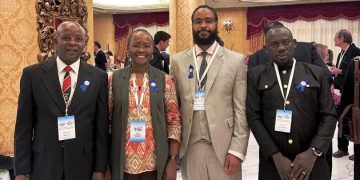



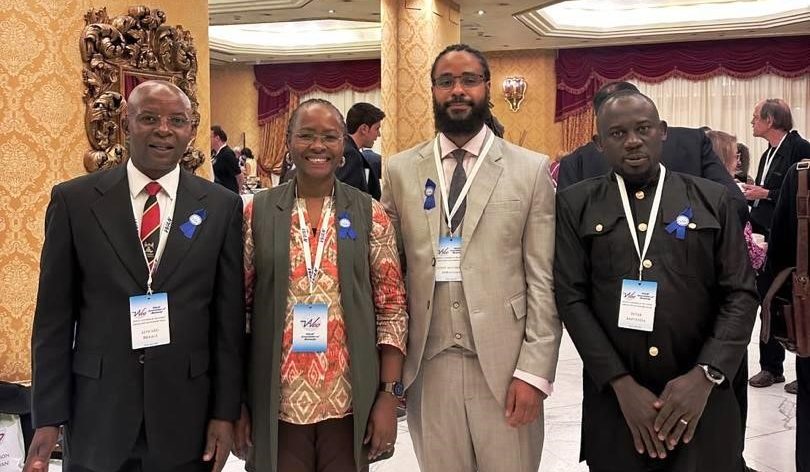
Makerere University has signed a Memorandum of Understanding (MoU) with the World Association of Noonomy (WAN) in Rome, Italy, deepening its collaboration on the study and application of the Theory of Noonomy in Africa.
The agreement was signed on behalf of Makerere by Deputy Vice Chancellor for Academic Affairs Prof. Sarah Ssali during the World Association of Noonomy’s Global Congress, which is taking place in Rome from September 16 to 19, 2026.
The partnership builds on Makerere’s inaugural African conference on Noonomy held on August 20, where scholars, policymakers and researchers examined the theory’s relevance to economic transformation, technological development and sustainability.
Makerere describes Noonomy as an approach to studying the material relations of production and consumption, with particular attention to knowledge, technology and human potential in shaping a more sustainable society.
Bbaale makes case for growth serving social welfare
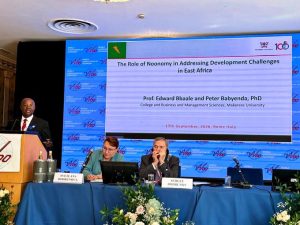
Makerere’s participation in the Rome congress has also included a presentation by Prof. Edward Bbaale, Principal of the College of Business and Management Sciences (CoBAMS).
Bbaale presented a paper titled “The Role of Noonomy in Addressing Development Challenges in East Africa,” which was co-authored by Dr Peter Babyenda.
Bbaale made a case for economic growth to serve social welfare needs, placing the question of development beyond the expansion of production alone.
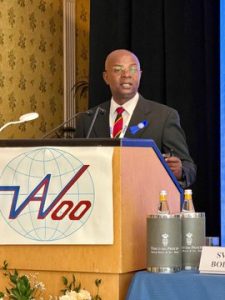
His presentation forms part of the university’s effort to examine how Noonomy can be applied to East African development challenges and national planning.
Bbaale is participating alongside Prof. Ssali, who presided over Makerere’s inaugural conference on the Theory of Noonomy in August.
Makerere seeks continental role
The Rome agreement follows Makerere’s announcement that it intends to establish a Noonomy Centre at CoBAMS.
At the August conference, Prof. Ssali said the proposed centre would serve as a platform for research, continental dialogue and innovation around Noonomy and its application to African socio-economic challenges.
Makerere said the August conference was organised by the School of Economics, CoBAMS, in collaboration with the S.Y. Witte Institute for New Industrial Development and St. Petersburg Polytechnic University, Russia, with support from the Makerere University Research and Innovations Fund (Mak-RIF).
The university has argued that Noonomy should not simply be imported into Africa as a finished framework.
Prof. Robert Wamala, Makerere’s Director of Research, Innovations and Partnerships, said during the August conference that African scholars should “interrogate, Africanise and generate evidence” on what a knowledge- and intelligence-driven economy means in the African context.
The proposed centre is therefore expected to examine how the theory applies to African economic and social conditions rather than treating the continent as a passive recipient of an externally developed school of thought.
Theory tested against Uganda’s development challenges
The August conference brought together representatives of Makerere University, the National Planning Authority and the Ministry of Finance, Planning and Economic Development.
Bbaale challenged participants to examine technological development against three considerations: productivity, human development and inclusion.
Discussions also addressed Uganda’s industrialisation ambitions, financing of science and technology, infrastructure, education, artificial intelligence and the need to build domestic capacity for knowledge-intensive production.
Makerere’s School of Economics has also committed to developing research on automation and labour markets in African economies, doctoral exchanges and empirical testing of Noonomy’s propositions using Ugandan and East African data.
From conference to institutional partnership
Prof. Ibrahim Mike Okumu, Dean of the School of Economics, said the August conference should mark the beginning of a sustained institutional relationship rather than a one-off academic event.
The School committed to developing a research agenda around issues including automation and labour markets, doctoral exchanges and empirical testing of Noonomy against Ugandan and East African data.
The MoU signed in Rome now gives that emerging relationship a broader international framework.