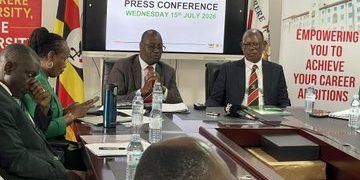



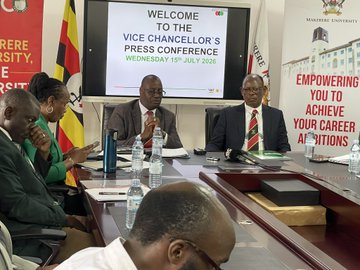
KAMPALA — Makerere University has promoted and recruited 153 academic staff members as part of efforts to strengthen its teaching workforce, improve research capacity and address staffing needs across the institution.
The development was announced by Vice Chancellor Prof. Barnabas Nawangwe during a media engagement on Wednesday, July 15, 2026, where he highlighted the university’s continued investment in human resources, infrastructure and research.
Prof. Nawangwe said people remain central to Makerere’s Strategic Plan, both as beneficiaries of the university’s services and as key implementers through its staff.
“The University continues to make significant strides in building a robust and motivated workforce through strategic recruitment, appointments and promotions,” he said.
According to the Vice Chancellor, the University Appointments Board approved several appointments in the past year, covering academic leadership positions, new academic hires and administrative support roles.
The appointments included senior academic leadership positions such as deans and heads of departments, alongside fresh academic appointments.
81 Staff Members Promoted
Prof. Nawangwe said Makerere approved a total of 81 promotions between July 2025 and July 2026, including academic and non-academic staff.
The academic promotions covered different levels, including promotions from assistant lecturer to lecturer, lecturer to senior lecturer, senior lecturer to associate professor and associate professor to professor.
The breakdown shows that 65 academic staff members were promoted, while 16 non-academic staff members also received promotions.
Among the academic promotions, 25 staff members were promoted to senior lecturer, 8 to professor, and others moved through various academic ranks based on merit and institutional requirements.
Prof. Nawangwe said the promotions demonstrate the university’s commitment to recognising excellence and retaining skilled personnel.
“We congratulate all newly appointed and promoted staff and reaffirm our dedication to creating an enabling environment that attracts, develops and retains top talent,” he said.
240 New Staff Recruited
In addition to promotions, Makerere recruited 240 new staff members during the same period.
The recruits included 88 academic staff and 152 non-academic staff.
The academic recruitment comprised 62 assistant lecturers and 26 lecturers, aimed at strengthening teaching and research capacity in priority areas.
Prof. Nawangwe said the university uses targeted recruitment to fill gaps created by retirements, resignations and specialised staffing requirements.
“As expected of any such institution, the University deals with staffing challenges arising from retirements, resignations and other specialised needs. We have always managed these through targeted recruitment, contract appointments, post-retirement contracts for professors and staff development programmes,” he said.
Strong Academic Workforce
The Vice Chancellor dismissed claims that Makerere lacks adequate teaching staff, saying the university remains among the best-staffed institutions on the African continent.
He said Makerere currently has about 1,400 teaching staff, of whom 1,140 hold PhDs, giving the institution one of the highest concentrations of doctorate-qualified academic staff in Africa.
“We have one of the best academic staff on the continent. We are among the best-staffed universities on the continent,” Prof. Nawangwe said.
He added that the staffing levels translate into a lecturer-to-student ratio that is better than the international benchmark, enabling students to access quality academic support.
Recruitment Process Based on Merit
Makerere University Human Resource Officer Deus Mujuni said the recruitment process is guided by transparency and managed through the institution’s Human Resource Management System.
He said the system ensures that recruitment follows clear procedures, from application and shortlisting to interviews and appointment.
“We have a very robust recruitment process. This recruitment process is managed through what we call the Human Resource Management System,” Mujuni said.
He explained that applicants only interact with the university during the application stage and after appointment, with selection handled by relevant committees.
“There are no people who have been recruited behind the door. Recruitment is always external, and we follow government standards,” he said.
Mujuni said recruitment is based on institutional needs, with priority given to areas such as science, technology, engineering and mathematics (STEM), including computing, engineering and other specialised disciplines.
Staffing Structure 62% Filled
Mujuni said Makerere has an approved staffing structure that guides recruitment and deployment of employees across departments.
He revealed that the current structure is 62% filled, rejecting suggestions that the university is facing a staffing crisis.
“The university has an approved structure, and as of yesterday, it was 62% filled. This means the university continues to intentionally ensure that we have enough staff in the right places and at the right time to achieve our mandate,” he said.
He said the university continues to recruit competent professionals while aligning appointments with government priorities and institutional objectives.
“We are not in a crisis as has been painted outside. The university is very intentional and continues to put in place staff who are competent and able to deliver,” Mujuni said.
Focus on Emerging Skills
Mujuni said future recruitment will continue to prioritise disciplines that support national development, particularly science, technology and innovation.
He said Makerere is strengthening capacity in areas such as artificial intelligence, computing and engineering while maintaining support for humanities disciplines.
“We always put staff in line with science and STEM, but we also take care of humanities because they remain important in the day-to-day operations of the country,” he said.
He added that continuous staff training will remain a key priority as the university adapts to emerging technologies and changing demands in higher education.
Prof. Nawangwe said Makerere remains committed to building a world-class institution driven by excellence in teaching, learning, research and national development.