


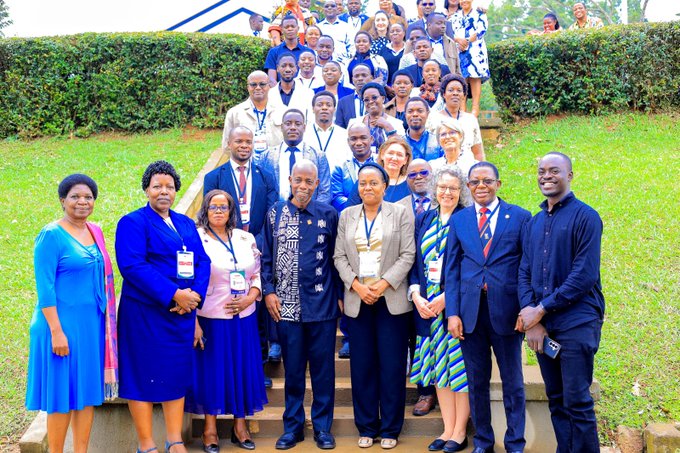
KAMPALA — Makerere University has called for greater investment in digital infrastructure, artificial intelligence literacy and gender equality in higher education as a six-year collaborative project involving universities in Uganda, Tanzania and Norway reported more than 30 research publications and improved graduate completion.
The call was made on Tuesday during the opening of the International Conference on Gender and Digitalisation in Higher Education at Makerere University. The November 17–18 conference, held under the theme “Reimagining Gender in the Digital Age: Opportunities and Transformations in Higher Education”, has attracted academics, researchers and policymakers from Uganda, Norway, Italy, Kenya, Nigeria, Ghana, South Sudan, Tanzania and Zambia.
Associate Professor Ruth Nsibirano, the conference convener and Principal Investigator of the Gender and Digitalisation (GENDIG) project at Makerere, said the initiative sought to ensure that women and other disadvantaged groups are not excluded from opportunities created by digital transformation.
“Our central message is that no one should be left behind,” Nsibirano said.
The project, which began in 2021, supported the digitisation of Makerere’s Master’s in Gender Studies curriculum and Diploma in Gender and Local Economic Development. It also trained academic staff to develop digital learning materials.
Nsibirano said the Makerere team had produced more than 30 publications from research conducted by students and staff. “The Makerere GENDIG team is proud to have more than 30 publications arising from research conducted by students and staff,” she said.
She also reported improvements in graduate supervision, with 43 students from the Institute of Gender and Development Studies completing their studies during the most recent graduation ceremony.
“That did not happen by accident. It was not an isolated occurrence. It was the result of deliberate and sustained efforts to support graduate students,” she said.
The project introduced structured, weekly supervision sessions and supported academic exchanges and partnerships with civil society organisations.
Makerere University Academic Registrar Professor Buyinza Mukadasi said digital technologies were changing how universities generate, access, share and apply knowledge, requiring institutions to rethink their systems and investments.

“The concept of reimagining challenges us to rethink our existing institutional structures, policies, systems, resources and available assets,” Mukadasi said.
He proposed a compulsory artificial intelligence utilisation course for all first-year students, regardless of their academic disciplines. “AI literacy should become a foundational skill across all disciplines,” he said, urging universities to invest in digital infrastructure and ensure that technological progress advances gender equity.
Dr Angela Nakafeero, Commissioner for Gender and Women’s Affairs at the Ministry of Gender, Labour and Social Development, questioned whether Uganda was participating in developing the technologies shaping the future or simply consuming innovations produced elsewhere.
“Who is building this digital world? Are we, as Ugandans, participating in its construction? Are we contributing to the technologies that are shaping the future?” she asked.
Nakafeero, the Guest of Honour, called for more girls and women to pursue science, technology, engineering and mathematics (STEM), while recognising the contribution of arts-related disciplines. She also urged researchers to examine how technology could reduce women’s unpaid care work and address online gender-based violence.
In his keynote address, Dr Eng. F. Francis Tusubira, Managing Partner of Knowledge Consult Ltd, said progress towards gender equality remained slow and fragile, with global estimates suggesting that achieving parity could take more than a century at the current rate.

Invoking management thinker Peter Drucker, he said: “Culture eats strategy for breakfast.”
Tusubira used Makerere’s Directorate of ICT Support as an example, saying that of 18 staff photographs displayed on its website, only two represented women. He said one was a caretaker and the other a front-desk administrator or receptionist.
He argued that meaningful change required organised women’s activism, political leadership and enforceable legal and institutional structures.
On artificial intelligence, Tusubira warned that systems trained on historical records that marginalise women could reproduce existing biases. “Otherwise, we risk automating historical prejudice,” he said, calling for women’s contributions to be better represented in the information used to develop AI systems.
During a panel discussion, Dr Lulu Simon Mahai, Director of Social Services and former Director of the Institute of Gender Studies at the University of Dar es Salaam, said the project had supported an undergraduate course in Gender and Community Development, five scholarship beneficiaries and academic writing support for six women.
The university also trained 120 students with disabilities in ICT, using assistive technologies including BrailleSense, NoteTouch+, computers and magnifiers.
“Sometimes, when we support students with disabilities, we take these achievements for granted. However, we are planting a seed for future generations,” Mahai said.
Associate Professor Anne-Hild Leer-Helgesen, Head of the Department of Global Development and Planning at the University of Agder and a GENDIG Principal Investigator, said digitalisation had helped universities continue teaching during the COVID-19 pandemic.
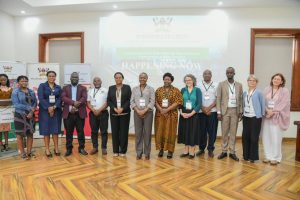
“Digitalisation of higher education and teaching was what saved us as teachers and students. We would not have been able to continue higher education if we had not managed to move online,” she said.
However, she cautioned that digital learning could weaken physical interaction. “The combination of digitalisation and individualism is not necessarily good for teaching and learning,” she said.
Nsibirano said some Makerere students still lacked smartphones and reliable internet access, raising questions about the effectiveness of online teaching.
“In the next project, we want to investigate whether online teaching is effective in the African context. Are we delivering? Are students actually learning?” she said.
The partners also cited funding constraints, inflation, exchange-rate fluctuations and differences in financial accountability procedures as challenges. Mahai said limited resources had prevented regular follow-up visits to rural women who received digital skills training.
The partners called for continued investment in graduate scholarships, doctoral training and disability inclusion. Leer-Helgesen said the next NORAD programme was expected to be managed by a university in the Global South, giving African institutions greater responsibility for setting priorities.
Panel moderator Dr Ritah Nakanjako urged partners to extend the collaboration. “I want you to become creative and find ways of ensuring that we have GENDIG 3, GENDIG 4 and GENDIG 5,” she said.
Speaking on the second day of the conference, Acting Vice Chancellor and Deputy Vice Chancellor (Academic Affairs), Prof. Sarah Ssali, called for gender equality to be placed at the centre of digital transformation in higher education.
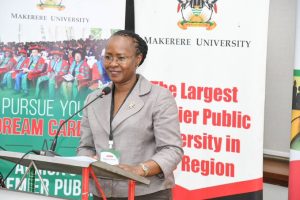
“Universities must ensure that technology promotes inclusive, equitable and gender responsive learning environments,” she noted.
She cautioned that digital technologies are not neutral and that inequalities in access to devices, internet connectivity, affordable data and digital skills can deepen existing inequalities and create new forms of exclusion.
“We must create institutions in which digital technologies expand opportunities rather than reinforce exclusion,” she added, reaffirming Makerere’s commitment to research, evidence-based policy and digital teaching and learning that gives all students meaningful opportunities to participate and succeed.
The project is supported by the Norwegian Agency for Development Cooperation (NORAD) under the Norwegian Programme for Capacity Development in Higher Education and Research for Development (NORHED).