


MASINDI — A once-degraded forest in Rwentumba Village, Kimanya Parish, Masindi District, is gradually returning to life as residents combine forest conservation with modern beekeeping to generate income.
The transformation is being led by the Rwentumba Communal Land Association (CLA), with support from the Environmental Conservation Trust of Uganda (ECOTRUST) through the Mobilizing More 4 Climate (MoMo4C) initiative.
The community currently manages about 280 acres of forest, named after River Rwentumba, a small tributary that eventually flows into Lake Albert.
The association was formed after communities living around the forest were mobilised and sensitised about the importance of protecting natural forests. Residents were encouraged to restore degraded sections rather than continue clearing them for activities such as sugarcane farming.
For the community, however, conservation also had to make economic sense.
Christopher Byamukama, Project Coordinator of the Rwentumba Communal Land Association, said members realised that tree planting alone would not provide immediate income because mature trees can take years to generate economic returns.
“When we looked at tree planting, we realised the benefits would take many years because trees need 10 to 15 years to mature. We needed something that could give us income earlier while encouraging us to conserve the forest,” Byamukama said.
From 10 hives to 110
With support from ECOTRUST, the association explored several livelihood options, including fish farming and tree nurseries, before settling on beekeeping.
Byamukama said beekeeping required relatively little investment and was well suited to the forest environment, where flowering trees and plants provide forage for bees.
“We selected beekeeping because it required less investment, we already had some basic knowledge, and the forest provides plenty of flowers and plants that bees need for food,” he said.
The project began in 2020, when the community received 10 Kenya Top Bar (KTB) beehives alongside training in modern beekeeping.
The early stages were not without challenges. Termites damaged some of the wooden hive stands, forcing farmers to improve their management practices following additional training.
In 2023, the association received another 100 Langstroth hives, bringing its total to 110.
Byamukama says the modern hives have significantly improved production.
“The Langstroth hives are easier to inspect, easier to harvest, and they produce honey much faster. On average, one hive can produce about 10 kilograms of honey every harvest, and we harvest after every three months,” he said.
Learning to harvest without destroying colonies
Training has also changed how the farmers handle honey.
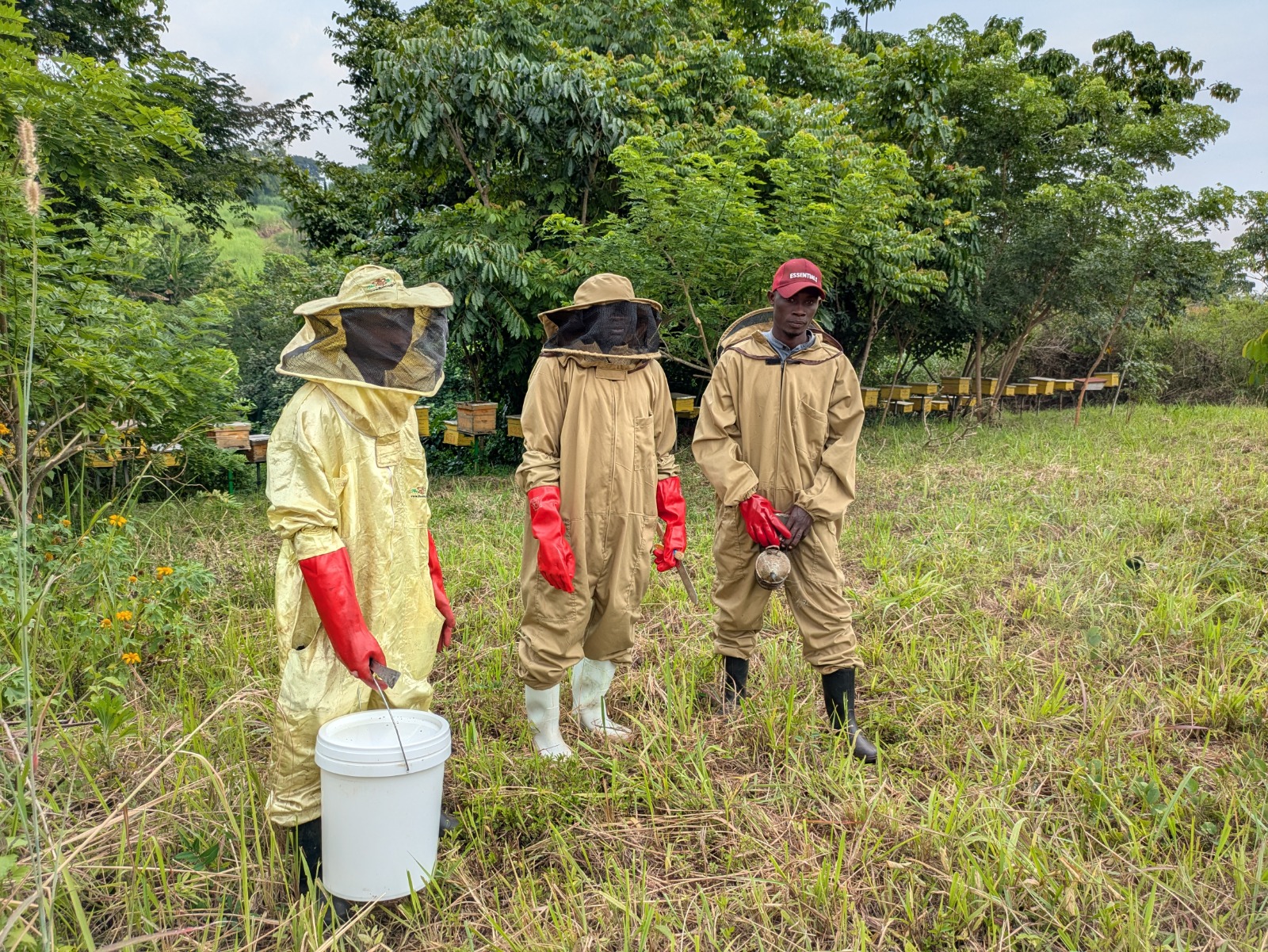
Rather than relying on traditional harvesting methods that can damage or destroy bee colonies, members now use protective clothing, smokers and honey extractors.
ECOTRUST trained the farmers in hive management, honey harvesting, processing and storage, with an emphasis on maintaining quality.
“Everything we are doing today is knowledge we received through the training. We learnt how to manage the bees, harvest clean honey and store it properly to maintain quality,” Byamukama said.
After harvesting, the honey is filtered, packed in clean containers and stored on raised wooden platforms to minimise the risk of moisture contamination.
The farmers have also secured a market through a partnership between ECOTRUST and The Hive Limited, which purchases honey produced by the community.
Umar Buyinza of The Hive Limited said the arrangement has helped farmers overcome one of the common challenges facing small-scale producers — finding reliable buyers.
“The partnership started with providing hives, equipment and training. Today, the farmers also have a ready market because they supply their honey to The Hive Limited,” Buyinza said.
Conservation becomes a community business
The project’s impact extends beyond household income.
Community members say the restoration of the forest has coincided with improvements in the local environment, including increased water levels in nearby rivers and the return of some wildlife.
For Byamukama, one of the most important achievements has been persuading landowners to participate in conservation.
“People understood that conserving the forest would benefit everyone. It was a win-win situation because we restored the forest while still allowing families to use part of their land,” he said.
The Rwentumba experience illustrates a broader challenge facing conservation efforts in Uganda: protecting forests is difficult when communities depend on the same land for their livelihoods.
By linking conservation to an income-generating activity, the association has given residents a financial reason to keep the forest standing.
The bees need the forest, and the community needs the income from the bees.
For Rwentumba, that connection is gradually turning a degraded landscape into both a conservation area and a source of livelihood.