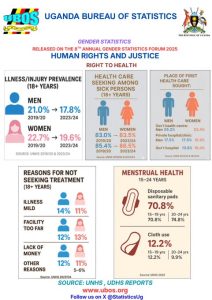
New data released during the 8th Annual Gender Statistics Forum shows that 22.7% of women in Uganda suffered sickness or injury in 2023/24, compared to 19.6% of men, while only 5.2% of females pursue education beyond secondary level.
The findings—presented on Day Six of African Statistics Week 2025—underscore the urgent need for stronger gender-responsive data to drive equitable policies across the continent.
Hosted at Statistics House in Kampala, the forum brought together national and regional stakeholders to advance discussions on innovations that strengthen gender data systems and inform evidence-based decision-making.
Gender equality is key to reducing poverty
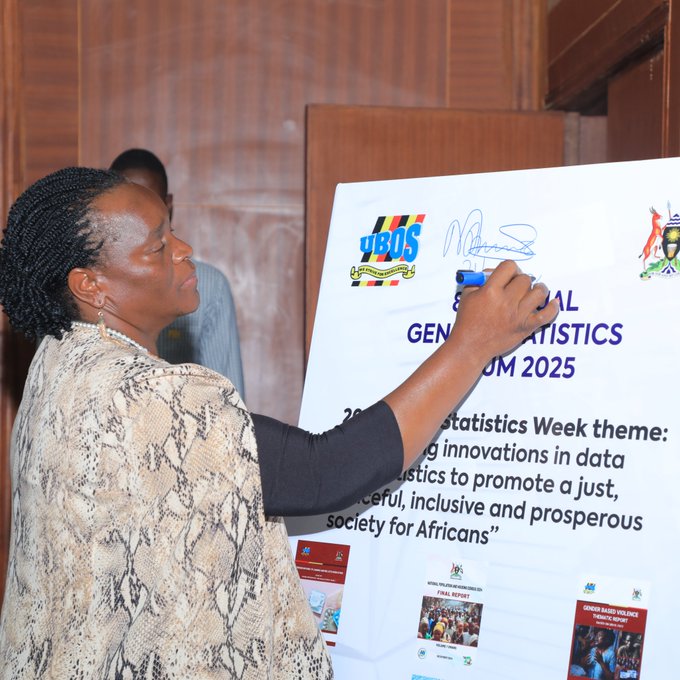
Launching the new Gender Statistics Report, the State Minister for Gender and Culture Affairs, Hon. Peace Mutuuzo, called for intensified efforts toward gender equality as a pathway to inclusive development and national transformation.
“This will help achieve Agenda 2040 and the SDGs,” she said. “Leadership has often been male-dominated because women were denied resources. Inclusive development must start with taming the cultural and societal setting by creating equal opportunities for all in employment, service, education, and health.”
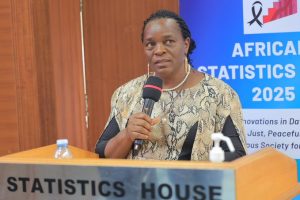
She emphasised Uganda’s demographic advantage, noting that the country has the second youngest population in the world. “We need to train them and find sustainable employment for them, thereby ensuring human capital development,” she said. “This will help us remain firm and ensure peace and stability.”
UBOS commits to stronger gender data systems
The Executive Director of the Uganda Bureau of Statistics (UBOS), Dr Chris N. Mukiza, reaffirmed the agency’s commitment to delivering high-quality data to support national planning.
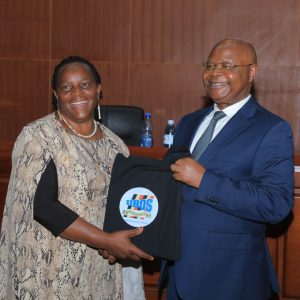
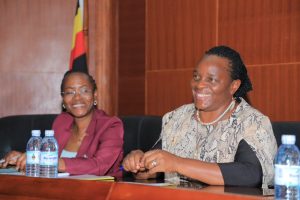
State Minister for Gender and Culture Affairs, Hon. Peace Mutuuzo, with UBOS ED Dr Chris Mukiza
“UBOS remains committed to providing timely and accurate data to enhance evidence-based planning,” Dr Mukiza said.
He also thanked Hon. Mutuuzo for her dedication to advancing gender concerns. UBOS later presented her with a hamper in appreciation of her efforts.
Key findings from the 2023/24 Gender Statistics Report
Presenting the report, Mr Oweka Benson, UBOS Statistician, highlighted persistent inequalities across health, education, and gender-based violence.

Health: 22.7% of females experienced sickness or injury compared to 19.6% of males. 83% of those affected sought healthcare—mainly from private clinics, followed by government facilities.
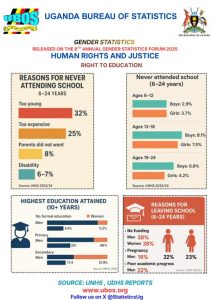
Education: 22.7% of females have no formal education. Only 5.2% pursue education beyond secondary school. Despite accessibility, 21% of females and 25% of males have never attended school, largely citing cost, disability, orphanhood, or lack of interest. 10% of girls left school due to pregnancy.
Menstrual health: Use of sanitary pads has risen among girls aged 15–19 (70.8%) and 20–24 (74.8%). However, 13% still use cloth, and up to 3.8% have nothing to use during menstruation.
Violence: Women with little or no education experienced higher levels of physical violence. Men aged 15–19 reported more violence than females in the same age group. Violence peaks among women and men aged 25–29.
As Uganda continues to refine its gender data systems, leaders and technical experts urged stronger partnerships, better funding for gender statistics, and continued investment in human capital—especially for women and youth.