


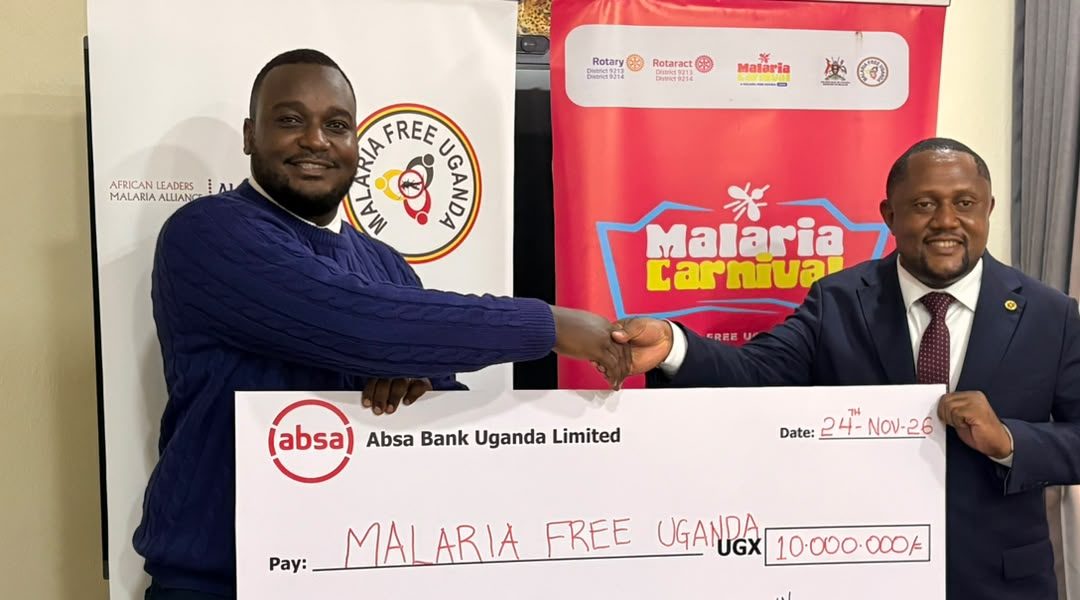
Children’s Voices Against Malaria (CVAMU) has committed Shs10 million towards the fifth Malaria Carnival, with its executive director, Mr Henry Lutwama, urging parents, schools and communities to step up efforts to protect children from the disease.
The contribution, handed over at Emin Pasha Hotel in Kampala on Wednesday, November 25, is expected to support this year’s campaign to bridge the funding gap for the routine distribution of long-lasting insecticidal mosquito nets.
The carnival, organised by Malaria Free Uganda, will take place on December 6 at Las Vegas Hotel in Bunga, with organisers appealing for wider public participation in the fight against malaria.
Receiving the contribution, Malaria Free Uganda country coordinator Mr Aubrey Agaba said this year’s fundraising drive was particularly focused on ensuring more families could access mosquito nets, a critical intervention in preventing malaria infections.
But for Mr Lutwama, the campaign must go beyond the distribution of mosquito nets. It must also confront the far-reaching consequences of malaria on children’s education, household incomes and the well-being of families.
He said repeated malaria infections often impose costs that extend well beyond hospital bills, particularly for households already struggling to meet the demands of keeping their children in school.
“When a child falls sick with malaria, the cost goes beyond the hospital bill. There are lessons missed, nights a parent spends awake and income lost while caring for that child. For some families, this happens several times a year,” he said.
Mr Lutwama, who also serves as a Special Presidential Assistant, called on parents and school administrators to make malaria prevention an integral part of safeguarding children’s education.
He urged parents to ensure children consistently sleep under insecticide-treated mosquito nets and that those who develop symptoms receive prompt medical attention.
“Parents make enormous sacrifices to keep their children in school. Protecting those children from malaria must receive the same attention we give to school fees, books and examination results,” he said.
He also challenged schools to strengthen their health arrangements by establishing clear channels through which learners can access qualified health workers, malaria testing and treatment, as well as referral services for cases requiring urgent medical attention.
The call is particularly significant given the continuing malaria burden among young children.
Findings from the Uganda Malaria Indicator Survey 2024–25 show that malaria prevalence, measured through microscopy among children aged six to 59 months, increased from 10 per cent in 2018–19 to 13 per cent.
The figures reinforce concerns about the vulnerability of young children and the need to sustain prevention and early diagnosis efforts.
The World Health Organisation recommends that suspected malaria cases undergo prompt diagnostic testing before treatment, underscoring the importance of ensuring that sick learners are not left without timely access to appropriate healthcare.
Mr Lutwama further emphasised the importance of involving children in malaria prevention and advocacy, arguing that young people can help spread awareness among their peers but must be supported by adults.
“Children can remind their friends to use mosquito nets and speak about malaria in their schools. Adults must make sure those nets are available and that a sick child gets care without delay,” he said.
He called on businesses, religious and cultural leaders, schools and families to support the campaign, saying the fight against malaria requires collective responsibility.
“I invite everyone to join us at Las Vegas Hotel in Bunga on December 6. Come with your family, bring a friend and support the cause. Whether you contribute money, time or help another family protect its children, you have a part to play,” Mr Lutwama said.
The fifth Malaria Carnival is expected to provide an opportunity for stakeholders and members of the public to rally support for malaria prevention, with particular emphasis on ensuring that families have access to the tools needed to protect children.