




KAMPALA — Accounting professionals have been urged to address mental health stigma and prepare for emerging sustainability reporting requirements as the Association of Chartered Certified Accountants (ACCA) Uganda concluded its 2026 Members Convention at Speke Resort Munyonyo.
The two-day convention, held under the theme “Navigating Change: Flexible and Inclusive Career Pathways,” brought together finance professionals, business leaders and industry experts to discuss changing demands in the accounting profession, green finance, carbon markets and sustainable development.
Dr Noeline Nakasujja, a psychiatry professor at Makerere University’s College of Health Sciences and an associate of Rodium Mental Health, challenged accountants to recognise that professional achievement and financial expertise do not make them immune to mental health challenges.

She said the pressure to maintain an image of competence often prevents professionals from acknowledging psychological difficulties.
“People don’t want to show they are having challenges, and I just want to point out in this room that for the great brains that you all have in dealing with numbers, you can also end up in a mental health problem because you have a brain, and that’s where things go wrong. So let’s stigmatise mental illness because any of us can be a candidate,” Dr Nakasujja said.
On sustainability reporting, Joseph Owolabi, CEO of Rubicola Consulting and immediate past ACCA president, urged organisations to begin collecting environmental data early, even before mandatory reporting requirements take effect.
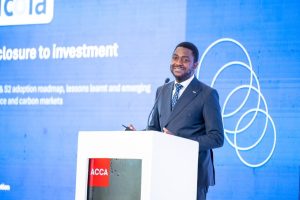
He said businesses needed reliable sustainability information to respond to regulators, investors and customers.
“Even if you don’t want to be an early adopter, start early. Start doing parallel reporting. Build your sustainability data that would be able to serve your use, whether it’s with regulators, with investors, and customers,” Owolabi said.
He also highlighted the importance of green taxonomies, which help identify projects that meet recognised environmental criteria and qualify for green financing.
Lydia Nankabirwa, Manager of Standards and Technical Services at the Institute of Certified Public Accountants of Uganda (ICPAU), outlined plans for implementing international sustainability reporting standards through a phased roadmap overseen by a committee.

“What the committee is handling is sustainability reporting, and what we want the committee to do is serve as a resource hub, a committee that will be in charge of all of the resources related to sustainability reporting, developing resources, guidance that then will support our members in the implementation of these standards,” she said.
Discussions also examined how financial institutions could integrate sustainability into lending, investment and risk management.
Jackie Lutaaya, Manager of Commercial Banks Supervision at the Bank of Uganda, said regulators were interested in how financial institutions incorporated sustainability considerations into their operations.

“From a supervisory perspective, it is to find out what the institutions are doing, how they understand it, how they embed it in their strategy and their enterprise management,” she said.
Dennis Ochieng, Director of Finance and Business Operations at Uganda Development Bank, said the institution’s sustainability framework focused on creating lasting economic, social and environmental value through development finance.
“We view sustainability as the creation of long-term economic, social, and environmental value through development finance. And our approach recognises that sustainable economic development can only be achieved if economic growth, social inclusion, and environmental stewardship are pursued collectively,” Ochieng said.

The convention also explored carbon markets and the potential integration of carbon credits into formal capital markets.
Mark Mutaahi, Venture Lead at Carbon Access Lab, explained that carbon credits represent measurable reductions or removals of greenhouse gas emissions.
“A carbon credit is a financial claim to either reduction or removal of one tonne of carbon dioxide equivalent from the atmosphere,” he said.
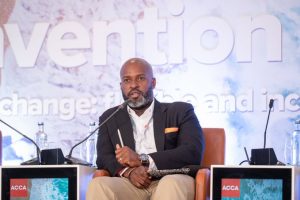
The discussion was moderated by Pheonagh F., co-founder of the Africa Centre for Applied Digital Health, with contributions from Dennis Kizito, Director of Market Supervision at the Capital Markets Authority; Allan Lwetabe, Director of Investments at Development Finance Partners; and Mutaahi.
Meanwhile, Dr Edward Isingoma, Managing Director of Pearl Capital Partners, discussed the differences between venture capital and private equity, drawing on investment experiences in East Africa’s agricultural sector.

“Private equity is more than capital — it’s a commitment to build alongside a business, through the challenges and into its next stage of growth,” he said.
The convention concluded with remarks from Bishop Lwere, overseer of the National Fellowship of Born-again Pentecostal Churches of Uganda, who challenged accounting professionals to reflect on moral integrity and spiritual accountability in their work.
The event was supported by the Bank of Uganda and the National Social Security Fund (NSSF).