



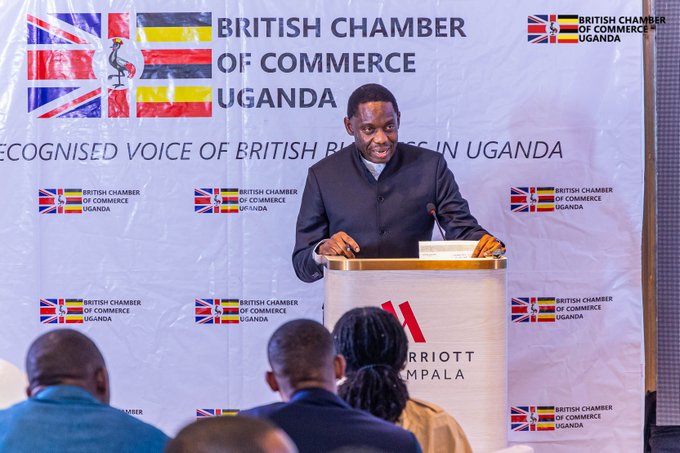
KAMPALA — Bank of Uganda Governor Dr Michael Atingi-Ego has urged Ugandan businesses and financial institutions to begin sustainability reporting immediately, warning that climate-related risks are increasingly threatening economic growth, loan repayment and the stability of the financial sector.
Atingi-Ego said sustainability was no longer simply an environmental or corporate social responsibility concern but had become a business and competitiveness issue, particularly as international markets introduce stricter environmental requirements.
“Start sustainability reporting now, rather than waiting for 2028. The first report need not be perfect. But it must be honest,” he said.
The Governor was speaking on Wednesday, November 18, at the British Chamber of Commerce Uganda (BCCU) ESG Gala Dinner and Forum held at Kampala Marriott Hotel in Nsambya, under the theme, “ESG in Action: Turning Sustainability into Competitive Advantage.”
He pointed to the European Union Deforestation Regulation, which takes effect for large and medium-sized operators and downstream traders dealing in covered commodities from December 30, 2026, as a direct test for Uganda’s export competitiveness.
Under the regulation, businesses placing coffee and other covered commodities on the EU market must demonstrate that their products are traceable, legally produced and not linked to deforestation. Most micro and small enterprises are expected to comply from mid-2027.
“Most of the coffee Uganda grows is drunk abroad, and much of it in Europe. From the 30th of December this year, forty-two days from now, every bean entering that market must be proven deforestation-free and traceable to the very plot on which it was grown,” Atingi-Ego said.
“That is not a distant Brussels technicality. It is a test of whether Uganda’s most storied export keeps its place on the world’s tables.”
He said the new requirements should be treated as an opportunity for Ugandan businesses to improve their production systems, demonstrate compliance and secure access to international markets.
“The rules arriving in Brussels are being written, in effect, for a country like ours to win. Uganda is not a latecomer to sustainability. We were sustainable before it had a name. Our task is to prove it with data — and to be paid for it,” he said.
Atingi-Ego identified climate exposure, population growth and the country’s natural resources as three reasons why environmental, social and governance (ESG) considerations should matter to Uganda.
He said about two-thirds of Ugandans depend directly or indirectly on agriculture, which remains largely rain-fed, while formal irrigation covers only about one per cent of cultivated land.
He warned that droughts and floods affect more than agricultural production, disrupting food supplies, pushing up prices, reducing rural incomes and weakening borrowers’ ability to repay loans.
“Climate-related risks matter for one reason above all: they can threaten macroeconomic and financial stability,” he said.

“Droughts and floods do not stay in the fields. They disrupt harvests, push up food prices, weaken borrowers’ repayment capacity, erode collateral values and, ultimately, the asset quality of our financial institutions.”
He cited estimates showing that natural disasters caused Uganda losses of about USD152 million in the 2019/2020 financial year and another USD65 million in 2021 and 2022.
The Governor also referred to Uganda’s estimated USD28.1 billion climate financing requirement through 2030 under its updated Nationally Determined Contribution. Of this amount, the country expects to mobilise about USD4.1 billion domestically, leaving approximately 85 per cent to be sourced from international public and private financing.
“That is not simply a financing gap. It is the largest investment opportunity in our economy,” he said.
He argued that investors would increasingly favour companies able to demonstrate, through credible data, how they identify and manage climate-related risks.
Atingi-Ego also called on companies to prepare for the adoption of the International Financial Reporting Standards (IFRS) sustainability disclosure standards, which Uganda’s Institute of Certified Public Accountants of Uganda (ICPAU) has adopted.
Voluntary adoption of IFRS S1 and S2 began on January 1, 2026, while mandatory adoption will apply from January 1, 2028, for listed companies, banks, other financial institutions, insurers and government business entities applying IFRS.
SACCOs, retirement benefit schemes and other large entities are expected to follow from January 2029.
He explained that IFRS S1 requires companies to disclose material sustainability-related risks and opportunities affecting their cash flows and business prospects, while IFRS S2 focuses specifically on climate-related risks, opportunities and greenhouse gas emissions across the value chain.
“The message could not be clearer: start now, and improve over time,” he said.
Atingi-Ego said the Bank of Uganda was preparing supervisory guidance to help financial institutions identify, measure, manage and disclose climate-related financial risks.
He added that the central bank had signed a cooperation agreement with the European Investment Bank to support technical assistance on climate-risk supervision, disclosure and reporting, as well as development of a roadmap for greening the financial sector.
The Governor said the Bank of Uganda’s approach was to strengthen financial-sector resilience without unnecessarily restricting access to credit.
“Let me be precise about our role. It is not to prescribe business decisions or direct credit. It is to ensure that material risks are understood, managed and disclosed — and that the financial system remains resilient,” he said.
He also urged banks to incorporate climate risks into lending decisions without using them as a reason to withdraw financing from vulnerable sectors.

“Build climate risk into credit decisions, and use that understanding to finance the transition — not to withdraw from it. De-risking by exclusion is not risk management; it is risk transfer, to those least able to bear it,” he said.
He called for more financing for resilient enterprises in agriculture, agro-processing, manufacturing, tourism, energy, minerals and infrastructure, while addressing barriers that prevent micro, small and medium-sized enterprises from accessing affordable credit.
Atingi-Ego further challenged the British Chamber of Commerce Uganda to use its networks to connect British companies seeking to reduce emissions in their supply chains with Ugandan businesses and financial institutions working towards sustainable certification.
He proposed that the Chamber work with the Bank of Uganda, ICPAU and the Capital Markets Authority to convene a sustainable finance deal-room in 2027, where Ugandan projects aligned with the National Green Taxonomy could meet British and international investors.
“Markets are not deepened by declarations. They are deepened by deals — and this Chamber can make the introductions,” he said.
He said the Bank of Uganda would continue supporting price stability, a sound financial system and an enabling environment for sustainable finance, adding that the success of ESG initiatives should ultimately be measured by improvements in productivity, economic resilience and people’s livelihoods.
“May they carry more than beans. May they carry proof that Uganda can turn sustainability into competitive advantage,” he said, referring to the first consignments of Ugandan coffee expected to enter the EU market under the new deforestation rules.