



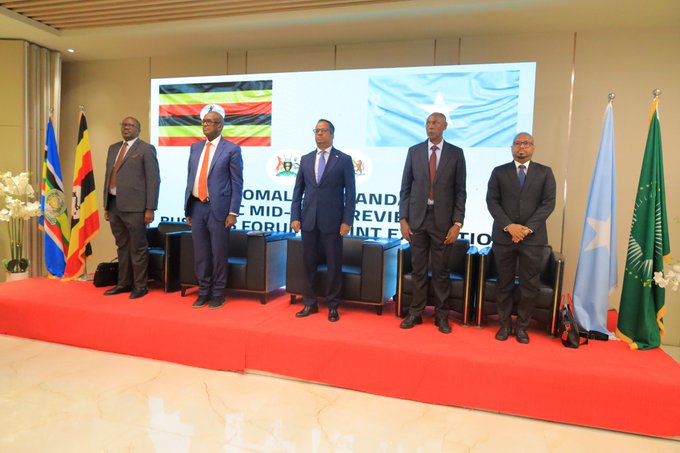
MOGADISHU – Uganda has urged Somalia to conclude talks on an air services agreement and act on draft deals covering customs, standards, statistics and health, as the two countries began reviewing commitments made at their last joint commission meeting.
Vincent Bagiire Waiswa, the Permanent Secretary in Uganda’s Ministry of Foreign Affairs, said on Wednesday that both sides should finish negotiations on the Bilateral Air Service Agreement “as soon as possible” so it can be signed.
Bagiire was speaking at the opening of a mid-term review of the Uganda–Somalia Joint Permanent Commission (JPC) at the Airport Hotel in Mogadishu. The review is running alongside an investment and business forum and a joint exhibition.
He said Uganda had submitted draft memoranda of understanding (MoUs) on customs, standards and quality assurance, statistics and health. He added that Uganda Airlines’ operational challenges in Somalia were among the new areas of cooperation agreed at the second JPC session in Kampala in October 2025.

Uganda Airlines is the only carrier flying non-stop between Entebbe and Mogadishu, with four flights a week, according to flight schedule data. The two countries also agreed in Kampala to set up a Joint Permanent Investment and Business Council to address non-tariff barriers, but it has not yet been made operational.
“The signing of the Memoranda of Understanding and Agreements should translate into tangible results-oriented collaboration that drives economic growth and shared prosperity,” Bagiire said.
Hamza Adan Haadoow, the Permanent Secretary in Somalia’s Ministry of Foreign Affairs and International Cooperation, who co-chairs the review, set out three priorities: implementing existing commitments, assigning clear responsibilities and timelines, and putting in place strong follow-up mechanisms.
“Let us ensure that our cooperation goes beyond agreements on paper and delivers tangible benefits to the people of Somalia and Uganda,” he said.
Haadoow said Somalia saw “considerable potential” to expand cooperation with Uganda in trade, investment, tourism, agriculture, education, health, labour and aviation. He urged businesses at the forum to “establish partnerships, explore new markets, and identify commercially viable opportunities that benefit both countries”.
The review comes as trade between the two countries grows from a low base. Exports from Uganda to Somalia rose from sh11.4b ($2.75m) in 2023 to sh28b ($6.78m) in 2024, according to United Nations Comtrade data. Tobacco products led at sh10.6b ($2.55m), followed by aircraft and parts at sh5b ($1.2m) and wood products at sh2.2b ($528,470).
Trade in the other direction is far smaller. Somalia’s exports to Uganda were sh146m ($35,400) in 2021, down from sh2.8b ($671,000) in 2016, according to UN Comtrade figures.
“Our imports and exports between Uganda and Somalia have grown exponentially. However, we believe that our private sector can do better than the current statistics,” Bagiire said.
He said both governments had provided platforms through business forums and exhibitions, and it was now up to the private sector to take up the opportunities. Somali importers are looking for fresh fruit, grains, maize, wheat and cassava flour, long-life milk, pharmaceuticals and medical devices, and processed coffee and tea, according to UG Standard’s preview of the forum.
“Uganda is landlocked, while Somalia has the longest coastline in Africa spanning a length of 3,333km along the Indian Ocean,” Bagiire said. He said Somalia could act as a trade bridge between Africa and the Gulf states, and described Mogadishu as a prospective “New Dubai” in the East African Community (EAC). Shorter sea routes “will substantially reduce the cost of shipping and increase market access, if fully actualised”, he said.
Gen Henry Tumukunde, the Minister of Gender, Labour and Social Development, said Africa had “inherited fragmented markets that make us consumers of foreign goods and exporters of our raw wealth”.

“We watch our neighbours buy from distant continents what is grown or manufactured just a few miles away across a border line. This is a luxury we can no longer afford,” he said.
Gen Tumukunde is scheduled to sign a Bilateral Labour Agreement with his Somali counterpart on Wednesday afternoon. The business forum runs on Thursday under the theme “Harnessing Trade, Tourism and Investment Opportunities in both Countries and Beyond”. It is scheduled to end with the signing of a Mogadishu Declaration on trade and investment.
The Gulf is already Uganda’s biggest export market. The finance ministry’s Performance of the Economy report for May 2026 shows the Middle East took 54.2% of Uganda’s merchandise exports in April 2026, almost all of it going to the United Arab Emirates. The EAC was second with 20.8%.

Uganda’s exports reached a record sh46 trillion ($12.7b) in the 12 months to November 2025, up 33% from sh30 trillion ($8.5b) a year earlier, according to the Bank of Uganda.
Somalia became the EAC’s eighth member on March 4, 2024. Intra-EAC exports rose 33.2% to sh13.2 trillion ($3.2b) in the April–June 2026 quarter, according to the EAC Quarterly Statistics Bulletin.
The forum comes as the foreign affairs ministry implements its Economic and Commercial Diplomacy Strategy for 2025/26 to 2029/30, which makes embassies responsible for delivering exports, investment and tourism. The strategy is aligned with the Government’s tenfold growth strategy, which aims to grow the economy to about sh2,069 trillion ($500b) by 2040.