


Uganda’s economy grew by 6.4% in the 2025/26 financial year, up from 6.3% in the previous year, as the government released Shs21.82 trillion for the second quarter of the 2026/27 financial year to sustain economic activity and finance public services and strategic investments.
The Ministry of Finance, Planning and Economic Development said the economy’s nominal value rose to Shs250.45 trillion (US$69.345 billion) in the financial year ended June 2026, compared with Shs227.87 trillion (US$61.986 billion) in 2024/25.
The figures were released as part of the government’s latest state-of-the-economy update and announcement on second-quarter expenditure releases.
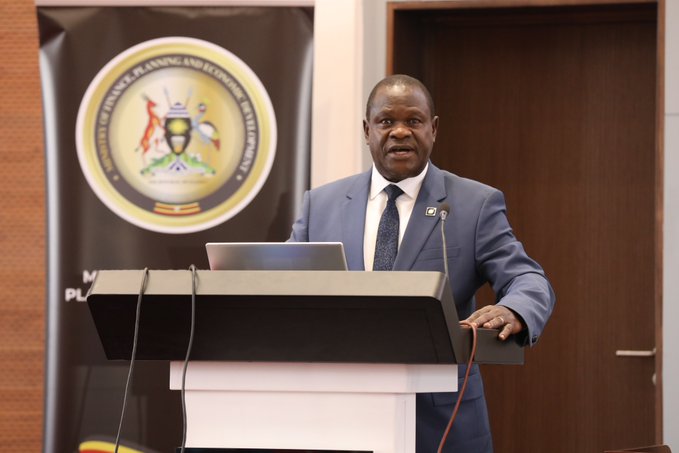
Patrick Ocailap, the acting Permanent Secretary and Secretary to the Treasury, said economic activity had maintained its momentum into the current financial year, citing business activity indicators that remained above the 50-point threshold.
The Purchasing Managers’ Index (PMI) averaged 54.5 in the first three months of the 2026/27 financial year, while the Business Tendency Index (BTI) averaged 56.6.
Readings above 50 generally indicate expansion in business activity or positive business sentiment, although the indicators measure different aspects of economic conditions.
The ministry said the second-quarter expenditure releases were intended to sustain economic activity, protect essential public services and finance strategic investments under the government’s Agro-industrialisation, Tourism, Mineral-based development and Science, Technology and Innovation (ATMS) agenda.
The priorities also include information and communications technology and the creative sector, alongside other supporting sectors.
The total second-quarter release amounts to Shs21.82 trillion, equivalent to approximately 26% of the approved annual budget, according to the ministry.
The government said the spending would be undertaken while safeguarding fiscal and debt sustainability.