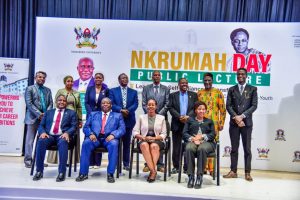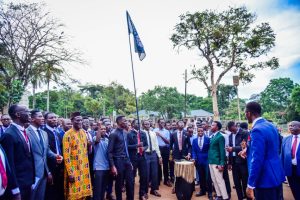



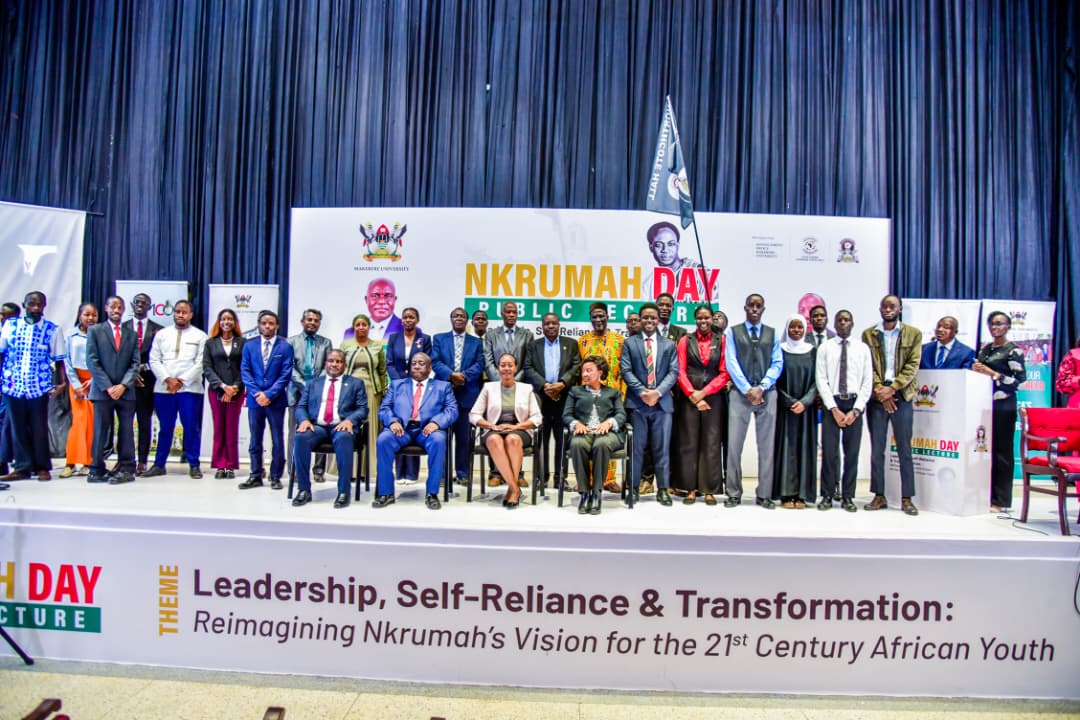
Political analyst Prof. Gerald Karyeija has called for African leaders to prioritise service, accountability and ethical responsibility, saying leadership should be measured by what individuals do for society rather than the positions they occupy.
“Leadership does not begin with the title. It begins with responsibility,” Karyeija said while delivering the keynote address at Makerere University’s 2026 Annual Kwame Nkrumah Day and Public Lecture.
“Leadership is not only about power, privilege, entitlement, or status. It’s about service. It’s about stewardship,” he added.
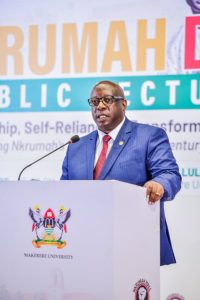
Karyeija, who heads Quality Assurance at Uganda Management Institute (UMI), said the annual event should go beyond commemorating Ghana’s first president, Kwame Nkrumah, to examine leadership, institutional strength and Africa’s future.
“We are not gathered here to merely remember Nkrumah. We are gathered here to reflect on leadership, the strength of institutions, and Africa’s future,” he said.
He acknowledged Nkrumah’s contribution to Pan-Africanism and the formation of the African Union, while noting that his legacy was also complex.
Karyeija urged leaders and educated Africans to use their knowledge and influence responsibly, warning against the pursuit of power without ethical grounding. He argued that the value of education lies not only in academic qualifications but also in the character it develops.
The lecture placed leadership within a broader discussion of Africa’s political independence, economic self-reliance, technological advancement and the institutions needed to translate the continent’s aspirations into practical outcomes.
Kiyonga calls for economic and technological advancement
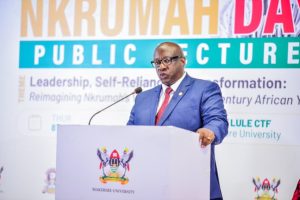
Dr Charles Kahigiriza, who represented the chief guest, Rt. Hon. Dr Crispus Walter Kiyonga, and read his remarks verbatim, said the generation that secured political independence and victories must be followed by one that advances Africa economically and technologically.
Kiyonga said the present generation must build on the political gains made by its predecessors rather than treat independence as the completion of Africa’s liberation.
“Leadership today can no longer be measured solely by political titles or parliamentary seats,” he said in remarks delivered by Kahigiriza, adding that contemporary leadership requires “intellectual courage.”
He said such courage includes questioning the wholesale importation of foreign solutions without adapting them to African realities.
Makerere urged to turn Pan-Africanism into action
Associate Prof. Gorettie Nabanoga, Acting Deputy Vice-Chancellor for Finance and Administration, representing Vice-Chancellor Prof. Barnabas Nawangwe, challenged participants to move beyond celebrating Nkrumah’s memory and work towards implementing his vision.
“Perhaps the Pan-Africanism of this generation must therefore move from solidarity to capacity, from rhetoric to institutions, from potential to production, and from aspirations to implementation,” Nabanoga said.
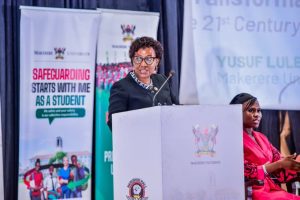
She said Makerere University should be more than an institution that awards degrees, arguing that its contribution to Africa’s future must include critical thinking, knowledge generation and innovation.
“We build for the future when we develop people who can think critically, when we generate knowledge, when we challenge perceived knowledge and wisdom, and when we innovate,” she said.
Nabanoga reminded students that their university education carried responsibilities beyond personal advancement.
“You are not simply the leaders of tomorrow; you are citizens of Africa today. The opportunity you enjoy at Makerere University comes with responsibility,” she said.
Speakers question Africa’s understanding of liberation
Dr Zahara Nampewo, one of the panellists, cited Nkrumah’s argument that political independence alone could not secure the continent’s freedom.
“In his book, in 1963, Kwame Nkrumah said that our independence is meaningless unless it is linked with the total liberation of the African continent. And liberation doesn’t only refer to political liberation, but it refers to individual liberation, economic liberation, social liberation,” Nampewo said.
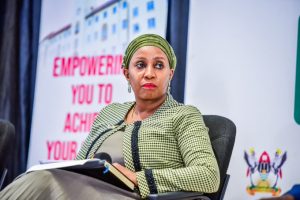
She challenged young Africans to examine how they use technology and whether their digital habits strengthen or undermine confidence in African culture.
“What are we using technology for? Is it only for leisure? Are we using it to build confidence in African culture, or are we often only watching TikTok? What kind of information are we watching? Is it information that holds or negates African culture and confidence?” she asked.
Dr Zaid Sekitto, a lecturer in Makerere University’s Department of History, Archaeology and Heritage Studies, questioned the tendency of contemporary leaders to attribute their failures to the circumstances inherited from previous generations.
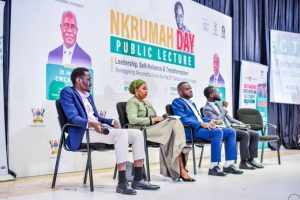
Sekitto said leaders had a responsibility to confront the structures that continued to constrain Africa rather than use history as an excuse for inaction.
Quoting a writer, he said: “We are underdeveloped not because colonialism exploited us, but perhaps because it did not exploit us enough.”
He also cited Nkrumah’s argument that political independence was insufficient without economic, intellectual and cultural independence.
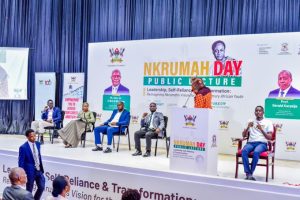
“Nkrumah argued that even after attaining political independence, it is meaningless without economic independence, intellectual independence, and perhaps what you call cultural independence,” Sekitto said.
“Leaders, we have failed to deal with the structures that colonialism left, and we have instead continued to actually perpetuate them,” he added.
Nkrumah Hall challenges students to take responsibility
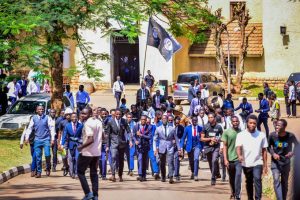
Joseph Ssekabira, chairman of Nkrumah Hall, said the hall represented an enduring ideological legacy rather than merely a physical structure at Makerere University.
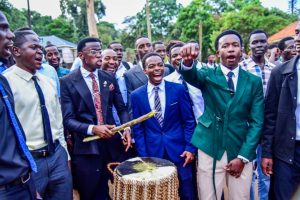
He challenged students to embrace Nkrumah’s vision of self-reliance by taking responsibility for the affairs of their university and country.
“Leadership begins the moment you decide that the condition of your country, your university, is your responsibility and not someone else’s,” Ssekabira said.
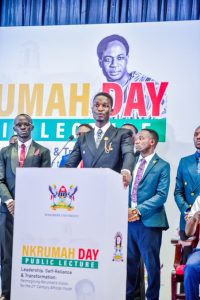
Dr Winnie Kabumbuli, Makerere University’s Dean of Students, said commemorating Nkrumah at the hall named after him underscored the university’s commitment to Pan-Africanism.
“The name Nkrumah Hall has stood the test of time and sounds like a horn beautifully sounding over the African continent and beyond,” Kab said.
She said the event’s focus on leadership, self-reliance and transformation aligned with Makerere’s mission to prepare future leaders.
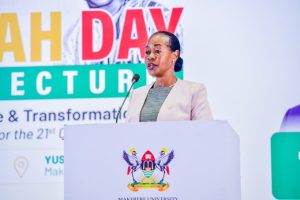
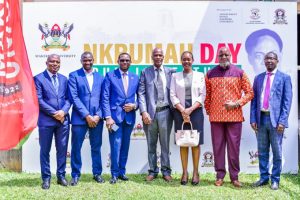
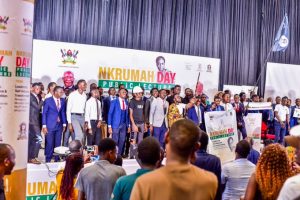
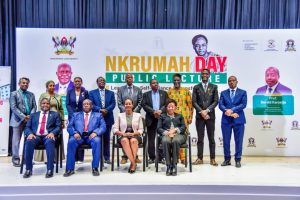
The 2026 Annual Kwame Nkrumah Day and Public Lecture was organised by Nkrumah Hall, led by Dr Rodney Rugyema, in partnership with the John N. L. L. Centre (TheJNLC), Makerere University Alumni and other partners. The event also featured a panel discussion moderated by journalist Samson Kasumba.
Former warden recognised for service
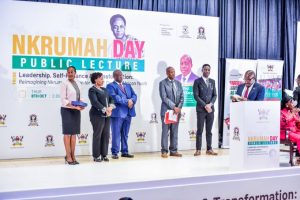
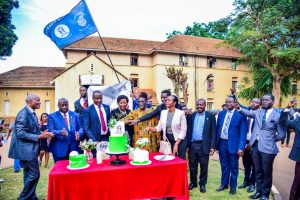
The event recognised John Kamya for his 13 years of service as warden of Nkrumah Hall between 2007 and 2020.
Kamya received an appreciation award from the chief guest in the presence of the hall chairman and other dignitaries.
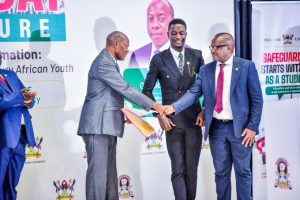
In his acceptance remarks, he recalled the 2018 visit to the hall by Samia Yaba Nkrumah, daughter of the former Ghanaian president, as one of his fondest memories in office.
He thanked Makerere University for allowing him to serve the institution and its stakeholders.