


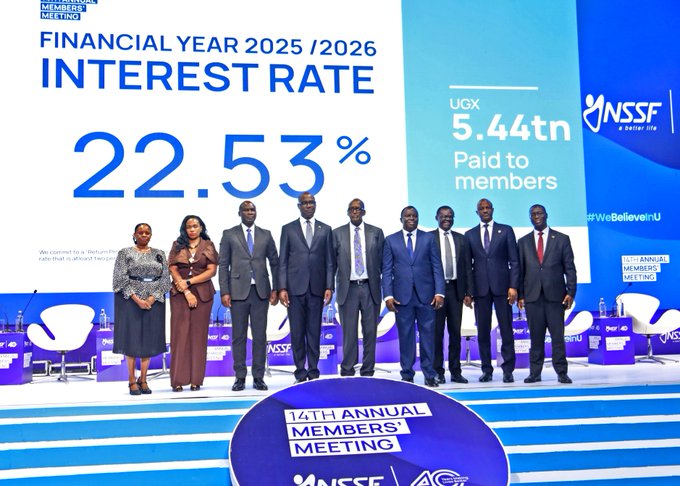
The National Social Security Fund (NSSF) on Thursday declared a 22.53% interest rate on members’ savings for the financial year ended June 30, 2026, the highest rate in the Fund’s 40-year history.
Finance Minister Henry Musasizi announced the rate at NSSF’s 14th Annual Members’ Meeting in Kampala on September 24. The declaration means about Shs5.44 trillion will be credited to members’ accounts, compared with about Shs2.8 trillion credited at the 13.5% rate declared for 2024/25.
But what does 22.53% actually mean for an individual saver—and how did NSSF generate enough income to support such a large credit?
It is interest on your savings
The 22.53% is applied to members’ qualifying savings balances. It is not a 22.53% increase in salary, nor does it mean a worker receives 22.53% of their annual salary.
As a simple illustration, a member with Shs10 million in qualifying savings would see about Shs2.253 million credited at that rate, bringing the balance to roughly Shs12.253 million before considering new contributions, withdrawals and the precise mechanics of NSSF’s interest calculation.
For Shs50 million, the equivalent illustration would be about Shs11.265 million. The actual amount credited to an individual therefore depends on the balance eligible for interest.
Where did the money come from?
NSSF is not simply holding members’ contributions in an account. It invests the savings in assets intended to generate income.
During 2025/26, member contributions rose by 13% to about Shs2.42 trillion, while the Fund’s assets grew by 26.4% to Shs32.87 trillion. Benefits paid to members also rose by 17% to about Shs1.55 trillion.
At the end of June, about 76.8% of NSSF’s portfolio was in fixed-income investments, including government securities; equities accounted for about 18.4%, while real estate made up the remainder.
That investment mix is important because most of the Fund’s income came from assets already generating returns.
NSSF’s total income increased by 85% to Shs6.51 trillion during the financial year. Of this, about Shs3.88 trillion was realised income—money actually earned or received. Interest income was about Shs3.5 trillion, dividends contributed Shs369 billion and real estate generated about Shs16 billion.
The Fund also recorded about Shs2.62 trillion in unrealised gains, largely reflecting increases in the value of investments that had not yet been sold.
This distinction helps explain the record rate.
If NSSF owns shares worth Shs100 billion and their market value rises to Shs130 billion, the Fund has a Shs30 billion gain in the value of its investment. But it has not necessarily received Shs30 billion in cash.
Such gains are nevertheless reflected in the Fund’s financial performance and can strengthen its overall asset position.
Equities provided a major boost
Although equities represented less than a fifth of NSSF’s portfolio, they performed strongly during the year.
NSSF’s equity holdings rose to about Shs5.93 trillion, with the Fund reporting a return of roughly 60.8% on equities. Regional stock markets, particularly in East Africa, recorded substantial gains during the period.
Government securities, however, remained the major source of realised investment income, generating about Shs3.5 trillion in interest.
This combination—steady income from fixed-income assets and strong gains from equities—helped push the Fund’s overall income sharply higher.
The Fund also benefited from dividends and foreign-exchange movements, although currency gains were relatively small compared with the increase in investment values.
Why doesn’t NSSF simply pay out all its income?
Because NSSF has obligations beyond declaring interest.
During 2025/26, it paid about Shs1.55 trillion in benefits to 50,499 members. It also paid about Shs301.5 billion in income tax and spent roughly Shs277 billion on operating costs, according to the Fund.
The Shs5.44 trillion credited to members therefore should not be interpreted as NSSF simply taking its entire Shs6.51 trillion income and distributing it.
The Fund must continue paying eligible members, managing its investments, meeting operational costs and maintaining reserves.
The rate is also not a promise that NSSF will earn 22.53% every year.
Under the NSSF Act, the Finance Minister declares the annual interest rate after consulting the Board. The law does not prescribe a formula that automatically produces the rate each year. In practice, the financial performance of the Fund during the year that has ended is a major factor in determining what can be credited to members.
What does inflation have to do with it?
For a saver, the headline rate becomes more meaningful when compared with inflation.
If savings grow faster than prices, their purchasing power can increase.
Uganda’s annual inflation was 3.7% around the end of the financial year, depending on the measure and reporting period, far below the 22.53% NSSF declared.
That does not mean a saver will become 19 percentage points richer every year. It simply means that, during this particular period, the nominal interest credited by NSSF was substantially above the rate at which consumer prices were rising.
NSSF’s longer-term objective is to preserve and grow the real value of members’ savings rather than relying on one exceptional year.
The real advantage is time
For a long-term saver, the significance of the declaration goes beyond this year’s credit.
When interest remains in the account, it becomes part of the savings base on which future returns can be earned. That is compound growth.
For example, if Shs10 million were to receive 22.53%, the balance would rise to about Shs12.253 million. If that entire amount somehow earned another 22.53% the following year, it would rise to roughly Shs15 million.
But that second-year assumption is only an illustration. NSSF’s annual interest rate changes according to the Fund’s performance and the rate declared for each financial year.
The Fund’s previous rate was 13.5%, while the previous record before 2026 was 15% (2017/18 financial year).
What the rate does—and does not—tell savers
The 22.53% declaration tells savers that NSSF had an unusually strong financial year.
It does not tell them what the Fund will earn next year.
Markets rise and fall. Government borrowing conditions change. Interest rates move. Equity prices can decline. Property values can fluctuate. Currency movements can also affect investment returns.
NSSF’s relatively diversified portfolio is therefore designed to balance return, risk and liquidity rather than chase the highest possible return in any single year.
The Fund is also trying to expand its membership and savings base. It reported about 3.6 million registered members, with around 2.7 million having balances, and is targeting 15 million members and Shs80 trillion in assets by 2035.
For ordinary savers, the most important message from the 22.53% declaration is therefore simple: their accumulated NSSF savings have received a substantial boost.
But the bigger story is what happens over decades.
NSSF takes workers’ contributions, pools them into a large investment fund, puts the money into government securities, equities, property and other assets, earns income and investment gains, pays benefits and other obligations, and credits part of that performance back to members.
The 22.53% is the visible number.
Behind it is a Shs32.87 trillion investment fund whose performance depends on thousands of investments, financial markets, government securities, companies, property and, ultimately, the millions of Ugandans whose savings make up the Fund.
For a retirement saver, therefore, the value of the announcement is not simply the size of this year’s interest rate. It is whether NSSF can continue turning regular contributions into sustained long-term growth while protecting those savings through both strong and difficult financial years.