



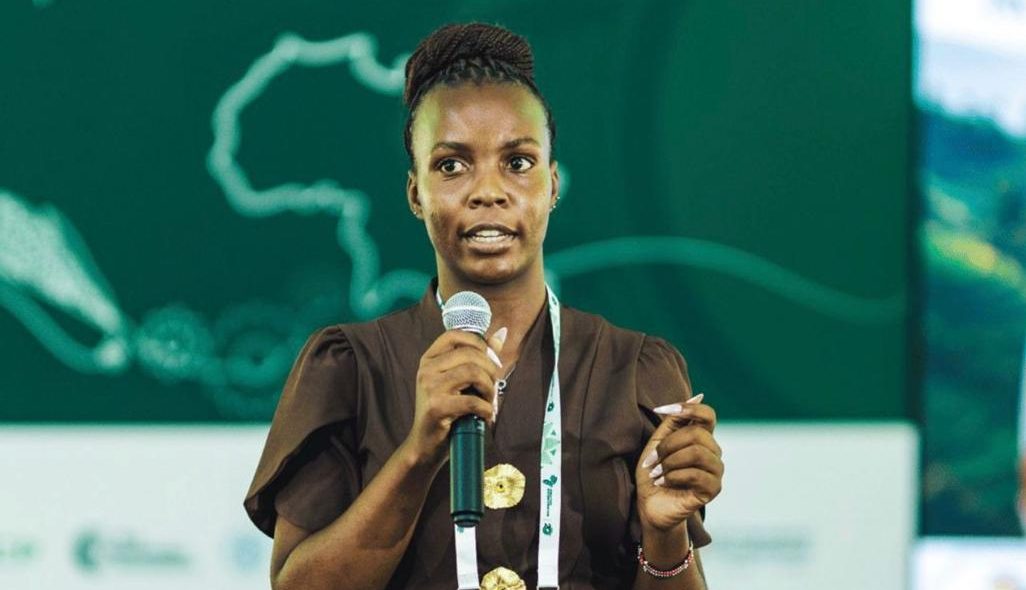
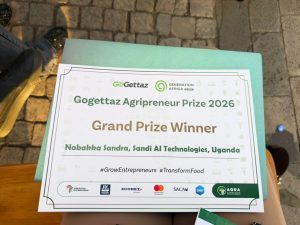
KIGALI, Rwanda — Ugandan agritech startup SANDI AI Technologies has won the 2026 GoGettaz Agripreneur Prize, taking home US$50,000 (about Shs190 million) for its use of artificial intelligence to help smallholder farmers access finance.
The startup, founded by Ugandan entrepreneur Nabakka Sandra, received the top award during the Africa Food Systems Forum (AFS Forum) 2026 Summit in Kigali, Rwanda, bringing continental recognition to a technology venture seeking to tackle one of the biggest constraints facing Africa’s farmers: limited access to affordable capital.
SANDI AI’s platform uses artificial intelligence to develop alternative approaches to assessing farmers and connecting them to financial opportunities, particularly those who may struggle to qualify for conventional loans because they lack formal collateral or traditional financial records.
For millions of smallholder farmers, the financing gap can determine whether a farm remains a subsistence activity or becomes a viable commercial enterprise.
Sandra said the company’s approach is built around understanding farmers beyond the conventional requirements used by financial institutions.

“Farmers should not be limited by systems that were not designed around their realities,” Sandra said. “Technology gives us an opportunity to understand farmers better, recognise their potential, and create pathways that allow them to access the resources they need to grow.”
The US$50,000 prize is expected to support SANDI AI’s technology development and expansion as it seeks to reach more farmers and strengthen its financial inclusion solutions.
The award places the Ugandan startup among a growing group of African agrifood enterprises using technology to address challenges ranging from agricultural productivity and food security to access to finance.
Bridging the agricultural finance gap
Agriculture remains central to Africa’s economy, supporting millions of households and providing livelihoods across the continent. Yet farmers continue to face significant barriers when seeking financing to purchase inputs, expand production or respond to changing market opportunities.
Traditional lending systems often rely on requirements such as fixed assets, formal income records and conventional collateral. These requirements can exclude smallholder farmers whose most valuable assets may be their land, farming experience, production capacity and relationships within agricultural value chains.
SANDI AI is seeking to change how farmers are assessed by using artificial intelligence and agricultural data to develop a fuller picture of their circumstances and financing needs.
The company’s model reflects a broader shift in African financial technology, where startups are attempting to use digital tools to reach people who have historically remained outside formal financial systems.
For farmers, the challenge is not necessarily the absence of productive opportunities. Often, it is the absence of capital to act on those opportunities.
A farmer may have land, a reliable market and the knowledge to produce, but without money for seed, fertiliser, equipment or labour, production remains constrained. This is the gap SANDI AI is attempting to address.
From AI to practical agricultural solutions
Sandra’s venture sits at the intersection of artificial intelligence, agriculture and financial inclusion.
Rather than treating AI simply as a tool for automation, SANDI AI is applying the technology to a distinctly African problem: how to make financial systems better understand people whose economic lives do not always fit conventional financial models.
The approach is part of a wider movement among African technology entrepreneurs who are developing products around challenges in their own communities rather than simply adapting technologies created for markets elsewhere.
For Sandra, agriculture provides a particularly important entry point because of the sector’s role in employment, food production and rural incomes.
The company’s ambition is to use technology to help turn agricultural potential into economic opportunity by making it easier for farmers to access the resources required to grow.
That ambition has now earned the company continental recognition through the GoGettaz competition.
Continental recognition
The GoGettaz Agripreneur Prize is designed to recognise young African entrepreneurs developing businesses across the agriculture and food value chains.
SANDI AI emerged as the overall winner after competing against agrifood ventures from across the continent.
The award was presented during the Africa Food Systems Forum 2026 Summit in Kigali, which brought together African leaders, entrepreneurs, investors, policymakers and other stakeholders to discuss the future of the continent’s food systems.
The recognition gives SANDI AI access not only to the prize money but also to increased visibility among potential investors, development partners and other players in Africa’s growing agritech ecosystem.
For Uganda’s technology sector, the achievement is also a demonstration that locally developed solutions can compete for recognition beyond the country’s borders.
Uganda has a large agricultural economy, but many farmers continue to operate at a small scale and face difficulties accessing formal financial services. The emergence of companies attempting to bridge that gap points to the growing role technology could play in changing how agricultural finance works.
What comes next for SANDI AI
The Shs190 million award gives SANDI AI capital to strengthen its technology and expand its operations, but the bigger challenge will be proving that its model can work at scale.
Artificial intelligence may be capable of identifying patterns that conventional lending systems overlook, but the technology must ultimately translate into real financial access for farmers.
That means helping farmers obtain capital on terms they can manage while giving lenders sufficient confidence to finance agricultural activities that are often exposed to weather, market and production risks.
For Sandra, the objective is to build a financial system that sees farmers not merely through the limitations of traditional lending requirements, but through their economic potential. “Farmers deserve financial systems designed around their realities,” she said. “Our ambition is to make access to finance smarter, fairer, and more inclusive.”