


KAMPALA — For generations, African education systems have operated on a simple proposition: acquire knowledge, pass examinations, collect certificates and eventually find a place in the world of work.
But what happens when knowledge is no longer scarce?
Artificial intelligence can retrieve information in seconds, explain it in multiple languages, analyse data, write essays and increasingly perform tasks for which human beings spent years being trained.
That is forcing a deeper question onto Africa’s education debate: if machines can deliver knowledge, what exactly should schools produce?
Dr Tony Devine, Vice President for Education at the Global Peace Foundation in Seattle, United States, says Africa should not simply modernise an old system. It should rethink the purpose of education itself.
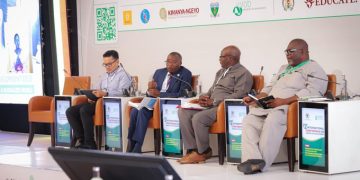
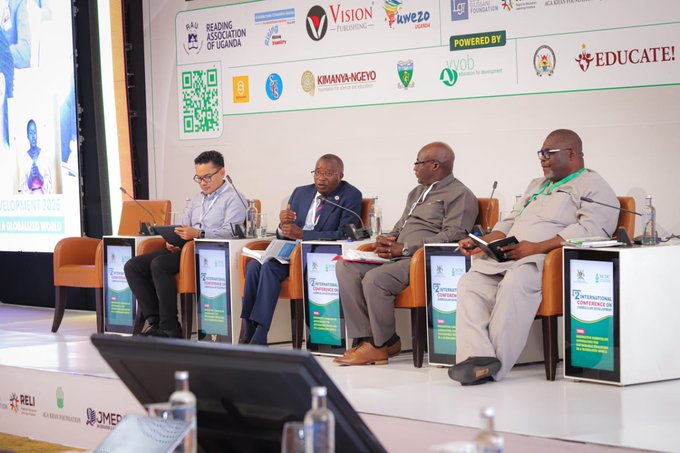
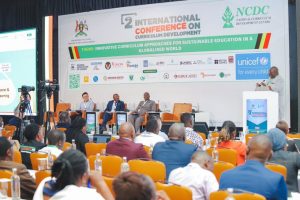
Speaking at the 2nd International Conference on Curriculum Development held at Speke Resort Munyonyo in Kampala, Devine said: “Knowledge has been the currency of education for hundreds of years.”
But the internet changed access to knowledge, and AI is changing it again.
“Artificial intelligence has greatly devalued this currency of knowledge in the educational centre.” “With knowledge everywhere, knowing is no longer enough.”
The implication is profound: education must move beyond asking what a learner knows to asking who that learner becomes and what they can do with what they know.
The melting iceberg
Devine used John Kotter’s “Our Iceberg Is Melting” to describe the crisis facing education. “The conventional education system, all over the world, not just here in Uganda, is sitting on a melting iceberg,” he said.
The forcing function is artificial intelligence. “We need to move urgently to solid ground.”
That solid ground, he argued, should include character, relationships, physical vitality, creativity and applied skills.
The argument matters particularly for Africa, whose young population is expanding rapidly. “So what are we going to do with this dividend? That’s the question.”
Prof Benson Banda, Director of Zambia’s National Science Centre, has warned that African curricula can produce graduates who are “globally relevant but locally irrelevant” — people able to recite the periodic table but unable to recognise a plant growing around them.
Dr Syafiq Mat Noor of the University of Leeds has similarly argued that decolonisation requires Africans to reclaim epistemic authority: the power to determine whose knowledge counts, how it is interpreted and what purposes education should serve.
AI adds another dimension: what happens when the machine itself can provide much of the knowledge schools have historically transmitted?
Competence is not enough
Devine welcomed competency-based education, including reforms in Uganda and Kenya. “It shifted from ‘What did you memorise?’ to ‘What can you do?’” he said.

But even competency, he argued, cannot be the foundation. “Competency is not the foundation; it is the peak of the pyramid.”
The foundation should be character. “The guided system for competency is character.”
That challenges an education debate increasingly framed around employability. We ask whether graduates can code, engineer, analyse data and communicate. But who are they while doing those things? What values guide their decisions?
The whole person
Devine said education has spent roughly 300 years concentrating disproportionately on the mental and cognitive dimensions of human development.
He identified four dimensions: spiritual and moral development; emotional and relational development; physical vitality; and mental and cognitive development.

“The education sector, for the last 300 years, and still in 2026, has only partially focused on one of these: the mental and cognitive dimension.”
Character, he said, is not simply good manners. “Character is not just something of a nice personality trait. This is deep stuff.”
He also challenged the separation between families and schools.
“The primary partnership should be between families and schools.” “Parents are the primary moral educator, and teachers are the famous supporter of that.”
The teacher is not disappearing
AI may teach mathematics, explain history, correct an essay or personalise a lesson. Devine does not believe this makes teachers obsolete.
“Teachers are needed more than ever, but not in the traditional sense of teaching the curriculum.” “Their new role is going to be a guide.”

The machine can provide information. It cannot assume responsibility for a child’s judgement, character, relationships, courage and sense of purpose.
But that requires teachers themselves to change. “This transformation does not start with the students. It starts with the educators.”
Devine warned against trying to transform education by changing curricula and examinations while leaving educators unchanged.
“What happens over and over and over again is that we start with trying to transform the system by people who are not working with their own personal transformation.”
His challenge was blunt: “No human is limited. We are the ones who put limits on ourselves.”
And the same applies to institutions. “It’s not a limit on resources; it’s a limit on resourcefulness.”

From certificates to capability
The conference also confronted the widening gap between education and employment.
Moderator Mary Goretti Nakabugo, Executive Director of Uwezo Uganda, asked what kind of workforce Uganda wants and what its education system actually produces.
The discussion brought together Prof Anthony Muwagga Mugagga of Makerere University, Dr Ruth Biyinzika Musoke of the Private Sector Foundation Uganda, Mrs Loy K. Abaine Muhwezi from the Ministry of Education and Sports, and Dr Hamis Mugendawala of the National Planning Authority.
The concern was shared: qualifications are increasing, but certificates alone do not guarantee workplace competence.
Mugendawala argued that education institutions remain too focused on producing certificates without sufficiently asking what graduates can actually do.
Mugagga said employers increasingly value what people can do with what they know, rather than the amount of information they can reproduce.

Dr Biyinzika highlighted another weakness: education can give students information without teaching them how to think.
COVID-19 exposed the problem. When societies faced circumstances for which there were no instructions, critical thinking, adaptability and problem-solving became more valuable than memorisation.
AI now makes that lesson unavoidable.
If machines can perform routine cognitive tasks faster and more cheaply, students cannot be trained simply to compete with machines at being machines.
They must learn to interrogate information, interpret it, challenge it, make judgements and use technology intelligently.
That also requires stronger links between education and industry: internships, mentorship, practical training, curriculum partnerships and systematic feedback from employers.

Education for the future, not the past
The larger question is whether African education systems are preparing young people for the future or for the world their parents entered. “We often teach for the present or even for the past,” Prof Mugagga observed.
That becomes increasingly dangerous on a continent with one of the world’s youngest populations.
The challenge is therefore larger than unemployment or curriculum reform.
What should African schools have been teaching 20 years ago? What should they teach today for the world that will exist 20 years from now?
And perhaps the most uncomfortable question of all: If AI has made knowledge abundant, why are we still designing schools as though knowledge were scarce?