


Ugandan diplomat Olara Otunnu has made a significant gain in the race to become the next Secretary-General of the United Nations, increasing his “encourage” votes from two to five in the second informal straw poll conducted by the UN Security Council on Friday.
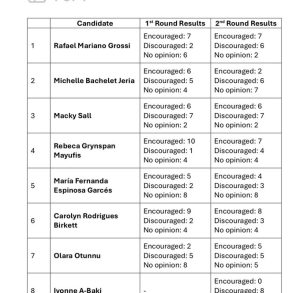
Otunnu received five “encourage”, five “discourage” and five “no opinion” votes among the Council’s 15 members, according to results circulated after the confidential poll. The result represents a three-vote improvement in support from the first straw poll, in which he recorded two encourage, five discourage and eight “no opinion” votes.
Guyana’s Carolyn Rodrigues-Birkett led the second poll with eight encourage votes, followed by Costa Rica’s Rebeca Grynspan and Argentina’s Rafael Grossi, each with seven. Senegal’s former President Macky Sall received six encourage votes, while Otunnu moved into fifth place with five.
The second poll was conducted as the Council begins narrowing the field of candidates seeking to succeed António Guterres, whose second term ends on December 31. The straw polls are informal and non-binding, but are closely watched because a candidate ultimately needs at least nine votes in the 15-member Security Council and must avoid a veto from any of the five permanent members.
The identity of individual members’ votes in the latest poll remains confidential.
Otunnu, who was nominated by Uganda in July, acknowledged receiving the official results but struck a cautious tone.
“I have received from the President of the Security Council the official outcome of the second straw ballot conducted today by the Security Council. I am grateful to all members of the Security Council. I look forward to continued engagement with members of the Security Council and all Member States of the United Nations,” Otunnu said in a statement posted on X.
His latest performance comes only days after he participated in the candidate dialogues with the UN General Assembly and Security Council. He was the only candidate to enter the race after the first straw poll and subsequently participate in the dialogues before the second vote.
Uganda’s Foreign Affairs Minister, Ambassador Adonia Ayebare, welcomed the result and said the government would continue to make Otunnu’s campaign a priority.
“Proud to be part of this Viable candidature of Ambassador Olara Otunnu for United Nations Secretary General,” Ayebare wrote on X. “We thank all Member states for granting him audience to present his vision.”
Ayebare added that President Yoweri Kaguta Museveni had instructed Uganda’s Foreign Affairs Ministry and its diplomatic teams around the world to make the campaign a “top priority.”
Otunnu has moved sharply from the bottom of the first poll, but five encourage votes remain four short of the nine required for a Security Council recommendation. He would therefore need to convert a substantial number of the members who currently have no opinion while also overcoming five discouraging votes.
The wider field remains fluid. Rodrigues-Birkett, who had nine encourage votes in the first poll, fell to eight in the second; Grynspan dropped from 10 to seven; while Grossi maintained seven encourage votes but saw his discourage votes rise. Sall remained unchanged at six encourage, seven discourage and two no opinion.
The results underline why the straw polls are only a snapshot rather than a final verdict. Quiet diplomacy, negotiations among member states and, eventually, the positions of the five permanent Security Council members — China, France, Russia, the United Kingdom and the United States — will determine whether any candidate can assemble the consensus required.
For Otunnu, however, the political arithmetic is at least moving in the right direction.
Three votes were gained.
The question now is whether those three votes mark the beginning of momentum — or merely the limit of how far a late entrant can travel in a contest that began before his candidacy existed.