


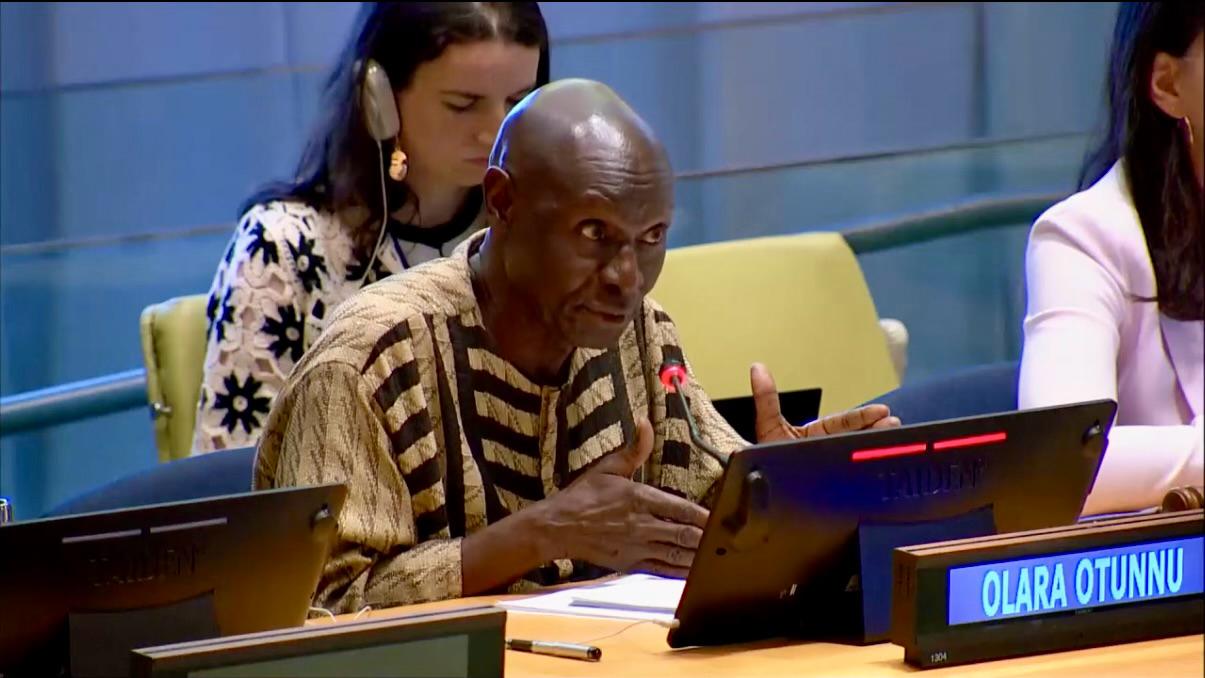
NEW YORK — Uganda’s candidate for United Nations Secretary-General, Ambassador Olara Otunnu, has called for fundamental reforms of the world body, arguing that the organisation must restore its credibility by applying the UN Charter, international law and human rights standards consistently and without selectivity.
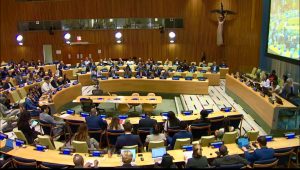
Otunnu made the remarks on Wednesday, August 19, during an interactive dialogue with UN Member States and civil society at the General Assembly in New York, where he presented his vision and responded to questions on conflicts, development, human rights, Security Council reform, artificial intelligence and the future of multilateralism.
The United Nations confirmed that Otunnu was nominated by Uganda on July 24, 2026, and that the dialogue formed part of the formal process for selecting a successor to Secretary-General António Guterres, whose second term ends on December 31, 2026.
The three-hour session was conducted in two segments, covering leadership and institutional reform before moving to peace and security, development and human rights.
In his opening statement, Otunnu argued that the UN was operating at a moment of profound global upheaval, marked by wars, economic fragmentation, challenges to human rights and rapid technological change.
He said the organisation remained the only institution representing all humanity and should return to the principles on which it was founded.
“We cannot continue to do business as usual,” Otunnu said, describing reform as no longer optional but an “imperative.”
He argued that the reform agenda should become a permanent feature of the organisation’s culture rather than a temporary project.
“Reform should not be the ending of multilateralism,” he said. “On the contrary, reform should strengthen multilateralism.”
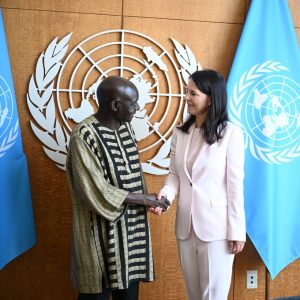
Otunnu said the UN’s legitimacy, effectiveness and efficiency depended on making reform part of the organisation’s institutional culture and ensuring that mandates were matched with the resources required to implement them.
Conflicts would be an immediate priority
Otunnu identified conflicts in Ukraine, Gaza, the Great Lakes region of Africa, Sudan, Iran, the Horn of Africa and the Sahel as areas requiring immediate attention from the Secretary-General.
He said the UN must remain “engaged, present, probing, listening” and constantly seek openings for diplomacy, while recognising that the final decisions rested with the parties to conflicts and the major powers involved.
Responding to questions from the Arab Group on Palestine, Otunnu said ending the immediate phase of the Gaza conflict would not be sufficient.
He argued that the UN should address the underlying causes of the conflict and pursue a long-term political solution.
On Ukraine, he said the UN and its institutions should work to prevent impunity and that the Secretary-General should engage immediately in conflicts where civilians are suffering.
“Children, women, innocent people are suffering unbelievably,” he said, describing the human cost of wars as unacceptable.
Calls for consistency on international law
A recurring theme throughout the dialogue was Otunnu’s argument that international law and human rights should not be applied selectively.
Responding to questions from the Arab Group and other delegations, he said the principles of the UN Charter should apply to all Member States.
“They should be promoted without any selectivity whatsoever,” he said, extending the argument to human rights and international law.
He told a civil society representative that the Secretary-General should be an impartial advocate of the Charter and should respond to violations of sovereignty consistently.
“The Secretary-General should be consistent, should be non-selective, and should be even-handed and impartial,” he said.
The issue of selectivity was particularly prominent in questions from Member States, reflecting one of the central tensions facing the multilateral system: how can an institution claim universal rules when those rules are perceived to be applied differently depending on the country involved?
Security Council reform
Otunnu described reform of the Security Council as a “very historic project”, but cautioned that the primary responsibility for reaching agreement rests with Member States.
He said the UN should recognise historical imbalances while building consensus between the permanent members of the Security Council and the wider membership.
He also said Africa’s demand for greater representation should be understood partly through the continent’s experience of historical imbalance. However, he stressed that the Secretary-General could encourage consensus but could not dictate the outcome of an intergovernmental process.
On relations between the General Assembly and Security Council, Otunnu said the two bodies should cooperate rather than compete.
“The Secretary-General is the go-between,” he said, arguing that the office should help reduce tensions between the two organs and promote cooperation.
From New York to northern Uganda
One of the more distinctive elements of Otunnu’s presentation was his attempt to connect high-level UN policy with his recent work in northern Uganda.
He said he had spent the previous five years working in communities affected by the Lord’s Resistance Army conflict, helping rebuild a society devastated by more than two decades of war.
That experience, he said, had given him a practical understanding of peacebuilding beyond diplomatic negotiations. “I have some idea what peacebuilding means at the ground level,” Otunnu said.
He argued that the UN should not simply formulate policies in New York, Geneva or Vienna but should follow their implementation to national and community levels.
The argument resurfaced when civil society groups questioned how communities could become meaningful participants in the UN system.
Otunnu said the organisation must reconnect itself with ordinary people and avoid becoming “an ivory tower divorced from the people of the world.”
AI as both opportunity and danger
Otunnu also placed artificial intelligence high on his agenda.
He said AI could become one of the most transformative forces in human history, potentially helping prevent disease and expand financial and digital inclusion, but warned that its rapid development also presented profound risks.
Asked which emerging technology required the most urgent UN attention, he singled out artificial intelligence.
He proposed that the UN convene governments, technology companies and other stakeholders to develop an international framework for governing AI.
The objective, he said, should be to ensure that the technology becomes “a force for good” and that its benefits are accessible to the entire world.
Development and the SDGs
Otunnu acknowledged that the world is not on track to meet the Sustainable Development Goals and said developing countries would require greater access to resources.
But he also placed responsibility on national governments.
He argued that countries seeking international assistance should first strengthen domestic planning, investment, resource mobilisation and anti-corruption measures.
The Secretary-General, he said, should then use the office’s diplomatic reach to mobilise additional international and private-sector resources.
He similarly backed the Pact for the Future and said its implementation should produce measurable results before its 2028 review.
Human rights and civil society
Otunnu said the UN must return to what he described as the fundamentals of the Charter in its approach to human rights.
He warned against the politicisation and instrumentalisation of human rights and called for greater sensitivity to different cultural and social contexts.
He also told civil society representatives that the UN should not merely consult them but reconnect itself with communities and ordinary people.
“The Secretary-General must do everything to reconnect the people of the world to the United Nations,” he said.
On the representation of different regions, cultures and genders within the UN bureaucracy, Otunnu said the organisation should “look like the world it represents.”
A Secretary-General with soft power
Otunnu described the authority of the Secretary-General not as conventional political power but as “soft power” derived from two sources: the principles of the UN Charter and the support of Member States.
He said an effective Secretary-General must use that authority to bring competing parties together, build consensus and propose innovative solutions during periods of deadlock.
He cited his experience during the 1981 General Assembly deadlock and the 1983 Grenada crisis, as well as his work establishing the UN regime for protecting children affected by armed conflict.
The official UN record confirms that Otunnu served as the first Special Representative for Children and Armed Conflict from 1998 to 2005.
The dialogue ended with Otunnu presenting his long experience across the UN’s three pillars and at grassroots level as the central argument for his candidacy.
“What I bring are decades of experience across the UN pillars,” he told delegates, adding that his experience included leadership, consensus-building, innovative problem-solving and work with communities.
The United Nations selection process will ultimately see the Security Council recommend a candidate to the General Assembly, which formally appoints the Secretary-General under Article 97 of the UN Charter.