



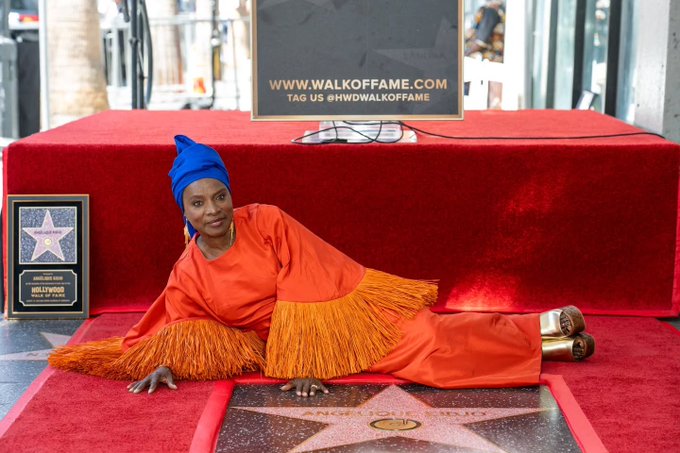
LOS ANGELES — Four decades after leaving Benin and building a career that carried African rhythms into some of the world’s biggest stages, five-time Grammy Award winner Angélique Kidjo has become the first Black African artist to receive a star on the Hollywood Walk of Fame.
Kidjo was honoured on Tuesday, August 18, with the 2,854th star in the Recording category at 7011 Hollywood Boulevard, across from the historic Hollywood Roosevelt Hotel. The Hollywood Chamber of Commerce had announced the honour as a landmark first for both African musicians and Black Africans.
The ceremony marked another milestone in the career of the Beninese singer, songwriter and activist, whose music has moved between West African traditions and global genres while keeping African identity at its centre.
Kidjo used the occasion to place the honour in a larger historical context, arguing that Africa is not a late arrival to world music but one of its foundations.
“Without us, there’s no music possible on this planet,” she said, according to reports from the ceremony.
Her point was larger than the star beneath her feet. The Hollywood Walk of Fame has spent decades turning entertainers into permanent markers of American popular culture; on Tuesday, one of those markers belonged to an African musician whose career has repeatedly challenged the idea that African music exists merely as an influence on somebody else’s sound.
Actor Willem Dafoe praised Kidjo during the ceremony, describing her as “the hardest-working woman in show business,” while fellow African musicians and entertainers, including Nigerian singer Adekunle Gold, joined family members and colleagues in celebrating the achievement.
Kidjo’s recognition comes after more than 40 years in music and five Grammy Awards. Her career has included collaborations across continents and genres, helping make her one of the most internationally recognised African musicians of her generation. Variety reported on the ceremony as Kidjo reflected on her career, her mother’s influence and her continuing musical work.
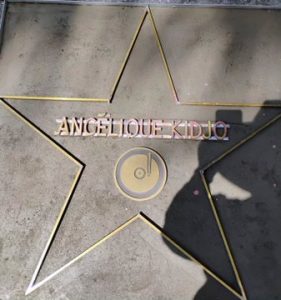
The Hollywood Chamber had announced Kidjo’s selection among the 2026 Walk of Fame class, which also includes musicians such as Miley Cyrus, Josh Groban, Lyle Lovett, Air Supply, Bone Thugs-N-Harmony and the Clark Sisters.
Kidjo’s achievement also carries a particular significance for African musicians navigating an entertainment industry historically shaped by Western institutions and markets.
The distinction does not make her the first African-born person to have a Hollywood Walk of Fame star; rather, the Hollywood Chamber specifically describes her as the first African musician and first Black African to receive the honour.
For an artist who has spent much of her career insisting that African music belongs at the centre of the global conversation rather than at its margins, the symbolism of the location is difficult to miss.
Hollywood has spent generations deciding which stories, faces and sounds become permanent.
Now, one of those stars carries the name Angélique Kidjo.