


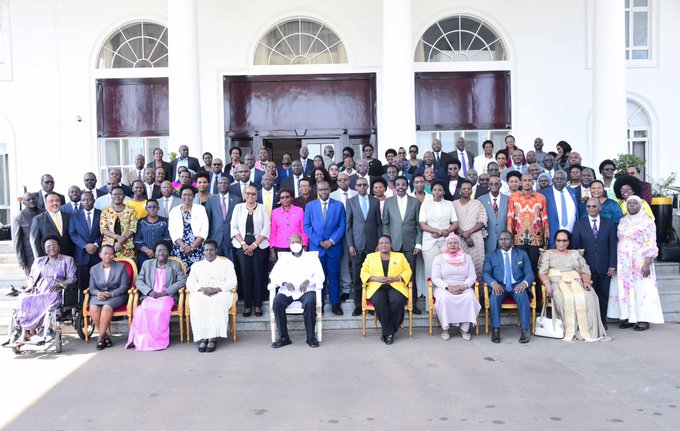
KAMPALA — President Yoweri Kaguta Museveni on Monday chaired the first Cabinet meeting of his newly constituted government for the 2026–2031 term, formally launching the implementation of the National Resistance Movement (NRM) administration’s agenda for the next five years.
The inaugural Cabinet meeting came after the swearing-in of the new administration on June 8, 2026, and the successful conclusion of a 10-day Cabinet Induction Retreat at the National Leadership Institute (NALI), Kyankwanzi.
The retreat, officially opened by President Museveni on June 15, was designed to equip both newly appointed and returning ministers with a shared understanding of the government’s priorities, leadership philosophy, public service ethics and governance framework. It also provided an opportunity for ministers to align with the NRM manifesto and the strategic objectives of the 2026–2031 administration.
The President has consistently emphasised that disciplined implementation, accountability and efficient service delivery will be central to the government’s efforts to accelerate Uganda’s socio-economic transformation over the next five years.
Monday’s meeting brought together the country’s top political leadership, including Vice President Jessica Alupo, Prime Minister Robinah Nabbanja, the Deputy Prime Ministers, Government Chief Whip Dr Jane Ruth Aceng, Cabinet Ministers, Ministers of State and other senior government officials.
Also in attendance were NRM Secretary General Richard Todwong, Permanent Secretaries from various government ministries, the Executive Director of the Kampala Capital City Authority (KCCA), Hajjat Sharifah Buzeki, and the Senior Presidential Advisor on Defence and Security Issues, Lt. Gen. Proscovia Nalweyiso.
The session marked the official commencement of collective government business under President Museveni’s new administration following his assumption of office for a new constitutional term.
Under Article 111 of the Constitution of the Republic of Uganda (1995, as amended), Cabinet is the highest policy-making organ of the Executive and comprises the President, the Vice President, the Prime Minister and such number of ministers as the President considers necessary for the efficient running of the State.
Uganda’s 83-member Cabinet is charged with providing policy direction, coordinating government programmes and overseeing the implementation of the administration’s development agenda during the 2026–2031 term.
The new administration is expected to focus on accelerating socio-economic transformation through improved service delivery, wealth creation, industrialisation, infrastructure development, human capital development and strengthened accountability across government institutions.