


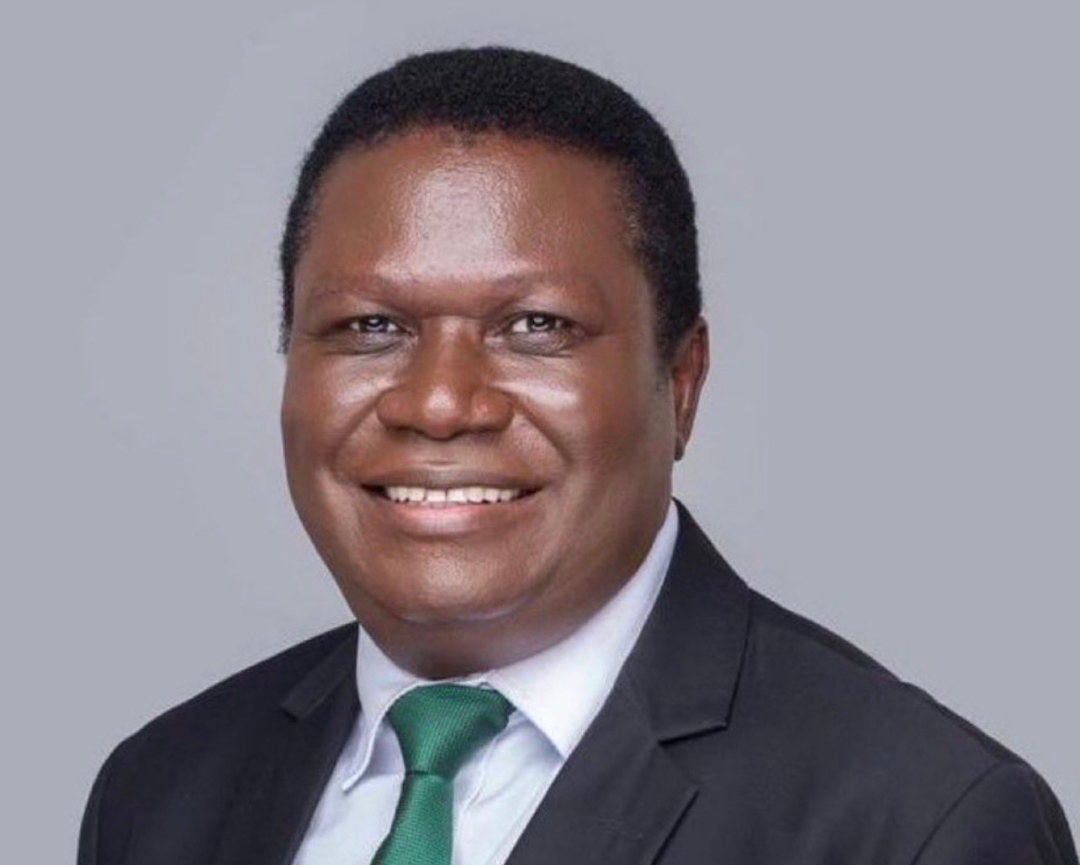
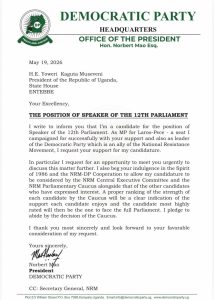
KAMPALA – Democratic Party (DP) President and Justice Minister Norbert Mao has publicly released a letter he wrote to President Yoweri Museveni formally requesting to be considered for the position of Speaker of the 12th Parliament.
“I beg your indulgence in the Spirit of 1986 and the NRM DP Cooperation to allow my candidature to be considered by the NRM Central Executive Committee and the NRM Parliamentary Caucus alongside that of the other candidates who have expressed interest,” he stated.
Mao broke his silence on the correspondence via his official X (formerly Twitter) account, stating that he wanted to clear the air following intense public speculation.
“Many people have been inquiring about the content of the letter I wrote and sent to President Museveni. Here it is. It is simple and straightforward,” Mao stated.
Respecting the NRM Caucus Chain of Command
In the letter dated May 19, 2026, Mao—who was recently elected as the Member of Parliament for Laroo-Pece Division—noted that his campaign has been running with the President’s support.
He acknowledged that while he belongs to the Democratic Party, the political realities of the House mean the ruling National Resistance Movement (NRM) holds the ultimate cards.
Explaining the strategy behind his letter, Mao emphasized that his pitch is built entirely on the constitutional and party frameworks guiding parliamentary deployments.
“The letter calls for constructive dialogue. Its basic premise is the guidance given by the President in Kyankwanzi that the ultimate power to DECIDE who becomes Speaker lies with the MPs, the majority of whom belong to NRM,” Mao shared on X.
He further noted that while the NRM’s Central Executive Committee (CEC) has the mandate to recommend candidates, the true battleground is the NRM Parliamentary Caucus.
“Therefore, the decision of the NRM Parliamentary Caucus will determine who becomes Speaker. The vote by the whole Parliament will only seal the Decision of the Caucus. That is why a well-guided process of the Caucus is pivotal. My letter asks that I be one of those whose names should be forwarded by CEC for consideration by the Caucus,” he added.
The Spirit of 1986
Defending his right to contest within an NRM-dominated legislature, Mao pointed to the existing cooperation agreement between the NRM and the DP, which has been in place since his appointment to the cabinet.
He noted that the foundation for this cooperation dates back to the early days of the NRM revolution.
“The basis of the letter is the Cooperation between NRM and DP which the President referred to in the first five minutes of his Inaugural Address, and what I call the Spirit of 1986 under which NRM and DP worked together to rebuild Uganda,” Mao argued, invoking local wisdom to stress the necessity of political synergy.
“The English say ‘it takes two to tango.’ My mother’s people say ‘engalo ibiri nokunaabisana’ [two hands wash each other].”
Defying Political Timidity
Mao did not hold back against critics who view his cross-party ambitions as unconventional or disruptive. He expressed regret that the post-1986 foundational unity of Uganda’s politics failed to mature, trapping the country in partisan gridlocks.
“Unfortunately, the Spirit of 1986 did not evolve. It failed to break the political mold that ushered in our chaotic post-independence politics. We have an opportunity to break the mold that scatters our energies,” Mao stated.
Looking toward the future, the DP leader hinted that the current cooperation agreement could pave the way for a much deeper institutional realignment in Ugandan politics.
“A dynamic cooperation can evolve into an alliance, a coalition, and eventually a merger. Even the NRM was cast out of Yoweri Museveni’s Popular Resistance Army and Yusuf Lule’s Uganda Freedom Fighters,” Mao observed.
“As Uganda moves forward, we must overcome the political timidity that has kept us in molds that undermine progress. Some of us are determined to defy conventions and work for a new political template.”
With the race for the 12th Parliament Speakership heating up, Mao’s formal entry and demand for NRM Caucus consideration sets up a fascinating constitutional and political test for the ruling party’s traditional dominance over House leadership.