




KAMPALA — Uganda’s National Science Week has officially kicked off at Kololo Independence Grounds, with President Yoweri Kaguta Museveni calling for a decisive shift toward science-led development, saying the country must move beyond reliance on raw materials and “make a qualitative leap.”
In a strong message delivered by the Vice President Jessica Alupo, who served as the Chief Guest, Museveni emphasised that science, technology, and innovation are central to Uganda’s future.
“We cannot remain a country that depends mainly on nature and luck. We cannot continue exporting raw materials and importing finished products at very high prices,” Museveni said. “That is not sustainable. That is not how serious countries develop.”
He stressed that science is not optional, but essential for national progress. “Science, Technology and Innovation are not luxuries. They are necessities for national survival and prosperity,” he stated.
The President outlined his vision of transforming Uganda from a subsistence-based economy into a modern, industrialised one driven by productivity, value addition, and innovation.
“This transformation requires a tenfold expansion of our economy,” he said. “That tenfold growth will not come from speeches alone. It will come from production, productivity, value addition, and industrialisation.”
Museveni also challenged scientists to ensure their work directly benefits citizens. “I have always told our scientists: research must solve the problems of the people,” he said. “Science that remains in books alone is not enough. We want science that creates jobs, wealth, and national strength.”
At the same event, the Minister for Science, Technology and Innovation, Monica Musenero Masanza, delivered a comprehensive address outlining progress made over the past five years in building Uganda’s science and innovation ecosystem.
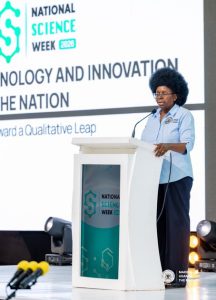
She said the country has moved from theory to practical results. I do not come bearing a list of activities. I come bearing an account… of what we have built together as a nation and what now stands ready for the next stage,” she told attendees.
Dr Musenero revealed that Uganda’s science ecosystem had previously struggled to translate knowledge into economic value, citing weak commercialisation and limited industrial application. “The country was generating knowledge, but it was not translating into industries, products, exports, jobs, and national wealth,” she said.
She noted that one of the biggest challenges identified was what she described as a systemic disconnect. “We discovered… a phenomenon we had to name — the Black Box,” she explained. “It is the absence of awareness of how Science, Technology and Innovation create economic value.”
Despite these challenges, the Minister highlighted significant achievements, including growth in local manufacturing, pharmaceuticals, electric mobility, and space science. “The total productive capability that now exists in Uganda’s STI ecosystem… is valued at USD 1.52 billion,” she said. “That is 4.5 times what the Government invested to create it.”
She added that the sector has already created jobs and reduced import dependence. “More than 150,000 Ugandans now hold employment… because of work that simply did not previously exist,” she noted.
Dr Musenero also emphasised the link between science and national independence. “This is the difference between a country that waits and a country that produces,” she said. “Most importantly, it means sovereignty.”
Looking ahead, she acknowledged that more work is needed, particularly in funding and commercialisation. “The runway has been built. The takeoff has not yet happened,” she said. “It is time for takeoff.”
President Museveni echoed a similar message to young Ugandans, urging them to embrace science and innovation as a pathway to prosperity. “Do not fear science. Master it. Do not only consume technology. Produce it. Do not wait for jobs. Build enterprises,” he said.
National Science Week is expected to bring together scientists, innovators, policymakers, and private sector players to showcase Uganda’s progress and explore pathways for accelerating science-driven economic transformation.