


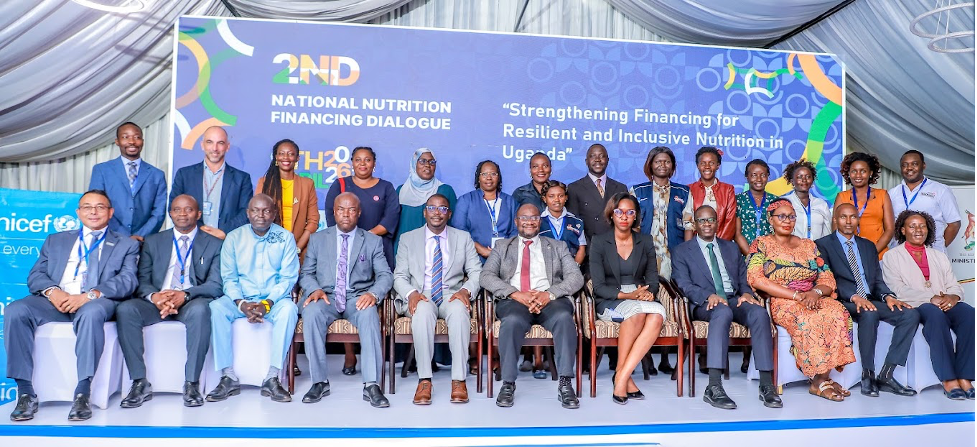
Uganda has convened the second National Nutrition Financing Dialogue as part of ongoing efforts to address persistent malnutrition and strengthen funding for nutrition-related interventions.
During the dialogue, stakeholders highlighted malnutrition as a critical national challenge, noting that child food poverty continues to limit access to safe, diverse, and nutritious diets. They emphasised the need to scale up nutrition-specific interventions while transforming food systems to make healthy diets both accessible and affordable.
Robin Nandy, the UNICEF Representative in Uganda, called for stronger commitment to domestic financing, describing it as essential for sustainable progress.
“While Uganda has demonstrated strong commitment through policy and multi-sectoral frameworks, financing remains a major bottleneck. This underscores the need for sustainable domestic funding,” he said.
Despite Uganda’s demonstrated political will through policies and participation in global and regional initiatives such as the African Union’s Agenda 2063 and the East African Community Vision 2050, financing gaps continue to hinder the effective implementation and scale-up of nutrition programmes.
Joseph Enyimu, Commissioner for Economic Development, Policy and Research at the Ministry of Finance, Planning and Economic Development, noted that although the proportion of Uganda’s population affected by hunger has declined in the past six months, the trend contrasts with a sharp rise in hunger levels across Africa.
“The current situation remains unacceptable for affected children and their families. We need to accurately identify and leverage opportunities to accelerate these improving trends,” he said.
Uganda is currently implementing its nutrition action plan, which requires an estimated Shs3.3 trillion to operationalise the second Uganda Nutrition Action Plan (UNAP II).
On behalf of Prof. Pamela Mbabazi, Executive Chairperson of the National Planning Authority, as the guest of Honor, Mr Bwengye Grace noted, “One central message is: Nutrition financing does not work alone. It stands on other pillars of nutrition governance. Financing works best where there is policy clarity, institutional coordination, clear roles, functioning delivery systems, strong data, and accountability.”
Jeremiah Nyagah, Country Director of World Vision, emphasised that nutrition remains central to the organisation’s mission of supporting vulnerable children and promoting sustainable human development under its 2026–2030 strategy.
He noted that the framework aims to improve the health and nutrition status of over five million children aged 0–18 years, with a strong focus on improving dietary intake.
“This strategic direction is reinforced through the ‘Enough Campaign’ launched in 2024, which seeks to end hunger and all forms of malnutrition through coordinated multi-sectoral action,” he said.
Stakeholders at the dialogue collectively called for increased domestic resource mobilisation, stronger partnerships, and innovative financing approaches to ensure sustainable progress in tackling malnutrition in Uganda.