


Johannesburg — Qualcomm Incorporated has announced the selection of 10 African startups for the 2026 cohort of its Qualcomm® Make in Africa Mentorship Program, a flagship initiative under the Qualcomm Africa Innovation Platform aimed at accelerating deep-tech innovation across the continent.
The program supports early-stage innovators building solutions in artificial intelligence, Internet of Things (IoT), edge computing, and advanced connectivity. It provides equity-free mentorship, technical training, and product development support to help startups scale technologies designed for African markets.
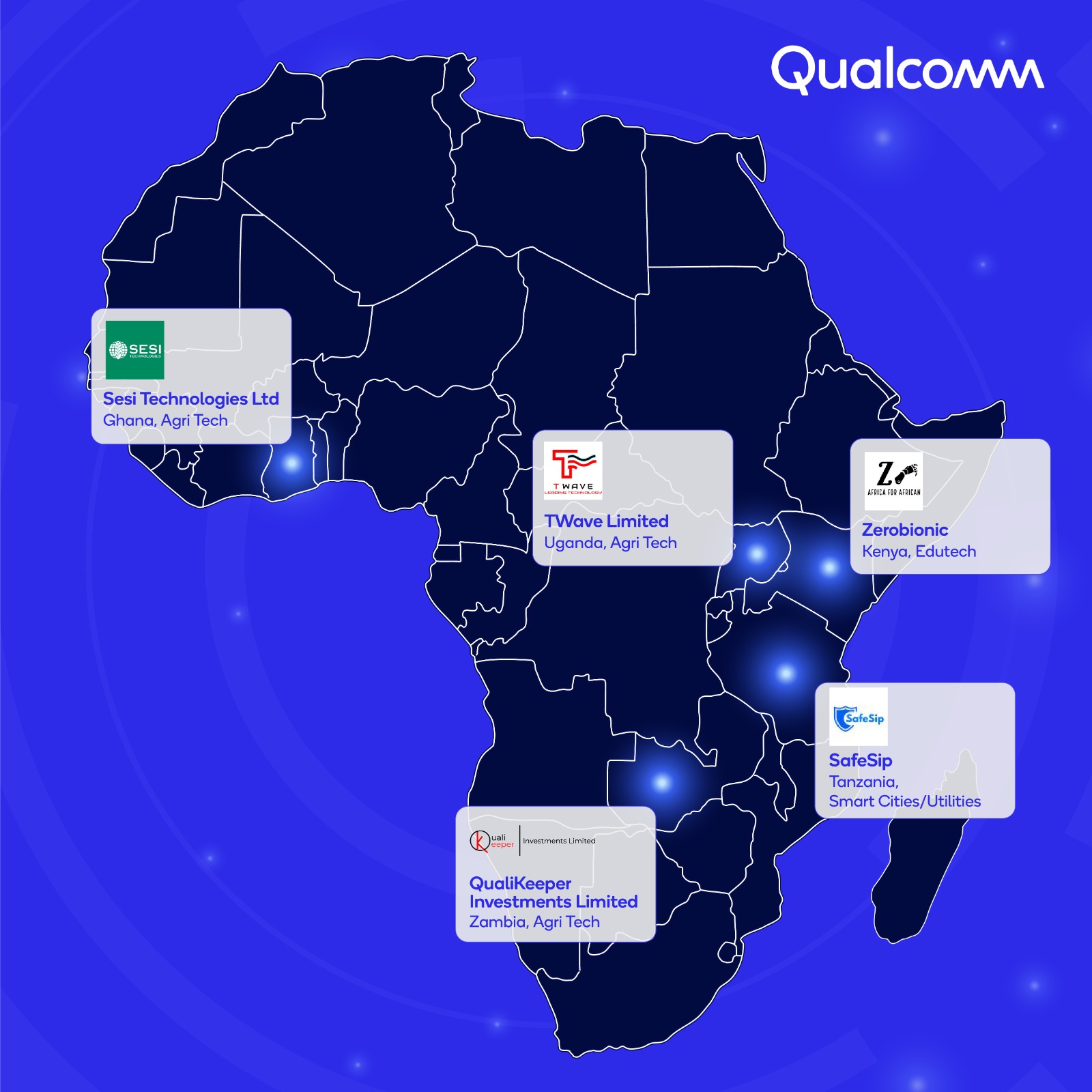
Among this year’s selected innovators is Uganda’s TWave Ltd, recognised for its automated, solar-powered fish feeding system designed to optimise aquaculture productivity—an innovation positioned to address inefficiencies in fish farming and improve food security in Uganda and beyond.
Uganda’s TWave Ltd: Smart aquaculture meets clean energy
TWave Ltd’s solution integrates automation, solar energy, and smart monitoring to regulate fish feeding cycles in aquaculture farms. The system is designed to reduce feed waste, lower operational costs, and improve yield consistency for fish farmers, particularly in off-grid and rural areas where energy access remains limited.
By combining IoT-enabled automation with renewable energy, TWave’s technology reflects a broader shift toward climate-smart agriculture and precision farming in Africa’s growing aquaculture sector.
Qualcomm highlights rising sophistication of African startups
Announcing the cohort in Johannesburg, Qualcomm emphasised the increasing technical depth of African innovation.
“This year’s startups’ achievements are a powerful testament to Africa’s flourishing innovation ecosystem,” said Wassim Chourbaji, President, Middle East and Africa, Qualcomm. “These startups are pushing the boundaries of what technologies such as Edge AI and 5G can enable, and how they can be deployed at scale across the continent.”
Chourbaji noted that the Make in Africa program has evolved into a platform supporting startups from ideation to commercialisation, with growing emphasis on scalable, real-world impact.
Edge AI, IoT, and commercialisation support
The 2026 cohort was selected from more than 1,200 applications across 45 African countries, reflecting strong competition and rising demand for advanced technology incubation.
Participants will receive free edge-AI capable platforms from Arduino, alongside 1:1 technical mentorship and business coaching. “Arduino® UNO™ Q and the upcoming Arduino® VENTUNO™ Q give the 2026 Qualcomm Make in Africa cohort a fast path from idea to intelligent machine,” said Fabio Violante, Vice President and General Manager of Arduino, Qualcomm Technologies Inc. “By bringing perception, decision-making, and actuation onto a single, affordable board, founders can prototype and deploy edge‑AI solutions directly where challenges exist — in farms, clinics, factories, and cities.”
They will also access engineering consultations for product development and guidance on protecting intellectual property. This includes patent filing consultation from Adams & Adams, Africa’s leading IP law firm, and free IP courses through L2Pro Africa – an IP e-learning platform designed to empower startups, SMEs, and researchers in Africa to protect, secure, and maximise their innovations.
At the end of the mentorship cycle, startups will be eligible for the Social Impact Fund through Qualcomm for Good, supporting societal and market impact through wireless technology. All participants will also receive a $5,000 stipend upon successful program completion. Finally, those who file patents during the program can claim up to $5,000 in filing fee reimbursements.
Other startups in the 2026 cohort
The program also includes innovators across agriculture, mobility, health, and assistive technology:
Amperra Charging Company (Namibia): AI-driven EV charging platform for scalable electric mobility
Anatsor Ltd (Nigeria): Digital poultry management system improving farm productivity
D-Olivette Labs (Nigeria): Agricultural bio-intelligence analytics platform
Mindora Corporation (Zimbabwe): Braille keyboard solution for digital accessibility
MVUTU (Congo): Solar-powered IoT cold storage system reducing post-harvest loss
QualiKeeper Investments Ltd (Zambia): AIoT livestock monitoring for rural farmers
SafeSip (Tanzania): Smart water monitoring system for safe drinking water access
Sesi Technologies Ltd (Ghana): AI cocoa quality assessment tool for supply chains
Zerobionic (Kenya): Assistive robotics for persons with disabilities.
African Telecommunications Union backs program
The African Telecommunications Union (ATU), a long-standing partner, reaffirmed its support for the initiative, emphasising its alignment with Africa’s digital transformation agenda.
“The ATU’s key mandate is to ensure that Africa’s telecommunications ecosystem serves Africa’s people. Qualcomm Make in Africa embodies that same principle by putting cutting-edge technology directly in the hands of African innovators,” said Secretary General John Omo.
Building Africa’s next generation of tech infrastructure
Now in its fourth year, the Qualcomm Make in Africa program continues to position itself as a launchpad for African deep-tech startups working at the intersection of AI, connectivity, and sustainability.
For Uganda’s TWave Ltd, inclusion in the 2026 cohort signals growing continental recognition of homegrown innovation in agriculture technology—particularly solutions that combine renewable energy and digital automation to transform traditional farming systems.
As Africa’s startup ecosystem becomes increasingly competitive and technologically advanced, initiatives like Make in Africa are shaping a new narrative: one where African-built technologies are designed not only for local challenges but for global scalability.