



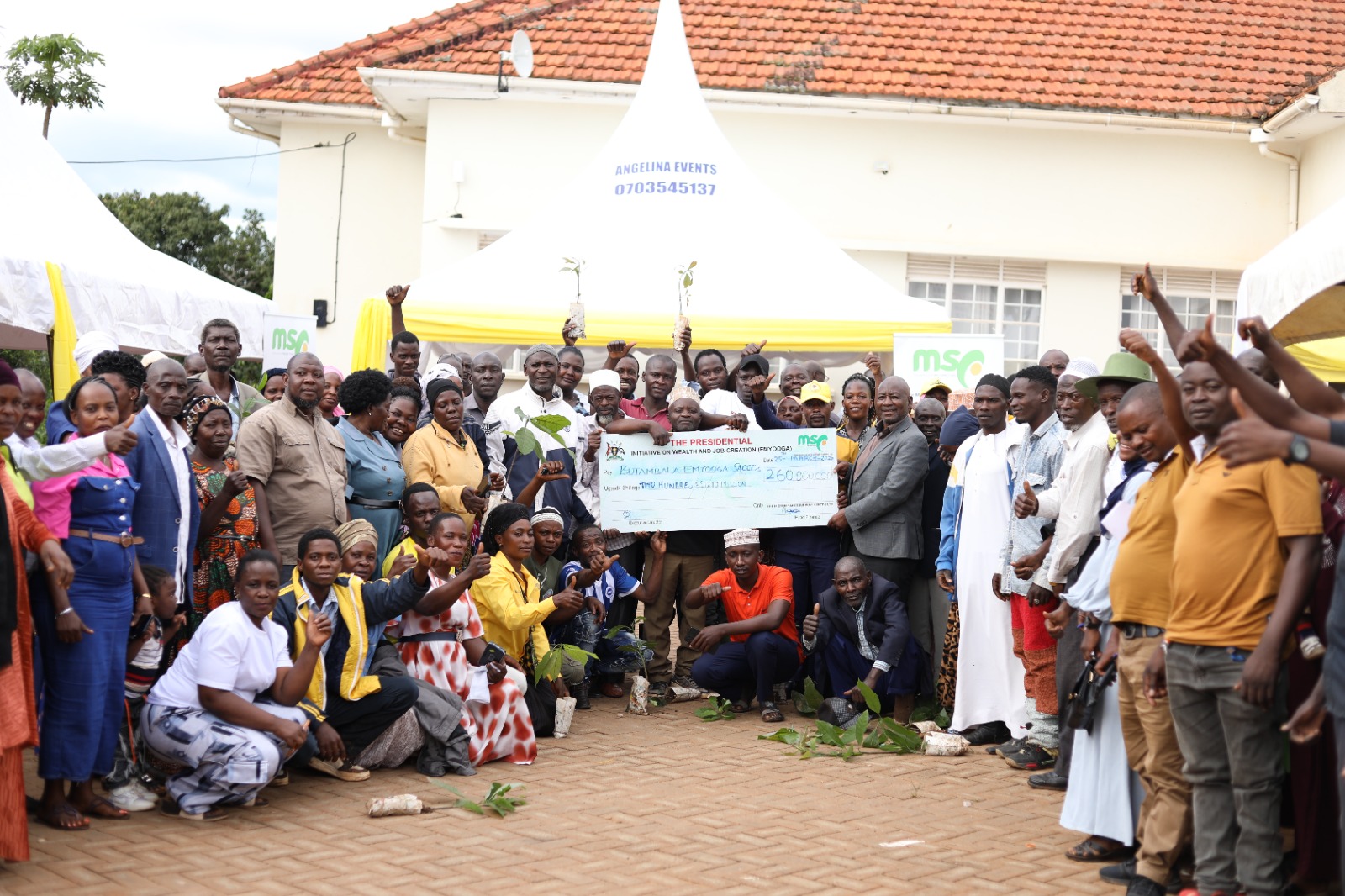
Butambala — The Microfinance Support Centre (MSC) Ltd carried out a dual initiative in Butambala District on Wednesday, March 25, 2026, combining financial empowerment through EMYOOGA SACCOs and environmental conservation via tree planting at St. Charles Lwanga Kayenje Catholic Day and Boarding Primary School.
EMYOOGA SACCOs Seed Capital Injection
MSC handed over a Shs260m dummy cheque to EMYOOGA Savings and Credit Co-operative Organisations (SACCOs) as additional seed capital, aiming to boost enterprise expansion, job creation, and grassroots wealth generation.

Speaking during the handover, Hajj Moses Ddumba, Resident District Commissioner (RDC) of Butambala, urged beneficiaries to manage the funds prudently. “You should know how much you earn to learn to save. Don’t spend more than what you earn.”
He urged them to invest wisely in development projects rather than wasting money on luxurious lifestyles. “I employ you to use the money for development investments, not fancy things. Be patient and use the money wisely,” he said.
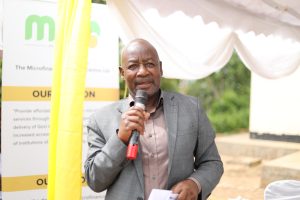
Lubega Faisal, the Butambala District Commercial Officer, highlighted progress in wealth-creation initiatives, including EMYOOGA.
“Butambala has one constituency with 18 EMYOOGA SACCOs, which received Shs560m seed capital when the program started. In 2025, 10 to 11 SACCOs received an additional Shs220m. This year, 13 SACCOs are receiving Shs260m more, with the expectation that it will be used effectively to improve livelihoods,” he explained.

Faisal emphasised the purpose of the funds: “The idea is simple: plant the seed, let it grow, harvest, and return part of it for others to benefit. SACCO leaders must ensure timely recovery and proper use so that the entire community in Butambala gains from this intervention.”
Joseph Baraza, Regional Manager for Central Uganda at MSC, explained the dual nature of their visit. “On behalf of the government, we released Shs260m to benefit 13 EMYOOGA SACCOs, each receiving Shs20m as directed. We encouraged the recipients to use the funds wisely, grow membership, and ensure loans are repaid.”

He added, “These are member SACCO funds, not money to be returned to government coffers. Government has committed to providing an additional Shs20m annually, provided these funds are well managed.”
The EMYOOGA program, launched in August 2019, is a presidential initiative aimed at transforming 68% of Ugandan homesteads from subsistence to market-oriented production.

The program targets: (i) Boda-boda riders, (ii) women entrepreneurs, (iii) carpenters, (iv) salon operators, (v) taxi operators, (vi) welders, (vii) market vendors, (viii) restaurant owners, (ix) youth leaders, (x) persons with disabilities, (xi) produce dealers, (xii) mechanics, (xiii) tailors, (xiv) performing artists, (xv) veterans (veterans’ widows and children), (xvi) fishermen, (xvii) elected local leaders and (xviii) journalists.
Individuals join parish-level associations that federate into constituency SACCOs, from which members borrow at low interest rates. Successful SACCOs demonstrating good governance and loan recovery can qualify for additional seed capital of Shs20m.

Tree Planting at St. Charles Lwanga Kayenje Primary School
Alongside the fund release, MSC conducted a tree planting exercise, handing over 800 fruit trees to St. Charles Lwanga Kayenje Catholic Day and Boarding Primary School in Kayenje Ward, Gombe Town Council, in line with their Corporate Social Responsibility (CSR) Mandate – Environment and engaging Children.
During the ceremony, RDC Hajj Ddumba emphasised the importance of growing trees. “Our message is about growing trees,” he said. “We are focusing on instilling this message in the younger generation, especially primary school pupils, so they can take responsibility for planting and caring for trees. They can also share this knowledge with their communities and relatives, highlighting the benefits of a well-covered environment with trees.”

He urged a return to older practices controlling tree cutting. “Even if a tree is yours, there used to be laws requiring permission before cutting it. This ensured new trees were planted and forest cover was maintained. It’s not just about planting trees—it’s about growing them. You must care for the tree from its infancy until it matures and begins bearing fruits. This approach ensures environmental sustainability and long-term benefits for everyone.”
Jacob Aoru, Headteacher of St. Charles Lwanga Kayenje School, expressed gratitude to MSC for selecting the school as a model. “Previously, we taught children about trees theoretically. Now, they can plant, nurture, and grow trees themselves. They will also benefit from the fruits, which provide essential vitamins and promote health.”

He added: “Our teachers and school pledge to protect these trees, and our children will enjoy the fruits. This initiative has simplified our teaching and created practical experiences for our learners.”
Nakawungu Mastula, Butambala District Environment Officer, stressed the need for community conservation. “It’s not just about planting trees but also growing and nurturing them. This includes applying fertilisers and protecting them from animals.”

She added, “My appeal is for re-afforestation and agroforestry, integrating tree planting with agricultural activities. Whenever a tree is cut, it should be replaced to maintain forest cover.”
Agnes Namakula, a Primary Seven pupil, pledged to care for the trees. “I am going to water the trees every day and take good care of them so that they grow. Trees provide shade to people, help in rain formation, provide fruits, and reduce carbon dioxide in the air. That is why it is important to care for them,” she said.
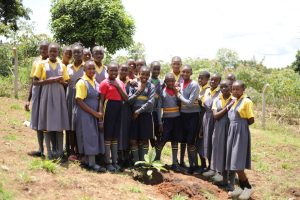
On his part, Baraza highlighted the dual purpose of MSC’s initiative. “Climate change is a global issue, and environmental degradation through deforestation and wetland encroachment is a concern. Most of what children learn in class about trees and rainfall is theoretical.”
He added, ”Today, we provided fruit-bearing trees and encouraged them to plant and nurture them. We hope to instil a culture of environmental responsibility so that climate change and environmental degradation can be addressed in the future.”
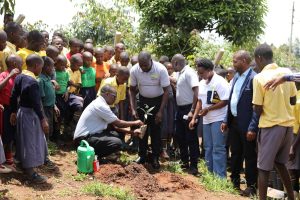
The initiative underscores MSC’s broader strategy of combining financial inclusion through EMYOOGA with environmental sustainability, ensuring that both economic empowerment and ecological responsibility are promoted at the grassroots level.