


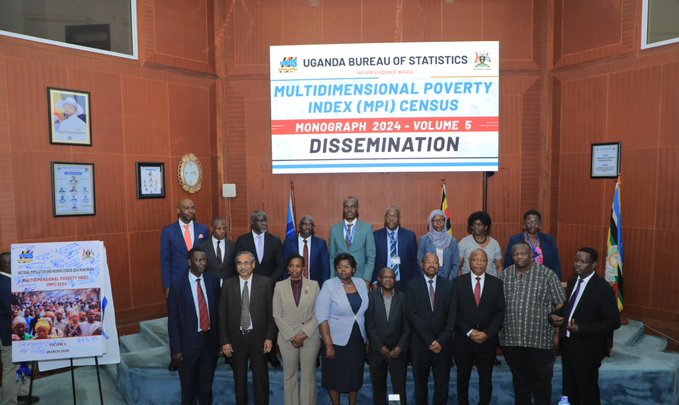
The Minister of State for Planning, Hon. Amos Lugoloobi, today officially launched the Multi-Dimensional Poverty Index (MPI) Census Monograph 2024 – Volume 5, produced by the Uganda Bureau of Statistics (UBOS), highlighting the persistent challenges of multidimensional poverty despite significant progress in reducing income poverty over the years.
Addressing dignitaries and stakeholders at the launch, Hon. Lugoloobi said while Uganda has reduced income poverty to 16.1 percent in FY 2023/24 from 56 percent in 1992/93, “we continue to face the challenge of multidimensional poverty, which affects health, education, living standards, and access to basic services”.
He added that the new indicators in the MPI Monograph would help the government better plan and target interventions to close gaps in deprivations across regions.
“I thank UBOS for producing this report that digs deeper into the complex nature of poverty and its dimensions. Quality statistics are central for planning, policy formulation, and evaluating national programmes, including the National Development Plan. Without reliable data, it is impossible to assess progress meaningfully,” Hon. Lugoloobi said.
The MPI Monograph shows that 27 percent of Ugandans are multidimensionally poor, with rural areas worse affected (31.5%) compared to urban areas (27%).
The study also highlights significant regional disparities: Karamoja subregion has the highest MPI at 56.9 percent, followed by West Nile at 39 percent and Sebei at 33.5 percent, while Kampala remains the lowest at 8.8 percent. At district level, Kaabong recorded the highest MPI at 63.9 percent, reflecting deep-seated structural deprivation.
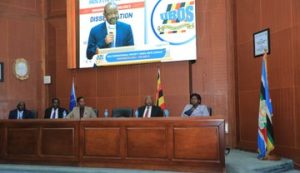
“This report provides a deeper understanding of poverty beyond income alone and offers evidence-based options for addressing its complex dimensions,” Hon. Lugoloobi said.
The minister urged all stakeholders, including government, the private sector, and academia, to utilise the data to strengthen programmes and improve the quality of life for all Ugandans.
He emphasised that infrastructure investments in industrial parks, roads, electricity, and rail networks are key to driving inclusive growth and job creation.
UBOS Executive Director, Dr Chris N. Mukiza, explained that the MPI Monograph is part of a series of thematic publications from the National Population and Housing Census (NPHC) 2024, including reports on population projections, sub-regional profiles, disability, and vulnerable children.
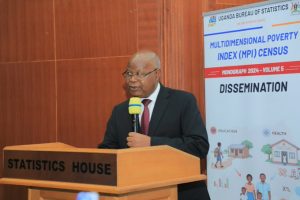
“Poverty is not only monetary. Losing a child to unclean water, lack of representation, and limited access to basic freedoms all contribute to the multidimensional poverty experience. This MPI Census Monograph will give us critical indicators to support progress towards SDG-1 on eliminating poverty in all its forms,” Dr Mukiza said.
He emphasised that the data equips policymakers with up-to-date information to design targeted strategies addressing specific dimensions of poverty.
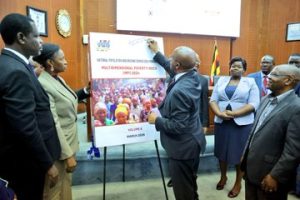
Representing the UBOS Board, Ms Irene Birungi Mugisha noted that reliable data is not only a technical requirement but a strategic national asset. “It enables government, the private sector, and all stakeholders to make informed decisions that improve livelihoods. Quality statistics have been instrumental in supporting the success of government programmes from NDP I through to NDP IV.”
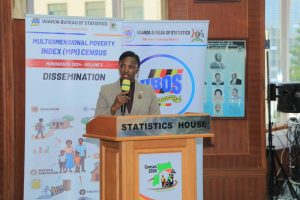
Dr Thangavel Palanivel, Chief Strategy & Policy Unit and Senior Economic Advisor at UNDP Uganda, highlighted the MPI’s role in aligning national development priorities with the Sustainable Development Goals.
“The MPI is not merely a measurement tool but a driver of human development. It identifies who is being left behind, where, and in what ways, while guiding more targeted, equitable, and responsive policy interventions and resource allocation,” he said.
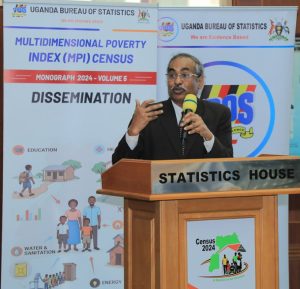
Dr Palanivel reaffirmed UNDP’s commitment to supporting Uganda in areas such as human development analytics, poverty diagnostics, governance reforms, and climate-resilient livelihoods.
The World Bank’s Economist, Dr John Ilukol, commended UBOS for providing robust data for policy and programming. “While income has traditionally been a key measure of poverty, the MPI Monograph provides a broader and more comprehensive understanding of poverty across its various dimensions,” Dr Ilukol said.
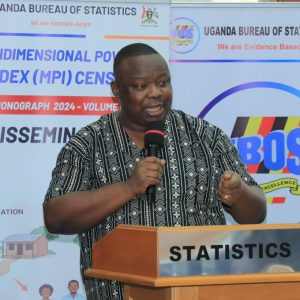
He added, “We will use this data not only as a publication but as a dataset to guide programme design, beneficiary targeting, and efforts towards shared prosperity.
Key findings from the MPI Monograph include:
National MPI stands at 27%, with rural areas at 31.5% and urban areas at 27%. Female-headed households have a higher MPI (28.9%) than male-headed households (26.2%). Child-headed households experience the highest multidimensional poverty at 36%.
Households headed by individuals with no formal education face an MPI of 43.5%, compared to 8.2% for those with post-secondary education. Karamoja remains the hardest-hit subregion at 56.9%, with Kampala recording the lowest at 8.8%.
Presenting the findings, Stephen Baryahirwa (Head of Department, Social Surveys and Censuses) and Elemiah Muhondogwa, Statistician, Labour Statistics, emphasised that Kaabong district has the highest MPI at 63.9%, highlighting critical areas for intervention.
Representing Parliament, Hon. Geoffrey Ekanya, MP for Tororo North County, observed that poverty trends across regions such as Karamoja, Bukedi, and West Nile have remained consistent over time. “Statistics are critical in informing policy and budgeting, as seen in past interventions targeting infant mortality and gender disparities.”
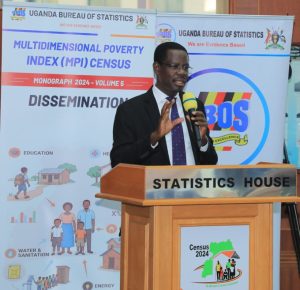
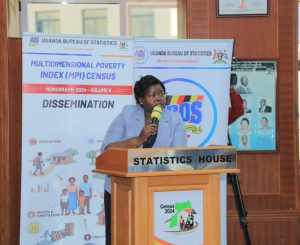
Hon. Faith Nakut, Woman MP for Napak District, echoed the need for targeted interventions:
“Napak remains among the districts most affected by multidimensional poverty, with 56 out of every 100 people experiencing its effects. While the government has invested significantly in poverty reduction programmes, outcomes remain limited, underscoring the need for more effective interventions.”
The launch concluded with a reaffirmation of the government’s commitment to leveraging MPI data for planning, guiding targeted interventions, and ultimately reducing multidimensional poverty across Uganda.