


As global conversations on gender equity intensify, Uganda is positioning itself not merely as a participant in the discourse, but as a contributor of policy experience drawn from its own governance reforms.
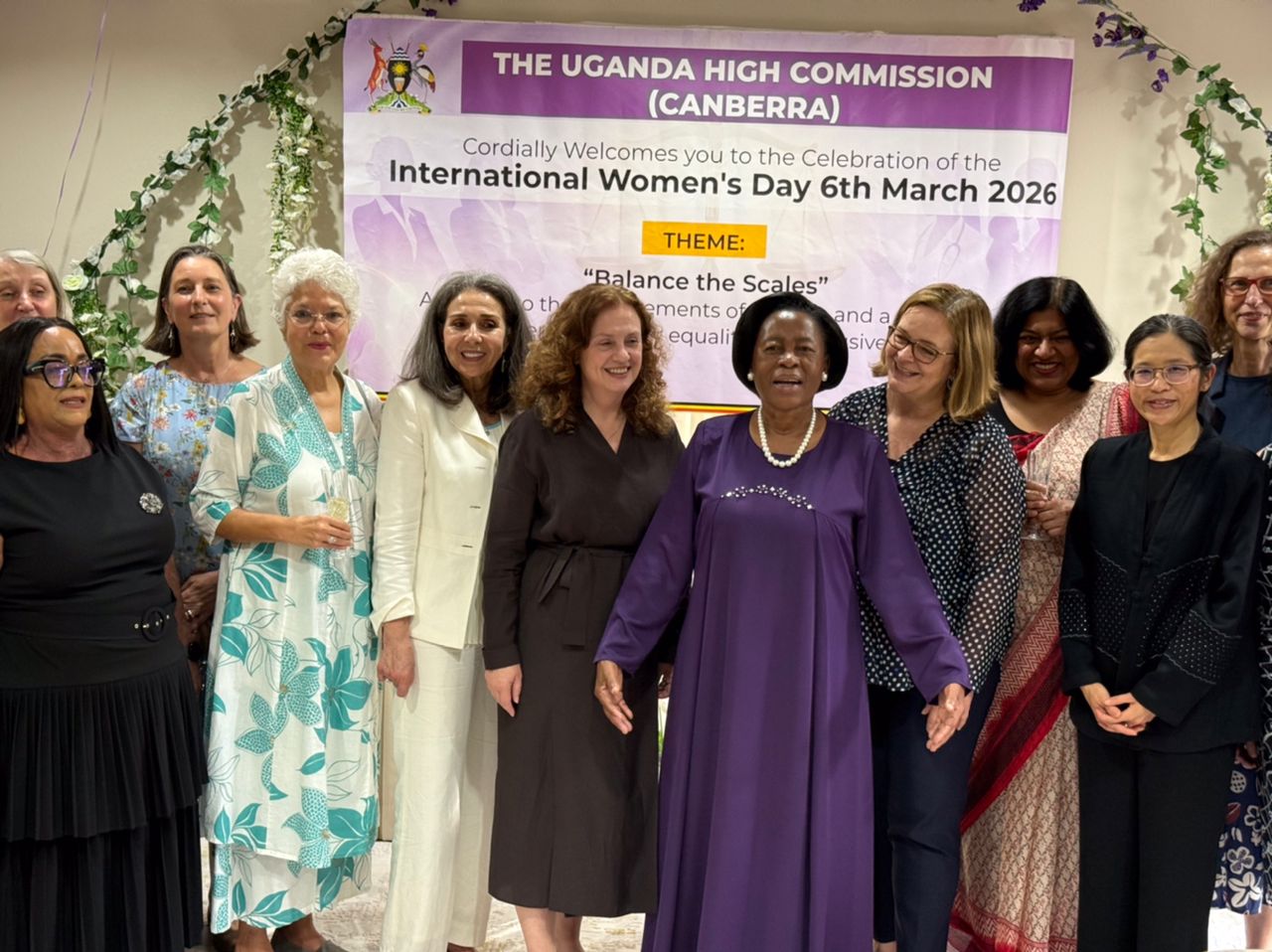
At a diplomatic reception held at the Residence of Uganda’s High Commissioner in Canberra under the theme “Balancing the Scales,” the spotlight extended beyond advocacy. It turned toward policy architecture.
Uganda’s affirmative action frameworks for the girl child and women were presented not simply as domestic commitments, but as models with relevance beyond national borders.
In her remarks, the High Commissioner highlighted Uganda’s constitutional and legislative provisions that have expanded representation for women in political structures, strengthened access to education for the girl child, and institutionalized inclusion across public service systems.
These measures, she noted, are not symbolic gestures but structural safeguards designed to widen participation in national development.
By foregrounding these reforms in a diplomatic setting attended by more than 15 ambassadors and high commissioners, Uganda signaled confidence in its governance trajectory. The message was clear. African nations are not only recipients of international frameworks on gender equity. They are innovators within them.
Across the continent, a new generation of governance reforms has emerged, focused on inclusion, institutional strengthening, and demographic leverage.
Uganda’s affirmative action model forms part of this broader African evolution, where policy mechanisms are increasingly tailored to local realities while aligned with global standards.
The global relevance of this positioning lies in scalability. Countries grappling with representation gaps and structural inequality are searching for workable frameworks.
Uganda’s experience offers insight into how affirmative measures can be embedded within constitutional order and administrative practice without destabilizing governance systems.
The Dean of the Diplomatic Corps in Australia, Betty Pavelich, Ambassador of Croatia, underscored the importance of inclusive leadership in fostering stability.
Her caution that global turbulence is often linked to imbalanced representation reinforced the strategic value of models that institutionalize participation.
For Uganda, presenting its affirmative action framework in this forum reflects a national outlook grounded in policy confidence. It communicates that the country is prepared to share lessons, exchange best practices, and contribute to the refinement of global governance conversations.
In an era where African narratives are increasingly defined by agency rather than dependency, Uganda’s approach illustrates a shift from passive alignment to active contribution.
The country’s reforms for the girl child and women are framed not only as domestic progress but as part of a continental and global dialogue on inclusive development.
By elevating affirmative action from local policy to diplomatic discourse, Uganda signals that it is not simply benefiting from global gender conversations. It is helping to shape them.