


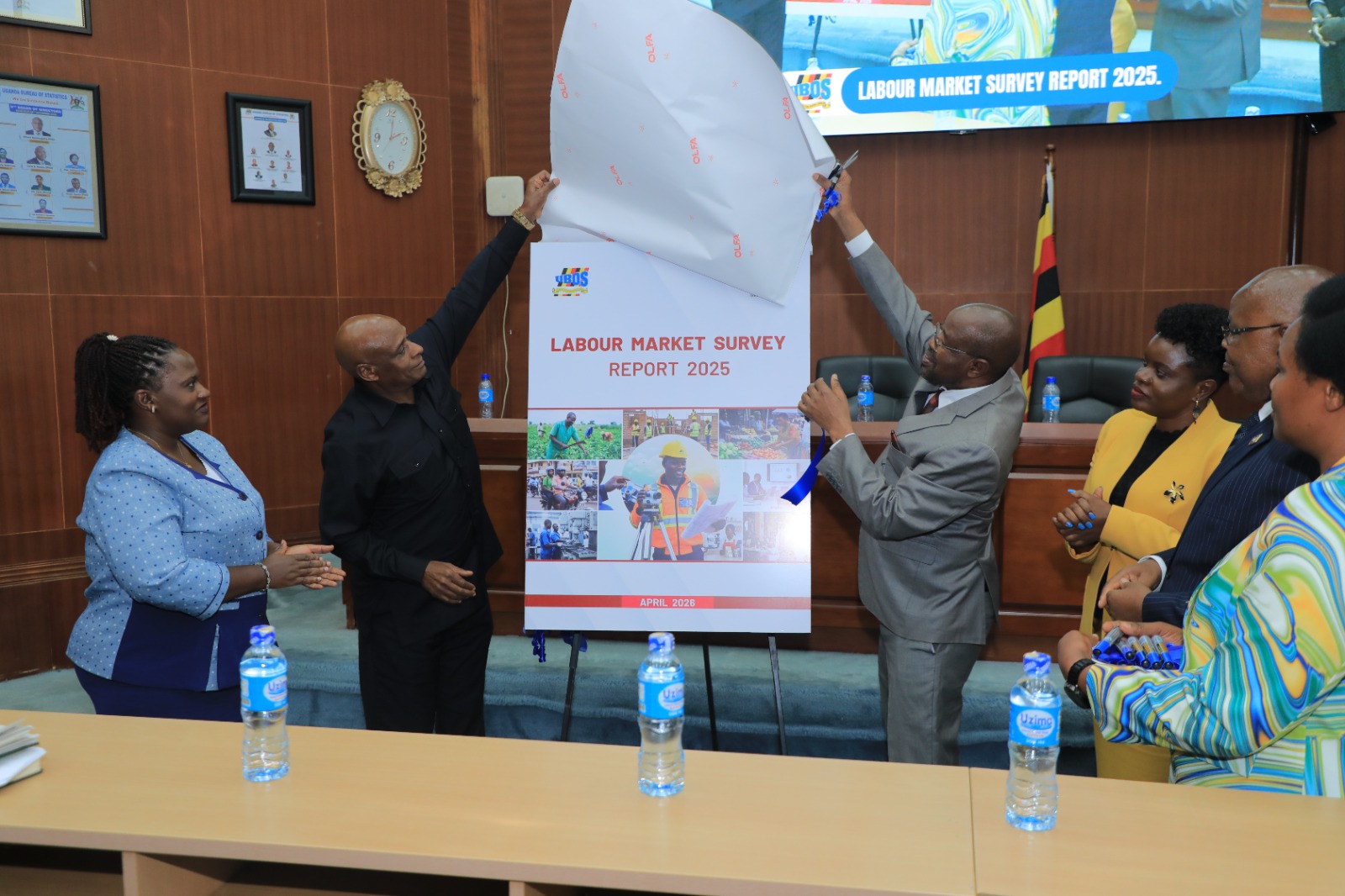
Kampala — The Uganda Bureau of Statistics (UBOS) has released the Labour Market Survey (LMS) 2025 report, offering a detailed snapshot of Uganda’s employment landscape, job creation patterns, and persistent informality in the labour market.
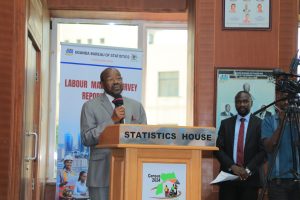
Presenting the findings at Statistics House in Kampala, the Executive Director of UBOS, Chris N. Mukiza (PhD), said the new survey responds to the growing need for more frequent and timely labour data in a rapidly changing economy.
“The Uganda Bureau of Statistics has, over time, compiled labour statistics through the National Population and Housing Census, the National Labour Force Survey, and the Uganda National Household Survey,” Mukiza said. “However, recognising the fast-changing nature of Uganda’s labour market, UBOS, with funding from the Government of Uganda, initiated the nationwide Labour Market Survey in 2025.”
He added that the LMS 2025 covered households, informal establishments, and formal establishments to better understand labour supply and demand dynamics.
“This report presents the status of labour market indicators on employment, unemployment, job creation, job loss, job vacancies, and other dynamics shaping Uganda’s labour market,” Mukiza said.
Key labour findings
According to UBOS, 57.6% of Ugandans aged 14–64 fall within the working-age population, with males slightly higher at 58.8% compared to females at 56.2%.
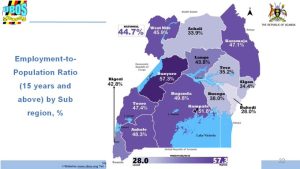
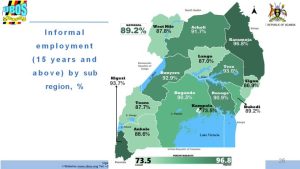
The Employment-to-Population Ratio (15 years and above) was highest in the Bunyoro sub-region and lowest in Bukedi, indicating significant regional disparities in job access.
The report also highlights persistently high informality in employment across the country. Karamoja leads with 96.8% of workers in the informal sector, followed by Kigezi (93.7%), Teso (93.0%), and Bunyoro (92.9%), while Kampala records the lowest at 73.5%.
Services sector dominates employment
The survey shows that Uganda’s services sector remains the largest employer, accounting for 50.5% of total employment.

The sector employs more females (56.4%) compared to males (46.3%). Agriculture, forestry, and fishing follow at 37.1%, employing 36.7% males and 37.4% females. The industry sector employs 12.4% of the workforce.
UBOS noted that informality remains particularly high even outside agriculture, standing at 87.6% among the working-age population and 91.5% among youth aged 18–30.
The Minister of State for Planning, Amos Lugoloobi, emphasised the importance of the data in shaping government employment policy and interventions.
Uganda currently has an estimated 7,350,199 employees and 305,364 job vacancies, signalling both employment growth and persistent labour absorption challenges.
UBOS also highlighted structural challenges affecting data collection and labour market efficiency, including non-responsive employers and restricted access to industrial parks.
“The Labour Market Survey provides critical insights into the demographic, occupational, and socio-economic characteristics of individuals and enterprises engaged in the production of goods and services,” UBOS noted.
The Bureau urged policymakers, researchers, and development partners to use the findings to strengthen employment-focused planning and inclusive growth strategies.
UBOS emphasised that the LMS will complement existing data systems, including the National Population and Housing Census (conducted every 10 years), the National Labour Force Survey (every 5 years), the Uganda National Household Survey (every 3 years), and the 2015 Manpower Survey.
According to Minister Lugoloobi, the government will continue improving labour statistics to support national development priorities aligned with full employment and decent work objectives.