


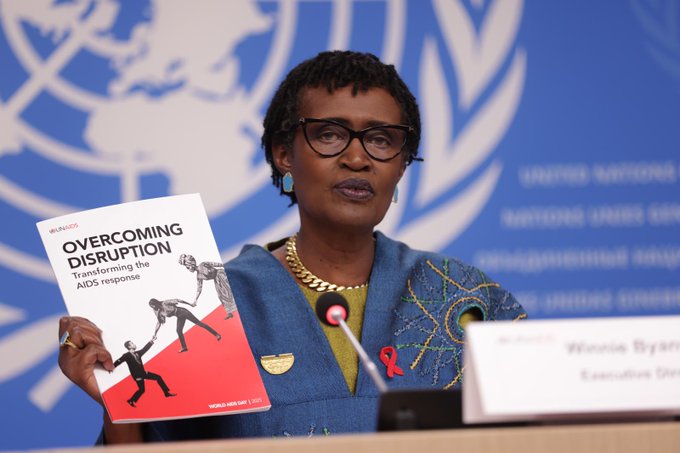
Kampala / Geneva – UNAIDS Executive Director Winnie Byanyima has described 2025 as a year of “profound disruption and deep uncertainty” for the global HIV response, but said it also revealed extraordinary resilience, solidarity and hope for ending AIDS.
In her end-of-year reflections released on December 30, 2025, Byanyima said sharp declines in international funding severely disrupted HIV services, forcing clinic closures, job losses among health workers and interruptions in treatment and prevention programmes.
“For several years, international HIV and development funding has been declining. Then, suddenly, at the beginning of this year, it collapsed,” Byanyima said. “People living with and at risk of HIV were lost to treatment and prevention services.”
Despite these setbacks, she said communities and governments stepped up, proving that progress is still possible when there is collective action.
“Throughout this year, I have been amazed at the resilience and determination of communities and governments,” she said. “That is the future of the HIV response: nationally owned, community-led, multisectoral and sustainable.”
UNAIDS Undergoing Painful Transition
Byanyima revealed that UNAIDS is undergoing a major restructuring as part of a broader transition, which has already resulted in the loss of many staff members.
“This has been a painful transition,” she said. “We have lost many colleagues who dedicated their working lives to the HIV response. We thank them wholeheartedly for their unrelenting commitment.”
She said the next phase will involve handing over some UNAIDS functions to other UN agencies, governments and regional bodies, stressing that the process must be carefully managed.
“The message from member states and communities was clear – we need a responsible and planned transition that safeguards gains and builds a more resilient HIV response,” she noted.
Inequality Still Driving the HIV Epidemic
Byanyima said inequality remains one of the biggest drivers of HIV globally and warned that the world is facing what she described as an “inequality-pandemic cycle”.
“Inequalities push people away from services, leading to deadlier and longer health crises that deepen inequalities further,” she said.
She highlighted recent work with the Global Council on Inequality, AIDS and Pandemics and the G20 Extraordinary Committee on Inequality, saying their findings showed inequality is harming public health, weakening economies and undermining democracy.
“We are in an inequality emergency,” Byanyima said, calling for urgent debt relief, tax justice and stronger multilateral cooperation to help low- and middle-income countries invest in health.
Communities and Human Rights at the Centre
The UNAIDS chief emphasised that communities most affected by HIV remain central to the response, including women, young people, LGBTQ+ communities, sex workers and people who use drugs.
“Communities know what works. They know how to reach people that governments cannot,” she said. “We must protect them, fund them and follow their leadership.”
However, she warned of a growing global backlash against human rights and gender equality, which she said threatens progress in the fight against HIV.
Hope for an HIV Prevention Breakthrough
Looking ahead, Byanyima said scientific innovation could still transform HIV prevention if access is made affordable and equitable.
She pointed to progress on long-acting HIV prevention medicines, including lenacapavir, which can be administered as an injection twice a year.
“When I started this year, lenacapavir cost as much as $40,000 per person per year,” she said. “Today, $40 lenacapavir is becoming a reality. This is a huge step towards global access.”
However, she cautioned that many countries, particularly in Africa and Latin America, remain excluded from generic production agreements.
“We have to get this right,” she said. “Otherwise, this prevention revolution could fall from our grasp.”
Message for 2026
As the world heads into 2026, Byanyima said a path to ending AIDS as a public health threat remains open, provided the global community protects what has worked.
“A multisectoral response, led by communities, focused on human rights, spurred by innovation and underpinned by data – that is how we end AIDS,” she said.
She called on governments and global leaders to ensure that the upcoming UN Political Declaration on HIV/AIDS in 2026 reflects the urgency of the moment.
Ending her message on a hopeful note, Byanyima said: “In the face of funding cuts, communities told me, ‘We will not only live – we will thrive.’ It is that spirit of hope that can guide the HIV response to a safe landing.”