


On Saturday, August 22, 2026, Coca-Cola Beverages Uganda, an official partner of the English Premier League, organised watch parties at Millennium Park in Lugogo, Kampala.
That is where I watched Manchester United embarrass themselves in their 2026 Premier League opener against Hull City.
I watched the entire match shaking my head. I didn’t see anything remarkable worth talking about; neither did I hold my breath because a particular player had received the ball. There was no sense that something extraordinary was about to happen.
And that absence bothered me more than the result.
Manchester United had just embarrassed themselves, and I found myself asking a question I never expected to ask about football:
Am I witnessing the end of an era of football legends?
As a former Manchester United fan — and I say former deliberately — I have watched enough football to know that clubs lose matches, great teams collapse, heroes become villains and villains sometimes become heroes.
That is football.
It has always been cruel.
But this felt different.
I wasn’t simply angry with Manchester United.
Maybe I was grieving.
Not the loss of a match. Not even the decline of a football club I once loved. I was grieving something I could not immediately name: a kind of football in which certain players seemed larger than the game itself; men who could make a child abandon whatever he was doing, move closer to the television and wait because something — anything — might happen when the ball reached their feet.
Where did those players go?
Where did the gods of football go?
The Pioneers We Inherited
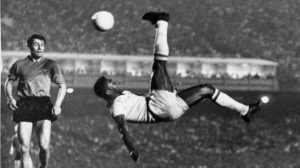
I wasn’t lucky enough to watch Edson Arantes do Nascimento, known to the world as Pelé, or Diego Maradona, in their prime.
By the time I was old enough to understand what football was, they had already crossed from the football pitch into history.
I encountered them differently: through grainy television footage, documentaries, newspaper photographs and stories told by people who had actually watched them.
Their greatest feats had already become mythology before I arrived.
I never watched Maradona’s 1986 World Cup run in real time; I never saw him receive the ball against England and embark on that impossible run, dribbling through the English defence before sending the goalkeeper the wrong way. I was not there when the goal was happening. I arrived later, when the goal had already become the Goal of the Century.
I never watched Pelé’s greatest performances either. His football belonged to a world that existed before my own football consciousness had awakened.
And they were not alone.
There were pioneers whose names belonged to an even earlier football universe: Garrincha. Eusébio. Ferenc Puskás. Johan Cruyff. Franz Beckenbauer. George Best. Bobby Charlton. Lev Yashin.
I never saw them sprint across a pitch.
I never saw their shirts soaked in sweat, their boots tearing through wet grass, or a goalkeeper stretching helplessly as one of their shots disappeared into the net.
I never found their faces inside the bubble-gum cards we children treasured.
They belonged to another generation.
Yet somehow, their ghosts were already waiting for us.
We inherited their legends before we inherited the technology that could show us their matches.
And perhaps that is how football used to work: one generation handed its heroes to the next through stories.
Pelé was not simply a footballer. He was Pelé.
Maradona was not simply an attacking midfielder. He was Maradona.
Their names had escaped the ordinary vocabulary of sport. They had become something closer to mythology: stories of extraordinary human beings who appeared, for a few years, to possess abilities the rest of us did not.
But there was something else about these pioneers.
They left us with an important inheritance: the idea that football could produce people who were larger than football itself.
And then my generation arrived.
My Generation Got Lucky
We did not merely inherit legends.
We got to watch ours unfold.
We saw them in colour. We watched them every weekend. We learned their faces, their hairstyles, their celebrations, their temperaments, their weaknesses and, most importantly, their weapons.
We grew up in a football universe populated by characters.
Not one homogeneous group of football geniuses, but several different species.
There were the defenders who could make an entire backline feel invincible.
There were midfielders who seemed to see spaces before they existed.
There were dead-ball artists who could turn a stationary ball into a weapon.
There were forwards who seemed to have made some private agreement with the goal.
And then there were the entertainers: players who could make a professional football pitch look like a schoolyard where the laws of physics were negotiable.
Maldini. Cafu. Roberto Carlos. Nesta. Cannavaro.
Zidane. Seedorf. Davids. Vieira. Gerrard. Scholes. Keane. Xavi. Iniesta.
Okocha. Ronaldinho. Ronaldo. Henry. Eto’o. Drogba. Batistuta. Raúl. Totti.
And then, standing at the far end of this extraordinary procession:
Lionel Messi.
Cristiano Ronaldo.
It is easy now to look at those names through statistics and rankings. Goals. Assists. Trophies. Appearances. Individual awards.
But that is not how I remember them.
I remember Maldini making me fall in love with Italian Serie A.
I remember Cafu and Roberto Carlos and feeling that if those two men were on the pitch, something about the football universe was under control.
I remember Okocha and the ridiculous stories local commentators told about his shots weighing almost 45 kilograms — nearly the weight of a bag of cement.
I remember Edgar Davids because of the goggles.
Michael Ballack made me love the German Bundesliga.
Raúl had the strange ability to make me move closer to the television and sit comfortably because I knew I was about to watch something worth watching.
And then there was Ronaldo Nazário.
That was my personal legend.
In 2002, when Brazil won another World Cup, I was a student in lower secondary school. I was so fascinated by Ronaldo that I cut my hair in his famous 2002 style and nearly got suspended from school.
That is how I remember football.
Not as a database.
Not as a collection of performance metrics.
As memory.
As characters.
As mythology.
And perhaps that is the first thing we have forgotten about football: before we learned to measure players, we learned to recognise them.
We knew them by the way they moved.
By the way they stood.
By the way they struck the ball.
By the strange things their bodies seemed capable of doing.
We knew them because, when the ball reached their feet, we stopped talking.
Something might happen.
The Guardians — The Goalkeepers Behind the Legends
Before the forwards became heroes, somebody had to stand behind them and keep the world from collapsing.
For my generation, goalkeepers were not merely the last line of defence. They were characters in their own right. Some looked like warriors. Others seemed to have discovered the secret of time. Some wore helmets. One of them took free kicks and penalties and seemed to regard the traditional definition of a goalkeeper as an administrative suggestion.
My favourites were Oliver Kahn, Edwin van der Sar, Petr Čech, Dida and José Luis Chilavert.
Five men.
Five different kinds of mythology.
Oliver Kahn — Der Titan
If there was one goalkeeper who embodied the footballer I remember from childhood, it was Oliver Kahn.
Der Titan.
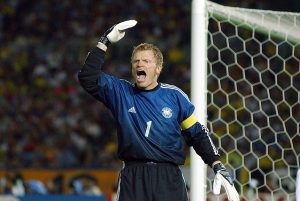
His defining tournament was the 2002 World Cup.
Germany reached the final, and Kahn seemed to be carrying them there almost by force of personality. Against the United States in the quarter-final, he produced save after save. Against South Korea in the semi-final, he again looked almost immovable.
Then came Brazil.
The final should have completed the mythology.
Instead, it gave us one of football’s cruellest images.
In the second half, Rivaldo’s shot struck Kahn’s hands and spilt loose. Ronaldo reacted first and scored.
Kahn had made an error.
For a goalkeeper who had spent almost the entire tournament looking invincible, the mistake was devastating.
But it did not destroy his legend.
It completed it.
Kahn still won the Golden Ball, the award for the tournament’s best player — an extraordinary distinction for a goalkeeper, especially one whose team had lost the final.
Think about what that means.
A goalkeeper had been so exceptional across a World Cup that even defeat could not erase his dominance.
And then there was the man himself.
Kahn did not merely guard a goal.
He seemed offended that anybody had come near it.
His face, his shouting, his aggression, the way he commanded the penalty area — he looked less like an employee of the goal and more like its appointed guardian.
That was why children remembered him.
You didn’t need his statistics.
You saw Der Titan and understood.
Edwin van der Sar — The Giant Who Seemed to Have Time
Van der Sar was almost the opposite.
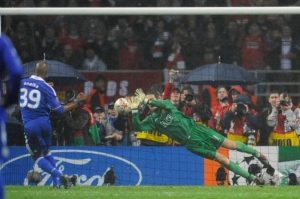
Where Kahn was fury, Van der Sar was composure.
Where Kahn appeared to fight the ball, Van der Sar often seemed to have already calculated where it was going.
His defining moment for me came in Moscow, 2008.
Manchester United and Chelsea drew 1–1 in the Champions League final. The match went to penalties.
Then Chelsea’s Nicolas Anelka stepped forward.
Van der Sar saved it.
United were champions of Europe.
But there was something else about Van der Sar that fascinated me: longevity.
In 2011, at the age of 40, he was still playing for Manchester United in another Champions League final. By then he had passed through Ajax, Juventus and Fulham before becoming one of the defining goalkeepers of the modern Manchester United era.
He had been around long enough to belong to different football generations.
And yet he never seemed rushed.
Kahn was a warrior standing between you and the kingdom.
Van der Sar looked like the goalkeeper had already calculated what you were going to do.
Petr Čech — The Helmet
Then came Petr Čech.
His story carries something darker.
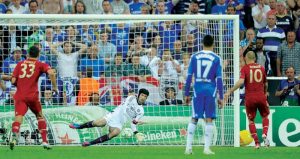
In 2006, Čech suffered a serious head injury after a collision with Reading’s Stephen Hunt. When he returned, he wore protective headgear.
And somehow, the helmet became part of the mythology.
The goalkeeper had become a man in armour.
His defining night came in Munich, 2012.
Chelsea were playing Bayern Munich in the Champions League final at Bayern’s home ground. Bayern scored late. Chelsea equalised. The match went to extra time and then penalties.
Čech had already saved Arjen Robben’s penalty during extra time.
Then, in the shootout, he saved Bastian Schweinsteiger’s effort.
Chelsea won the Champions League.
And the image remained:
Čech in the helmet.
A goalkeeper who looked as if he had arrived on the pitch wearing his own piece of battlefield equipment.
It was not merely protection anymore.
It was identity.
Dida — The Quiet Giant
Dida was different again.
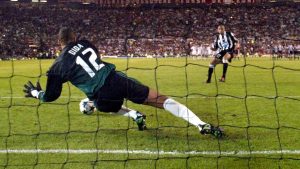
No Kahn theatrics.
No Čech helmet.
No Chilavert swagger.
He was quieter.
But his AC Milan years were extraordinary.
One of my defining memories is the 2003 Champions League final against Juventus.
0–0 after extra time.
Penalty shootout.
Dida saved three penalties.
Milan won.
Then came another Champions League final, this time in Istanbul in 2005, and almost the opposite memory.
Milan were 3–0 up at half-time against Liverpool.
Then Liverpool came back.
3–1.
3–2.
3–3.
Liverpool eventually won the penalty shootout.
Dida could not prevent the catastrophe.
But perhaps that is another strange quality of goalkeeping: sometimes the greatness of the goalkeeper becomes visible not only through what he saves, but through the enormity of what he cannot save.
José Luis Chilavert — The Goalkeeper Who Scored
And then there was José Luis Chilavert.
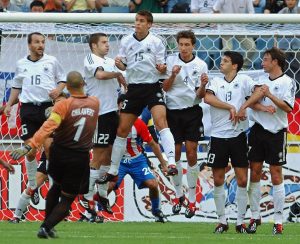
Now here was a man who appeared to have misunderstood the job description.
He wasn’t satisfied with stopping goals.
He scored them.
Free kicks.
Penalties.
More than 60 goals in his professional career — an absurd number for a goalkeeper. He even scored a hat-trick in a professional league match, becoming the first goalkeeper to do so.
I remember reading about Paraguay at the 1998 World Cup, where they reached the Round of 16 and pushed France into extra time before Laurent Blanc eventually scored the golden goal.
But what stayed with me was Chilavert himself.
He was not simply Paraguay’s goalkeeper.
He was Paraguay’s personality.
He commanded the penalty area, took free kicks, took penalties and occasionally seemed to regard the traditional definition of “goalkeeper” as an administrative suggestion.
A goalkeeper who scored was already unusual.
A goalkeeper who seemed to believe he belonged in the attacking half of the football imagination was something else entirely.
Today, we can compare goalkeepers through save percentages, clean sheets, post-shot expected goals, distribution statistics and dozens of other measurements.
Useful information.
But it cannot explain the childhood recognition that happened before statistics entered the room.
A child saw Kahn and thought: Titan.
Saw Čech and thought: helmet.
Saw Chilavert and thought: that goalkeeper can actually score.
That was how football entered our imagination.
Memory tells us who became a legend.
The Walls — The Defenders
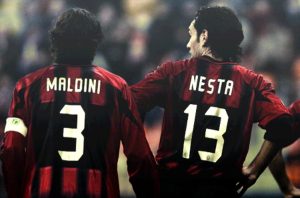
Maldini. Nesta. Cannavaro. Puyol. Ferdinand. Cafu. Roberto Carlos.
Before a football team could have magicians, entertainers and goal machines, it needed walls.
My generation had some extraordinary ones.
They were not all the same. Some defended through elegance. Some through anticipation. Some through violence. Some through sacrifice. Others seemed to believe that defending was merely something to do before joining the attack.
But when their names appeared on the television screen, something happened inside the young football fan.
We felt safe.
Paolo Maldini — Elegance as Defence
This is the man who made me fall in love with Italian Serie A.
When Maldini was there, something in the footballer’s mind relaxed.
He did not need to throw himself into tackles every five seconds. He seemed to understand defending as geometry: where to stand, when to move, when not to move.
That was his genius.
Defending could be beautiful.
I later read about the 1994 World Cup final, when Italy faced Brazil in Pasadena. Maldini was part of an extraordinary Italian defence that kept Brazil scoreless through 120 minutes before the match went to penalties.
But the final I actually remember from my football consciousness is 2005.
Milan against Liverpool.
The Champions League final in Istanbul.
Milan were 3–0 ahead at half-time. Maldini had scored the opening goal after only 50 seconds.
Then Liverpool came back.
3–1.
3–2.
3–3.
Milan eventually lost the shootout.
And yet Maldini’s legend did not shrink.
If anything, that night became part of the mythology of his generation.
Two years later, at the age of 38, he captained Milan against Liverpool again in the Champions League final.
This time Milan won.
That is Maldini.
Not simply longevity.
Continuity.
A footballer who seemed to belong to several generations at once.
Alessandro Nesta — Defending Without Panic
Nesta was different.
Maldini had elegance.
Nesta had anticipation.
He seemed to know where the attacker wanted to go before the attacker himself had completely decided.
And this is what made the great Milan defences so frightening.
Imagine being a striker.
You beat one.
There is another.
You get past the second.
There is still someone else.
Nesta’s career was interrupted by injuries, which perhaps makes his reputation even more fascinating. When healthy, he looked almost impossibly composed.
He was not always making the spectacular tackle.
Sometimes he simply arrived first.
And that is one of the great secrets of defending: the best tackle is sometimes the tackle you never have to make.
The 2006 World Cup also carries a strange footnote in his story. Nesta started Italy’s campaign but suffered an injury during the group stage and missed the knockout rounds.
Italy went on to win the World Cup.
Nesta therefore became a world champion without playing in the matches that decided the tournament.
It is an odd kind of football immortality.
Fabio Cannavaro — The Small Giant
Cannavaro broke the stereotype of the giant centre-back.
He was not enormous.
But he was aggressive, intelligent, quick and extraordinarily brave.
Then came Germany, 2006.
That Italian defence.
Cannavaro was magnificent throughout the tournament.
And the defining sequence came in the semi-final against Germany.
Extra time.
The match was still 0–0.
Cannavaro suddenly seemed to be everywhere.
Italy attacked.
Fabio Grosso scored.
Then Alessandro Del Piero scored again.
Italy were in the World Cup final.
Then came France.
Then Zidane’s infamous headbutt.
Then penalties.
Italy won the World Cup.
Cannavaro lifted the trophy.
And later that year, he won the Ballon d’Or.
I remember that 2006 final vividly because I was at St Kaggwa Bushenyi High School doing my A-Level.
I seemed to be one of the very few students who did not want France to win.
When France lost, something resembling a funeral descended on the school compound.
Students walked away slowly, faces long, conversations muted.
Those of us celebrating did it quietly.
You did not want to provoke the losers.
That is another thing statistics cannot record: where you were when a football match became part of your life
Carles Puyol — The Warrior
If Maldini was elegance and Nesta anticipation, Puyol was sacrifice.
Long hair flying everywhere.
Bandages.
Blood.
Head first.
He played as though the goal was a sacred place that must not be violated.
His defining moment came in the 2010 World Cup semi-final against Germany.
Spain and Germany were locked at 0–0.
Then Xavi delivered the corner.
Puyol rose.
Header.
Goal.
Spain reached the final and eventually became world champions.
The image of Puyol celebrating with his arms outstretched remains one of the great defensive images of that generation.

And Puyol was essential to Barcelona’s golden generation.
Xavi could control the game.
Iniesta could create magic.
Messi could destroy teams.
But Puyol gave the beautiful machine its warrior.
Every beautiful civilisation needs somebody willing to fight when beauty fails.
Cafu — The Man Who Made the Right Flank Immortal
Cafu.
Cafu was not merely defending.
He was coming.
Again.
And again.
And again.
The man seemed to have discovered an alternative source of oxygen.
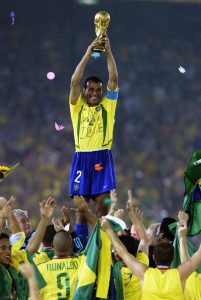
His defining image is 2002.
Brazil won the World Cup, and Cafu became the first player to appear in three consecutive World Cup finals — 1994, 1998 and 2002. In 2002, he captained Brazil against Germany and lifted the trophy.
I was in O-Level at Kitagwenda High School.
We would sneak small radios into school and disappear into hideouts at the edge of the compound where teachers rarely checked.
There, somehow, we listened to entire matches.
That is how we consumed football.
Not through smartphones.
Not through live statistical dashboards.
Sometimes through a tiny radio hidden from teachers.
And Cafu was one of those players whose presence could be recognised even through a poor radio signal.
But there was something deeper about him.
Cafu helped redefine what an attacking full-back could be.
The old question was:
Why leave your defensive position?
Cafu seemed to ask:
Why can’t I become the winger?
And then he would run almost the entire length of the pitch to prove the point.
I had a cousin, Julius, who seemed to believe he had inherited this particular Cafu gene.
During our training sessions and inter-class competitions, Julius would receive the ball near our own goal and begin his Cafu impersonation.
He would move towards the edge of the field.
Then accelerate.
Exactly along the touchline.
From one end of the pitch to the other.
And then came the hilarious part.
Julius would sometimes run straight past the opponent’s goalpost — the place where he was supposed to shoot — and continue off the pitch with the ball.
He had successfully reproduced Cafu’s running.
The finishing had not yet arrived.
But perhaps that was the point.
As children, we did not merely watch footballers.
We imitated them.
Their movements travelled from television screens into school compounds.
That is how mythology reproduces itself.
Roberto Carlos — When Football Physics Became Suspicious
And then there was Roberto Carlos.
If Cafu made you feel safe, Carlos made you wonder whether football’s laws had been properly written.
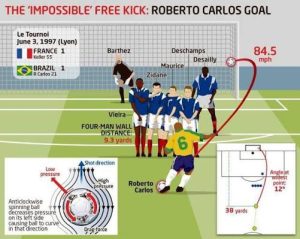
I read about the mythology of his free kick against France in 1997.
Brazil.
France.
A free kick.
Carlos struck the ball with the outside of his left foot.
At first, it appeared to be travelling wide.
Then it bent.
And bent.
And bent.
It curved around the wall and returned towards the goal.
Fabien Barthez could only watch.
The trajectory became so famous that physicists later discussed it in relation to the Magnus effect: the way spin can alter the flight of a moving object.
Forget the physics.
Roberto Carlos had bent the ball.
And then there was Brazil in 2002.
Cafu on one flank.
Carlos on the other.
Two attacking full-backs operating almost like additional wingers.
And that left foot.
And those extraordinary thighs.
Carlos was not a defender in the traditional sense.
He was an attacking weapon who happened to have defensive responsibilities.
As a young football fan, seeing Cafu, Nesta, Maldini and Carlos on the same pitch was enough to inspire confidence.
It was as if the team had walls.
Different kinds of walls.
Cafu was movement.
Nesta was anticipation.
Maldini was elegance.
Carlos was violence.
And then Cannavaro and Puyol added two more dimensions: courage and sacrifice.
This was the emotional architecture of the football universe of my time.
A child watches the starting XI appear on television.
Maldini.
Cafu.
Roberto Carlos.
Nesta.
And something inside him says:
We are safe.
That feeling is almost impossible to measure with modern football statistics.
And perhaps that is precisely what we have lost.
Not necessarily great defenders.
Great defensive personalities.
The Midfield Magicians
Zidane. Kaká. Seedorf. Davids. Vieira. Figo. Rui Costa. Nedvěd. Scholes. Keane. Gerrard. Lampard. Xavi. Iniesta. Ballack. Okocha.
If the defenders were the walls, midfielders were the people who controlled what happened inside them.
They could slow a match down or accelerate it. They could turn defence into attack with one pass. They could arrive late in the box, strike from thirty yards, disappear between defenders or simply stand in the middle of the pitch and make everyone else look hurried.
This was another reason my generation was lucky.
A midfielder did not have to be everything.
He could own one particular territory of the game.
Zidane owned elegance.
Seedorf owned power with intelligence.
Davids owned controlled aggression.
Xavi owned time.
Iniesta owned escape.
Scholes owned precision.
Keane owned will.
Gerrard owned unpredictability.
And somewhere at the far end of that spectrum was Jay-Jay Okocha, who seemed to ask whether football had to obey any rules at all.
Clarence Seedorf — Power with Intelligence
Seedorf was one of those footballers who could make a midfield look physically larger.
Strong.
Technical.
Calm.
And he possessed one of the strangest records in Champions League history: he won the competition with three different clubs — Ajax, Real Madrid and AC Milan.
While Maldini made me fall in love with Serie A, Seedorf was one of the men who made the Milan midfield feel like a control room.
He did not need to dominate every second.
He simply seemed to understand where the game was going.
Zinedine Zidane — When Football Became Art
Zidane requires almost no introduction.
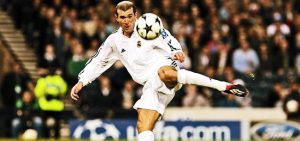
But his defining moments are worth preserving because they reveal the strange contradiction of genius: sometimes a footballer becomes immortal through victory; sometimes through beauty; sometimes through catastrophe.
I read about the 1998 World Cup final.
France against Brazil.
Zidane scored twice with his head.
France became world champions.
Then came 2002.
Real Madrid against Bayer Leverkusen in the Champions League final.
The ball arrived to Zidane outside the box.
Left foot.
Perfect contact.
Top corner.
There are goals remembered because they were important.
And there are goals remembered because they were beautiful.
That was the second kind.
Then came 2006.
Another World Cup final.
Zidane against Italy.
Then Materazzi.
Then the headbutt.
Then the red card.
His final professional match ended in expulsion.
Almost Shakespearean.
The genius did not leave quietly.
Kaká — Elegance at Speed
Kaká was different.
He wasn’t Ronaldinho’s circus.
He wasn’t Zidane’s theatre.
He was elegance in motion.
The period that stays with me is 2006–07, particularly Milan’s Champions League encounter with Manchester United.
Kaká seemed to glide through the United defence.
He scored twice in the first leg at Old Trafford. Milan won the tie and reached the final.
Liverpool waited.
Milan won 2–1.
Then came the 2007 Ballon d’Or.
Before Messi and Cristiano turned that award into a private argument, there was Kaká.
For a brief period, he looked like the heir to football’s throne.
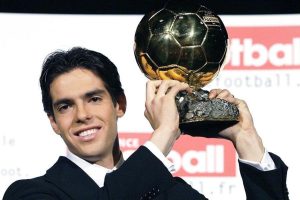
And there was something almost beautiful about his running: long strides, upright body, astonishing acceleration.
He did not appear to be fighting the grass.
He seemed to be travelling over it.
Edgar Davids — The Man with the Goggles
Yes.
The goggles.
That is enough for an entire generation.
Davids was aggressive, energetic and technically gifted. He looked like somebody had sent a scientist onto the pitch to conduct an experiment in controlled violence.
And those glasses made him unforgettable.
This is something we should not underestimate.
The footballers of my time had visual identities.
Davids had the goggles.
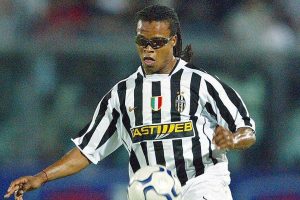
Roberto Carlos had the hair and those enormous thighs.
Kahn had the face.
Ronaldinho had the smile and hair.
Okocha had the tricks.
Beckham had the hair, the free kicks and that unmistakable posture over a stationary ball.
You could recognise many of these footballers before you even saw their names.
Footballers today may be more polished.
But are they as visually mythological?
Patrick Vieira — The Midfield Giant
Vieira changed the emotional temperature of a match.
So did Roy Keane.
So did Davids.
There were midfielders who could make opponents uncomfortable simply by existing.
Vieira’s rivalry with Keane became one of the great midfield tensions of the Premier League. Their famous confrontation in the tunnel before Arsenal and Manchester United in 2005 captured something about that era.
These were not midfielders who merely passed the ball.
They occupied territory.
When Vieira stood in the middle, the pitch seemed smaller for everyone else.
Paul Scholes — The Quiet Genius
Scholes is perhaps the most underappreciated player in my list.
He did not look spectacular.
He rarely behaved like a superstar.
He simply played.
And then, when the moment arrived, he could decide the entire match.
Manchester United against Barcelona, 2008 Champions League semi-final.
Second leg.
Old Trafford.
Scholes received the ball outside the box.
One touch.
Bang.
The ball flew into the corner.
United won 1–0 and reached the Champions League final.
Sometimes the quiet man writes the decisive sentence.
Scholes was also one of those footballers whose reputation grew strangely after retirement. Players such as Xavi, Iniesta and Zidane spoke about him with an admiration that many ordinary spectators perhaps did not fully appreciate while he was playing.
He was never the loudest character.
But football does not always announce its geniuses.
Sometimes they simply pass the ball.
Roy Keane — Football’s Controlled Explosion
Keane was not a magician in the conventional sense.
He was something else.
Will.
I remember the story of the 1999 Champions League semi-final against Juventus.
Manchester United were in trouble.
Keane was booked.
That meant he would miss the final if United qualified.
And yet he played as though the final did not exist.
He scored.
He dominated.
He dragged United back into the match.
Manchester United won.
Keane would not play in the final.
But that made the performance almost more powerful.
He had sacrificed his place in the greatest match of his club career for the victory that made that match possible.
That is mythology.
The captain who knew the price and paid it anyway.
Steven Gerrard — Unpredictability Itself
Gerrard.
This man was a constant headache for big teams.
Because Gerrard could do almost anything.
Pass.
Shoot.
Cross.
Tackle.
Run.
Score from distance.
Arrive late.
Take a free kick.
Lead.
When Gerrard stepped onto the pitch, you could never quite predict where the danger would come from.
And then came Istanbul, 2005.
Liverpool were 3–0 down against AC Milan.
Then Gerrard scored.
Liverpool came back.
3–3.
Penalty shootout.
Liverpool won the Champions League.
The comeback became one of football’s great acts of collective refusal: the refusal to accept the result already written on the scoreboard.
But that was Gerrard’s particular danger.
You could never quite know what damage he was going to cause.
Frank Lampard — The Midfielder Who Scored Like a Striker
Lampard’s greatness can certainly be expressed through statistics.
But statistics only tell us part of the story.
He arrived late.
Again.
And again.
And again.
Suddenly he was inside the penalty area.
A midfielder scoring like a striker.
His defining emotional moment for me is the 2008 Champions League final against Manchester United.
He scored Chelsea’s equaliser.
Then, after the goal, there was that image of him overcome with emotion following the death of his mother.
Football suddenly became something more than football.
For a few seconds, the stadium disappeared.
There was simply a son remembering his mother.
Sometimes the mythology of a footballer is not found in the trophy cabinet.
Sometimes it is found in a human moment nobody planned.
Xavi and Iniesta — The Men Who Made Possession Dangerous
These two were not simply midfielders.
They were the machinery behind Barcelona and Spain’s domination.
But they were different kinds of machinery.
Xavi controlled time.
Iniesta escaped it.
Xavi would receive the ball, pass, move, receive it again, and somehow make an entire team move according to his rhythm.
Iniesta could receive the ball surrounded by three players and somehow emerge on the other side.
And then came 2010.
World Cup final.
Spain against the Netherlands.
Extra time.
Iniesta received the ball.
Goal.
Spain became world champions.
Then he removed his shirt.
Underneath was a tribute to Dani Jarque, the Spanish footballer who had died of a heart attack the previous year at just 26.
A football moment suddenly became something larger than football.
Michael Ballack — The Man Who Made Germany Interesting
Ballack was the man who made me love the German Bundesliga.
Powerful.
Technical.
Physically imposing.
He could score.
Head.
Shoot from distance.
Arrive in the box.
And yet there was something almost tragic about his relationship with finals.
2002.
Bayer Leverkusen reached the Champions League final, came agonisingly close in the Bundesliga title race and reached the German Cup final.
They lost all three.
Ballack then missed the 2002 World Cup final through suspension after receiving a yellow card in the semi-final.
Then 2008.
Chelsea reached the Champions League final.
Lost to Manchester United on penalties.
Ballack’s career became associated with one of football’s cruellest paradoxes: you can be magnificent and still not get the ending you deserve.
Perhaps that is why I remember him so vividly.
Rui Costa — The Artist
Rui Costa was one of those players who made the ball seem heavier for everyone else and lighter for himself.
He belonged to the great tradition of Portuguese No. 10s.
Vision.
Passing.
Technique.
He was not necessarily the player who destroyed you physically.
He was the player who saw the pass before everyone else saw the space.
That was the artistry of the classic No. 10.
Before football became obsessed with pressing maps and passing networks, there was another question:
Who sees what the rest of us cannot see?
Rui Costa did.
Pavel Nedvěd — The Engine with a Thunderbolt
Nedvěd looked as though he was permanently angry with the laws of physics.
Long blond hair.
Relentless running.
Left foot.
Right foot.
Long-range shots.
He seemed capable of producing energy long after everyone else had exhausted theirs.
And 2003 was his great individual year.
He won the Ballon d’Or.
But football gave him another cruel joke.
He missed the Champions League final through suspension after receiving a yellow card in the semi-final.
Again, that strange cruelty of football: sometimes the player who helps you reach the final is the player who is not allowed to play it.
And Then There Was Jay-Jay Okocha
This one is special.
Because Okocha wasn’t merely a footballer.
He was entertainment.

I remember listening to an African Cup of Nations match when a Ugandan commentator made one of those wonderfully impossible declarations: Okocha’s shot, he claimed, weighed 45 kilograms — almost the weight of a bag of cement.
Was it scientifically true?
Of course not.
But who cared?
The commentator was telling us something more important:
This man is not ordinary.
Okocha could dribble through people.
Humiliate defenders.
Stop the ball.
Turn.
Twist.
Disappear.
And then there was that famous football description:
“So good they named him twice.”
Jay-Jay.
Jay-Jay.
But perhaps Okocha’s greatest contribution was psychological.
He gave African children permission to believe that an African footballer could be the entertainment, not merely the athlete expected to work harder than everybody else.
George Weah had already shattered one ceiling.
Okocha smashed another: the idea that African football had to be serious to be respected.
He made football playful again.
And perhaps that is why my list of midfielders ends with him.
Because after all the systems, trophies, tactics, rivalries and statistics, I remember the man who made people laugh.
Look at these footballers.
Maldini gave us confidence.
Cafu gave us movement.
Roberto Carlos gave us wonder.
Kahn gave us intimidation.
Zidane gave us elegance.
Keane gave us fury.
Scholes gave us precision.
Gerrard gave us unpredictability.
Ballack gave us Germany.
Xavi and Iniesta gave us control.
Nedvěd gave us power.
And then…
Okocha gave us joy.
That may be the most important quality of all.
Because the football I remember was not merely a competition between eleven men and eleven men.
It was theatre.
It was personality.
It was memory.
And before we ever learned to ask how many goals a midfielder produced per 90 minutes, we asked a much simpler question: What happens when this man gets the ball?
The Dead-Ball Artists — The Specialists
Juninho. Beckham. Pirlo. Del Piero. Roberto Carlos. Rivaldo. Zidane.
There was another kind of footballer my generation learned to recognise before we understood the language of football statistics: the dead-ball artist.
These players had a recognisable language.
A foul was committed.
The referee pointed.
The wall assembled.
The goalkeeper began shouting instructions.
And then the camera found the man walking toward the ball.
That was enough.
You already knew something might happen.
Juninho Pernambucano — The Man Who Made Distance Irrelevant
I’m beginning with Juninho.
This man’s free kicks were not simply powerful.
They were deceptive.
It was as if Juninho’s feet were vectors moving in the form of triangles.
The ball could rise, appear to be travelling one way, then suddenly dip or move sideways.
He became one of the great practitioners of what is now commonly called the knuckleball: striking the ball with very little spin, making its trajectory unusually difficult to predict.
But statistics cannot capture the psychological effect.
The referee blows the whistle.
The wall forms.
The goalkeeper arranges his defenders.
Juninho places the ball.
And suddenly everybody in the stadium becomes a physicist.
How far?
What angle?
Will it rise?
Will it dip?
Will it bend?
Then—
Goal.
He scored so many memorable free kicks for Lyon that eventually distance seemed almost irrelevant.
Thirty metres?
Fine.
Forty?
Why not?
And then came the famous 2009 Champions League free kick against Barcelona from extraordinary distance.
The ball travelled.
Dipped.
Swerved.
Víctor Valdés was beaten.
That is the kind of moment that creates mythology.
Juninho did not simply take free kicks.
He made distance look negotiable.
David Beckham — The Geometry of the Corner
Beckham’s weapon was different.
Precision.
He could make a football travel as though it had been programmed.
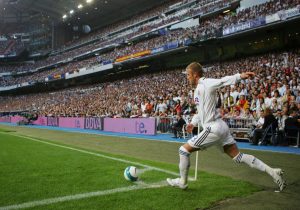
A corner kick from Beckham could become an invitation to a teammate’s head. A free kick could become a shot.
And his defining image remains 2001, against Greece.
England needed a result to qualify for the 2002 World Cup.
The match was almost over.
Free kick.
Beckham stood over the ball.
Then came that right foot.
Over the wall.
Into the corner.
England qualified.
And Beckham became the hero.
But what made Beckham extraordinary was not merely that he could score from free kicks.
He could make the ball arrive exactly where he wanted it to arrive.
While Juninho seemed to negotiate with physics, Beckham seemed to negotiate with geometry.
Andrea Pirlo — The Free Kick as Deception
Pirlo’s genius was quieter.
He didn’t look like a man preparing to commit violence against a football.
He looked almost bored.
Then came the touch.
The pass.
The free kick.
The long ball.
And then Italy against England at Euro 2012.
Penalty shootout.
Pirlo walked forward.
Joe Hart waited.
Pirlo chipped the ball down the middle.
A Panenka.
Hart dived.
Pirlo simply walked away.
That was Pirlo’s personality distilled into one movement:
Why overpower the goalkeeper when you can defeat his expectations?
That is what a Panenka does. It is not merely a penalty technique; it is a psychological wager. The kicker assumes the goalkeeper expects power or placement toward a corner, then gently chips the ball into the centre.
It requires nerve.
Almost arrogance.
Pirlo had both.
Alessandro Del Piero — The Del Piero Zone
Del Piero had what football fans came to call the “Del Piero zone”: that area on the left side of the attacking third from which he could cut inside and curl the ball toward the far corner.
But he was much more than a free-kick specialist.
And then came 2006.
Italy against Germany.
World Cup semi-final.
Extra time.
Italy had already survived 119 minutes of tension.
Then Del Piero received the ball.
He bent it into the top corner.
Germany were finished.
Italy went to the final.
Four days later, they were world champions.
That goal was not simply about technique.
It was about timing.
Some footballers score beautiful goals.
Others seem to understand exactly when a beautiful goal needs to happen.
Roberto Carlos — When Physics Surrendered
And then there was Roberto Carlos.
I have already mentioned his extraordinary left foot.
But it belongs here too.
Because his 1997 free kick against France may be the defining dead-ball image of that generation.
Beckham seemed to ask:
Where do I want this ball to go?
Carlos seemed to ask:
How much can I make this ball misbehave?
He struck the ball with the outside of his left foot.
It appeared to be travelling wide.
Then it bent.
And bent.
And bent again.
The ball seemed to change its mind in mid-air.
Fabien Barthez could only watch.
The famous explanation involves the Magnus effect: the spin of a moving object creates a force that alters its trajectory.
Fine.
Physics has its explanation.
Sometimes mythology arrives before science.
Rivaldo — The Magician Who Could Suddenly Become Dangerous
Rivaldo wasn’t merely a dead-ball specialist.
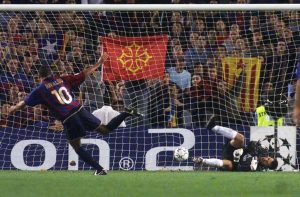
The dead ball was simply another weapon in a much larger arsenal.
Give Rivaldo possession around the edge of the box, and you could not know what came next.
Shoot.
Curl.
Chip.
Dribble.
Pass.
Or produce something nobody had anticipated.
His 2002 World Cup campaign remains one of the great memories of that Brazilian generation.
Brazil had Rivaldo.
Ronaldo.
Ronaldinho.
Three different kinds of madness.
And Rivaldo’s goal against Belgium in the quarter-final captured something of his game: positioning, anticipation, technique and that left foot.
He was not necessarily the loudest magician.
But he was dangerous because he could become one without warning.
Zinedine Zidane — The Ball Obeyed Differently
Zidane belongs here even though his greatest gift was not free kicks.
Because Zidane with a stationary ball was dangerous.
Zidane with a moving ball was dangerous.
Zidane without the ball was dangerous.
When Rivaldo and Zidane were allowed to touch a ball in midfield, anything could happen at any moment.
That is the difference between a technically excellent footballer and a magician.
The magician creates uncertainty.
The defender doesn’t know what comes next.
The spectator doesn’t know.
Sometimes, perhaps, even the magician doesn’t know.
And then there was the 2006 World Cup final penalty.
Zidane against Buffon.
He chose the Panenka.
The ball struck the underside of the crossbar and crossed the line.
For a fraction of a second, it seemed suspended between success and disaster.
That was Zidane.
Elegance with danger underneath.
These greats were not interchangeable.
They represented different philosophies of manipulating a football.
And perhaps this is why the old free kick felt different.
The referee awarded a free kick.
And the game paused.
The crowd became quiet.
The camera found the player.
The wall stood waiting.
The goalkeeper looked into the future and tried to guess what was coming.
The ball became an object of possibility.
Nobody needed an algorithm to tell us what the probability of a goal was.
We were already watching.
We were waiting.
Today we have VAR, expected goals, pressing maps, positional data and algorithms telling us what a player is expected to do.
But once upon a time, a referee simply blew a whistle and handed the situation to Juninho.
Or Beckham.
Or Pirlo.
Or Del Piero.
Or Carlos.
Or Rivaldo.
Or Zidane.
And we knew.
Something might happen.
That feeling had a name.
Anticipation.
And perhaps anticipation is one of the first things modern football has lost.
The Predators — The Men Who Made Goals Feel Inevitable
Henry. Ronaldo Nazário. Eto’o. Drogba. Van Nistelrooy. Shevchenko. Batistuta. Vieri. Inzaghi. Raúl. Totti. Suárez. Ibrahimović.
These forwards were not simply goalscorers.
They had different relationships with danger.
Some frightened defenders before they touched the ball.
Some disappeared for 89 minutes and appeared exactly where the goal was.
Some could carry an entire attack.
Some could turn a football match into theatre.
And some seemed to possess a private agreement with the goalpost: when the moment came, the ball would somehow find them.
Thierry Henry — The Manchester United Nightmare
As a Manchester United fan, you never wanted Henry to play.
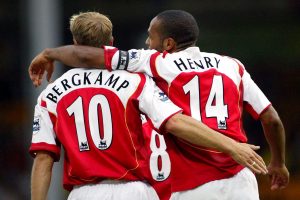
Henry wasn’t simply a great striker.
He was one of those opponents whose presence changed your expectations before the match began.
Speed.
Technique.
Intelligence.
Long strides.
That right foot.
And that devastating ability to cut inside from the left and place the ball beyond the goalkeeper.
There is one image that captures Henry’s arrogance as a footballer: the 2000 goal against Manchester United at Highbury, when he flicked the ball up, turned and volleyed it into the net.
The ball was still coming down.
Henry had already decided what to do.
And then there was the famous backheel against United.
Henry could score the ordinary.
He could score the impossible.
For United supporters, that was the nightmare.
You knew he was going to get chances.
The question was whether you could survive them.
Dennis Bergkamp — Football’s Philosopher
Bergkamp was different.
Henry attacked space.
Bergkamp manipulated it.
His famous goal against Newcastle in 2002 remains one of the great pieces of football choreography.
One touch.
Turn.
Defender goes one way.
Bergkamp goes the other.
Goal.
It looked less like football than somebody performing geometry with his feet.
I read about the 1998 World Cup, Netherlands against Argentina.
Frank de Boer sent a long pass.
Bergkamp controlled it beautifully.
One touch.
Defender beaten.
Finish.
Netherlands advanced.
And that goal should be remembered whenever people ask what a “first touch” means.
Bergkamp didn’t control the ball.
He negotiated with it.
Ruud van Nistelrooy — The Penalty-Box Machine
If Henry was movement, Ruud was execution.
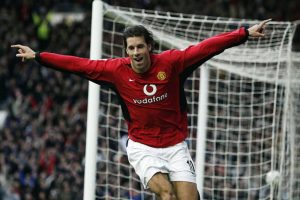
He could spend much of the match waiting.
Then suddenly:
Ball.
Six yards.
Goal.
He was one of the great penalty-box predators of his generation.
And as a United fan, there was something particularly satisfying about having Van Nistelrooy after suffering Henry.
The rivalry between those eras of Manchester United and Arsenal was almost a football civilisation in miniature.
Henry.
Van Nistelrooy.
Vieira.
Keane.
Ferdinand.
Campbell.
Scholes.
The football wasn’t merely competitive.
It felt personal.
Didier Drogba — The Man for the Great Occasions
Drogba was a different kind of beast.
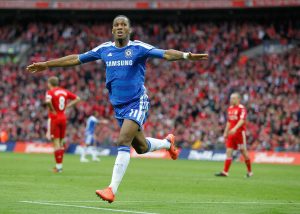
He seemed to grow larger when the match became more important.
And the greatest evidence is Munich, 2012.
Chelsea against Bayern Munich.
Chelsea were losing.
Corner.
Drogba rises.
Header.
1–1.
Extra time.
Penalty.
Drogba takes it.
Scores.
Chelsea win the Champions League.
There are strikers who score goals.
There are strikers who score important goals.
And then there are players who seem to become more dangerous when everybody else becomes frightened.
Drogba belonged to the third category.
Wayne Rooney — The Complete English Footballer
Rooney was almost impossible to classify.
Striker.
Second striker.
Midfielder.
Playmaker.
Ball-winner.
Long-range shooter.
He could tackle like a midfielder and finish like a striker.
And then came the bicycle kick against Manchester City in 2011.
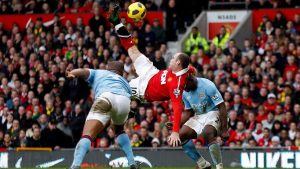
Cross.
Rooney rises.
Overhead kick.
Goal.
Old Trafford explodes.
Even people who didn’t support United had to admit:
That was ridiculous.
Rooney was the kind of footballer who seemed capable of doing something completely unrelated to his position.
You couldn’t reduce him to one function.
He was football’s answer to the question:
What if the striker could do almost everything?
Andriy Shevchenko — Elegance with Teeth
Shevchenko was one of the great strikers of the Milan era.
Fast.
Intelligent.
Two-footed.
Clinical.
And then there was 2003, when he scored the decisive penalty in the Champions League final shootout against Juventus.
For a period, his name itself became a warning.
Shevchenko meant danger.
He did not need to look violent to be lethal.
Some predators don’t roar.
They calculate.
David Villa — The Assassin
Villa is sometimes overshadowed by Messi and Cristiano.
History should be careful with that.
He was one of the most intelligent finishers of his generation.
At Euro 2008, Spain won the tournament and Villa finished as the leading scorer with four goals.
Then he became part of Barcelona’s extraordinary attacking generation.
Villa did not need ten chances.
Give him one.
That could be enough.
Fernando Torres — The Boy Who Became Immortal
Torres had one of the most beautiful trajectories of that generation.
Liverpool.
Spain.
Chelsea.
And then:
Euro 2008 final.
Spain against Germany.
Torres gets behind the defence.
The ball arrives.
He beats Philipp Lahm.
Finishes.
Spain win.
For a young Torres, that goal changed his place in history.
Then came another unforgettable moment:
Chelsea against Barcelona, 2012 Champions League semi-final.
Chelsea were down to ten men.
Barcelona needed another goal.
Torres breaks away.
Víctor Valdés comes out.
Torres scores.
Chelsea reach the final.
Sometimes one goal becomes a player’s immortality.
Zlatan Ibrahimović — Zlatan Did Not Enter Football; Zlatan Entered Mythology
Zlatan is almost his own category.
The man possessed extraordinary self-belief.
And then, unfortunately for everyone trying to dismiss him as merely arrogant, he kept producing evidence.
The obvious moment:
Sweden against England, 2012.
Long ball.
Joe Hart comes out.
Zlatan attempts the impossible.
An overhead kick from outside the box.
Goal.
One of the most absurd goals ever scored at international level.
You could almost hear Zlatan thinking:
Of course I can do that.
That was the strange thing about him.
His personality and his football seemed to be conspiring to prove each other right.
Luis Suárez — The Beautiful Monster
Suárez is complicated.
Brilliant.
Controversial.
Unpredictable.
Ruthless.
He could score from almost anywhere.
His 2013–14 Liverpool season was extraordinary: 31 Premier League goals in 33 appearances.
But another moment belongs to football history.
2010 World Cup. Uruguay against Ghana.
The ball is heading toward the goal.
Suárez uses his hands to stop it.
Red card.
Penalty.
Ghana miss.
Uruguay advance.
People still argue about the morality of that moment.
Villain?
Desperate patriot?
Cheat?
Competitor doing everything possible to keep his country alive?
Perhaps that is precisely why Suárez belongs in this mythology.
He did not merely score goals.
He made people argue about football.
Samuel Eto’o — The African Predator
Eto’o’s career is astonishing.
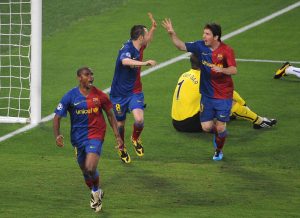
Barcelona.
Inter.
Champions League.
Again.
And again.
He scored in the 2006 Champions League final against Arsenal and again in the 2009 final against Manchester United.
Then came Inter’s historic 2010 treble.
For African football, Eto’o represented something important.
An African striker could sit at the centre of Europe’s greatest club competition.
Not as decoration.
Not as a curiosity.
Not as someone who had been brought over to provide athleticism.
He could decide the biggest matches.
George Weah had opened that door.
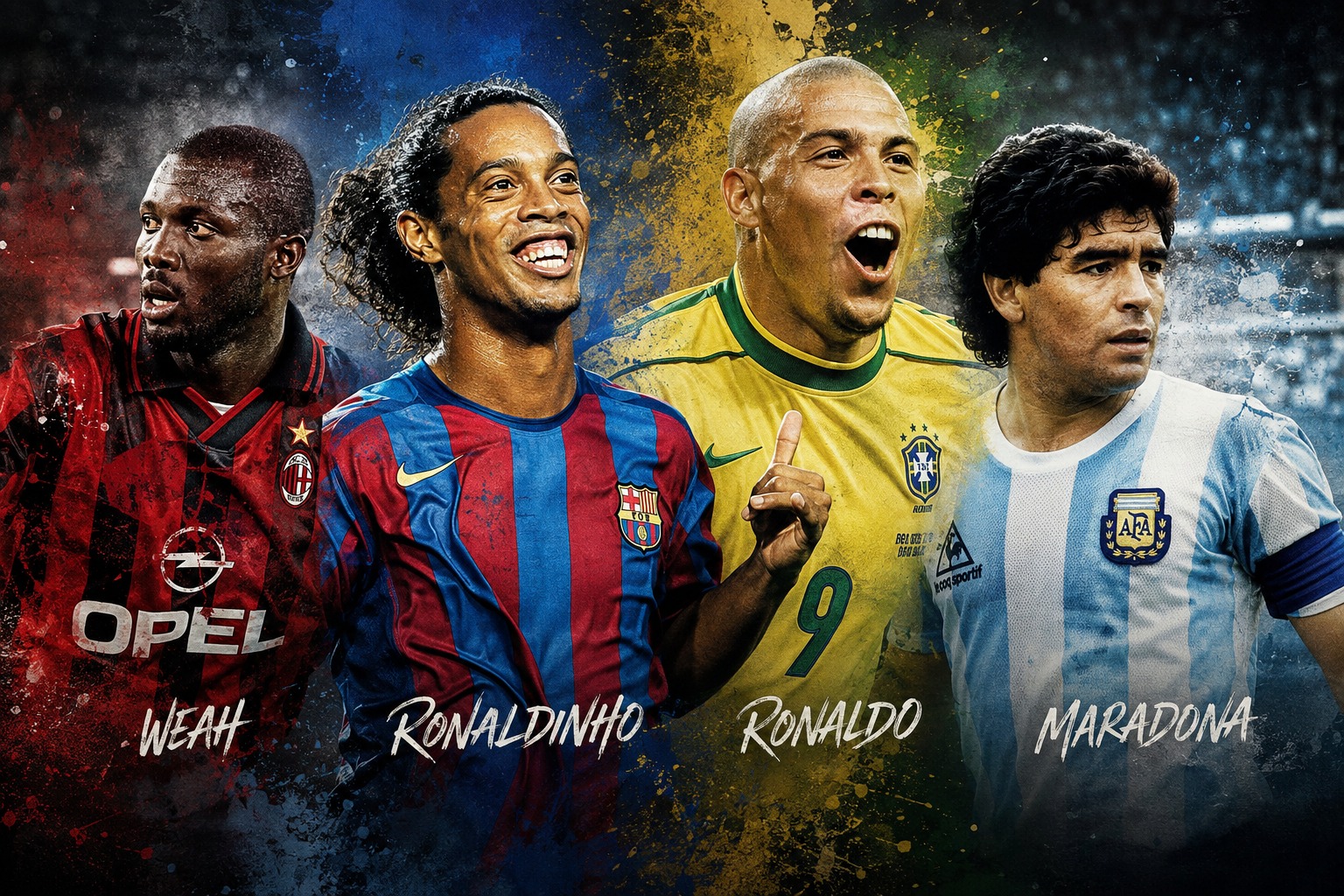
Eto’o walked through it with authority.
Ronaldo Nazário — My Personal Legend
Senior Three.
A young Ugandan boy goes to school with the 2002 Ronaldo haircut.
In 2003, I was nearly suspended from Equatorial College School in Ibanda for cutting my hair exactly the way Ronaldo had worn his during the World Cup.
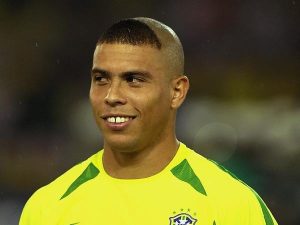
I wasn’t simply a football fan.
I was participating in the mythology.
Think about that for a moment.
A Brazilian striker appeared on television.
A teenager thousands of kilometres away in Uganda watched him.
And then decided:
I want to look like that man.
That is cultural power.
And Ronaldo had earned it.
The 2002 World Cup.
Eight goals.
Golden Boot.
Brazil reach the final.
Germany.
Oliver Kahn.
Ronaldo scores twice.
Brazil win their fifth World Cup.
But the story becomes more remarkable when we remember what came before it: devastating knee injuries, doubts about whether he would ever return to his former level, and then the resurrection.
He returned.
He became world champion.
He became the tournament’s leading scorer.
He became the central figure of Brazil’s victory.
Ronaldo did something extraordinarily rare:
he turned physical fragility into mythology.
He wasn’t Pelé.
Nobody was.
But for children of my generation, he was perhaps the closest thing to a successor mythology.
And that haircut remains part of the evidence.
The fact that a teenager in Uganda could see a Brazilian striker on television and decide to imitate his appearance tells us something statistics never can.
Football had crossed the screen and entered our bodies.
Romário — The Penalty-Box Philosopher
Romário was smaller than many of the defenders trying to stop him.
It didn’t matter.
He needed almost no space.
No unnecessary movement.
No wasted energy.
Get into the right place.
Finish.
Then came 1994.
Brazil win the World Cup.
Romário becomes the attacking symbol of that team, scoring five goals and later being named FIFA World Player of the Year.
He understood something that statistics can describe but not fully explain:
the shortest distance between a striker and a goal is sometimes simply intelligence.
Gabriel Batistuta — Violence in a Football Shirt
For lack of a better word, Batistuta was violence wearing a football jersey.
The shot.
The roar.
The arms stretched wide after scoring.
At Fiorentina, he became almost a deity.
He stayed through difficult years, helped the club win the 1996 Coppa Italia and became one of the defining figures in its history.
He also scored in three different World Cups.
But there was something else about Batistuta that belongs to an older football culture:
loyalty.
He remained with Fiorentina when a more commercially rational football might have demanded otherwise.
That idea feels increasingly strange now.
A footballer belonging to a city.
A club belonging to a player.
Can modern football still produce that kind of relationship?
Francesco Totti — Rome’s Prince
Totti belongs to a dying species.
The one-club icon.
Roma.
Roma.
Roma.
And then came the 2006 World Cup.
Italy against Australia.
Last minute.
Penalty.
Totti takes it.
Scores.
Italy advance.
Later, Italy win the World Cup.
Totti had been carrying the weight of Rome, Italy and his own mythology.
But perhaps his greatest achievement was simpler:
he stayed.
In an age when footballers increasingly move toward opportunity, Totti became inseparable from one place.
Rome did not merely employ him.
Rome claimed him.
Raúl — The Man Who Made You Sit Closer
Raúl was one of my favourites.
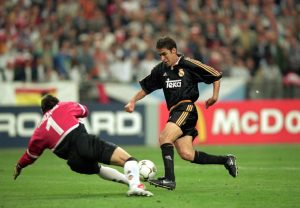
Seeing Raúl on the screen would make me edge closer and sit comfortably to watch the game.
That’s not about statistics.
That’s anticipation.
You trusted the footballer to give you something worth watching.
Raúl was intelligent movement, timing and finishing.
He became synonymous with Real Madrid’s Champions League identity.
Before Cristiano.
Before Benzema.
Before the modern Madrid machine.
There was Raúl.
And when that No. 7 appeared, you watched.
Forget that many of us were watching after escaping from school.
Who cared about punishment when Raúl was playing?
Filippo Inzaghi — The Man Who Was Always Somewhere
Inzaghi was almost an insult to conventional football aesthetics.
He didn’t need to dribble past five defenders.
He didn’t need to shoot from thirty metres.
He simply appeared where the ball was going to arrive.
There is a famous line attributed to Sir Alex Ferguson describing him as having been “born offside.”
Whether Ferguson said it exactly that way is less important than why the phrase survived.
It captured Inzaghi.
And then came 2007.
Champions League final.
Two goals against Liverpool.
Milan win.
Inzaghi had not necessarily dominated the match.
He had done something more Inzaghi-like.
He had found the two moments that mattered.
Michael Owen — Speed Before the Body Betrayed Him
Owen’s mythology began in 1998.
World Cup.
England against Argentina.
Owen receives the ball.
Runs.
Accelerates.
Finishes.
A teenager becomes a global football star.
Three years later, he won the 2001 Ballon d’Or.
His tragedy was that injuries gradually took away the extraordinary acceleration that had made him special.
Which creates another kind of football mythology: the memory of what a body once could do.
Davor Šuker — The Croatian Artist
Šuker is another legend I largely met through television, photographs and memory rather than childhood proximity.
1998 World Cup.
Croatia finish third.
Šuker scores six goals.
Golden Boot.
And there was that delicate penalty against Denmark at Euro 1996: another audacious chip down the middle.
But I remember Šuker for another reason.
His face.
His physical presence.
Like Edgar Davids, he had one of those unmistakable football identities.
You saw him and immediately knew:
That’s Šuker.
George Weah — Africa’s Great Answer
Weah deserves more than a paragraph in an African football memory.
Because he didn’t merely become a great African footballer.
He became the world’s best footballer.
George Weah had a rare relationship with the football: he did not seem to run with the ball; he seemed to roll with it, as though the man and the ball had become a single organism moving through the defence.
In 1995, he won the Ballon d’Or — the first African player to do so.
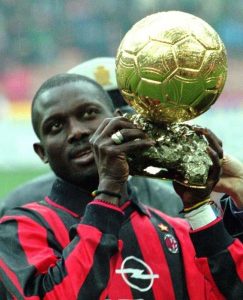
Then there was that extraordinary goal against Verona in 1996: receiving the ball inside his own half and carrying it through the opposition before scoring.
A Liberian boy becomes the world’s best footballer.
At a time when African footballers were still fighting to be regarded as equals in the European imagination, Weah’s achievement carried another message:
Africa belonged here.
Nwankwo Kanu — Elegance in an Unusual Body
Tall.
Long-legged.
Almost awkward.
And yet Kanu could make technically beautiful things happen.
His 1996 Olympic gold medal with Nigeria remains one of African football’s great stories.
Nigeria came from behind against Brazil.
Then Argentina.
Then the gold medal.
Kanu later moved to Arsenal and produced the famous 1999 hat-trick against Chelsea, after Arsenal had been 2–0 down.
His third goal came from an almost impossible angle.
Another African footballer refusing to fit the stereotype.
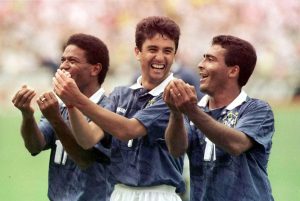
Bebeto — When Football Became Family
Bebeto’s defining image may not even be a goal.
It is the celebration.
1994 World Cup. Brazil against the Netherlands.
Bebeto scores.
Then he rocks his arms as though holding a baby.
His son had just been born.
The celebration became iconic.
Football suddenly became family.
For one moment, the World Cup was no longer about tactics or national prestige.
It was about a father celebrating his child.
Gianfranco Zola — The Little Magician
Zola was the small magician.
He wasn’t physically overwhelming.
He was technically overwhelming.
At Chelsea, he became one of the great cult figures of the Premier League.
He could receive the ball and suddenly make the pitch feel smaller.
Another player who reminds us that greatness does not have a body type.
Sometimes the giant is simply the man who can make everyone else look slow.
This is why I resist reducing my football childhood to a list of famous names.
I am not simply remembering great goalscorers.
I am remembering characters.
There was a time when a child could know a footballer by his face, his haircut, his running style, his celebration, his particular weapon, even the strange shape of his body.
We knew who we wanted nowhere near Manchester United’s penalty area.
We knew who we wanted taking the free kick.
We knew who made us move closer to the television.
We knew whose hairstyle we wanted badly enough to risk punishment at school.
We knew which footballers we wanted to find inside a bubble-gum wrapper.
That is something different from being a consumer of football statistics.
We became attached to people.
And perhaps this is the thread running through everything I have remembered so far: the goalkeepers, the walls, the midfield magicians, the dead-ball artists and now the predators.
They were not interchangeable pieces in a tactical system.
They were personalities with weapons.
And when the ball reached them, we did not ask for a probability model.
We asked a much older question:
What is this human being about to do?
Next Thursday on Gods of Football/Part Two: The Entertainers