



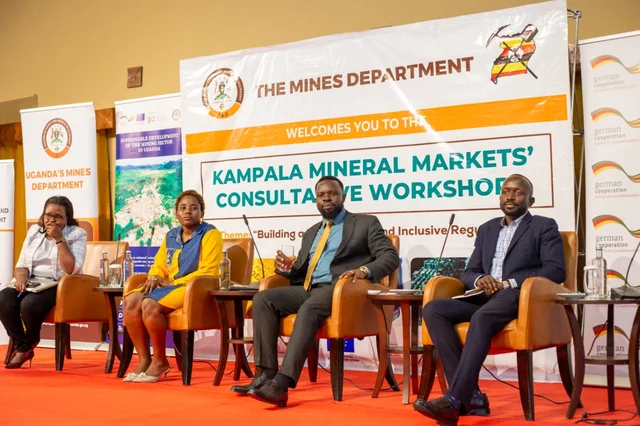
Players in Uganda’s mineral sector are moving to centralize gold trading through a proposed one-stop buying centre, a move aimed at cleaning up the market, eliminating scams, and boosting investor confidence.
The proposal was a key focus at the Mining and Minerals (Mineral Markets and Buying Centers) Regulations 2026 consultation workshop held at Speke Resort Munyonyo on May 14–15, 2026. The workshop brought together regulators, refiners, and traders, to discuss compliance, market integrity, and sustainable growth in the sector.
Industry players agreed that a centralized, regulated buying centre would streamline transactions, improve traceability, and reduce fraud that has long plagued Uganda’s gold trade.
The government plans to set up buying centres in areas with gold minerals, while Kampala will have an office where traders can conduct gold business. As part of the new regulations, all traders will be required to undergo fingerprint registration.
“We propose that markets operate within regulated hours up to five o’clock. Security is very critical, especially when you are moving gold at night,” Agnes Alaba, Assistant Commisioner at the Ministry of Energy and Mineral Development said.
“We have noted that there are investors who order gold and minerals without licenses. Every operation must take place within the market, and every trader must have a license granted by the ministry,” she added.
Speaking at the workshop, Benard Feni, Executive Director of Euro Gold Refinery SMC Ltd, said the proposed centre should be operated by a company with refining capacity, modern testing equipment, and a valid mining licence from the Ministry of Energy and Mineral Development.
“The company should be able to refine gold to 99% purity, hold a Firearms Act licence where applicable, and have the latest technology while meeting all internationally set standards,” Feni said.
He added that the operator must provide verifiable documentation, including certificates of origin, clearance from the Uganda Revenue Authority, export permits, and ISO and ICGR certifications. A clean criminal record for the operator should also be a requirement.
“It should be a true one-stop centre that gives buyers the right information, handles export processes, and provides certificates of origin showing where the gold comes from. That will quicken the process and eliminate scams,” Feni said.
Assistant commissioner of police Julius Caesar Tusingwire, commandant of the Police Minerals Protection Unit, said the establishment of organised mineral markets is going to address many security concerns, especially fraud and scams
Under the proposed regulations, all mineral trade will only take place within licensed and government-regulated mineral buying centres, while unlicensed buyers and dealers will face tougher penalties.
Government also plans to restrict trading hours, requiring mineral markets to close by 5:00 pm due to security concerns linked to nighttime gold transactions
The push comes as Uganda seeks to capture more value from its gold sector. Recent data shows Uganda exported gold worth $5.8 billion, much of this comes from artisanal and small-scale miners operating outside formal channels.
The Bank of Uganda recently finalized a contract with Euro Gold Refinery to refine gold under its Domestic Gold Purchase Programme, a step toward building domestic refining capacity and reducing reliance on raw exports.
Feni said Euro Gold’s long-term goal is to make Uganda a regional gold hub by 2030.
“By 2030, we want Uganda to be known not just for exporting raw materials, but for producing high-quality, 24-karat bullion for the global market,” he said.
The Ministry of Energy and Mineral Development is reviewing input from the workshop to finalize the 2026 regulations.