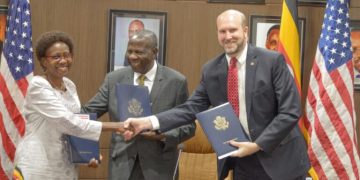



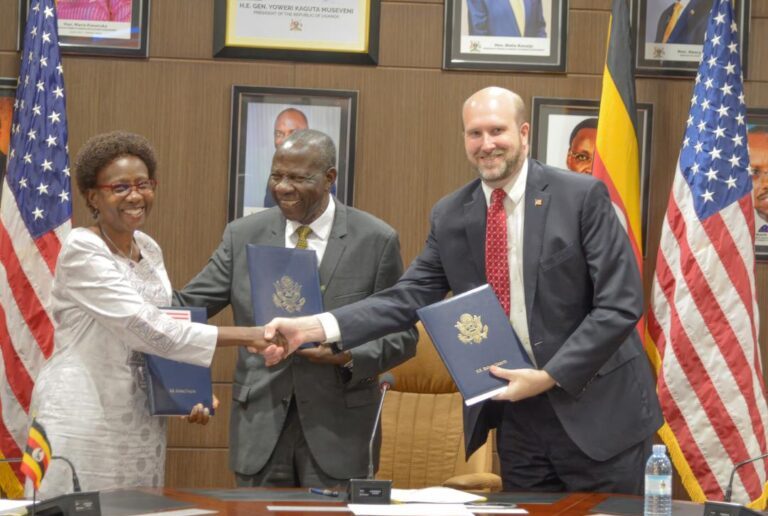
Uganda and the United States of America have signed a Memorandum of Understanding (MoU) on bilateral health cooperation, backed by a substantial commitment worth USD 2.3 billion.
The five-year, $2.3 billion bilateral health cooperation signed on Wednesday at the Finance Ministry outlines a comprehensive vision to save lives and strengthen Uganda’s health system.
The MOU advances the U.S.–Uganda bilateral relationship and supports Uganda in developing a resilient health system that prevents the spread of emerging and existing infectious diseases globally.

Finance Minister Matia Kasaija signed on behalf of the Government of Uganda, while the American Ambassador to Uganda, H.E. William W. Popp, signed on behalf of the United States of America.
Under the MOU, the United States plans to support priority health programs and commodities, including HIV/AIDS, TB, malaria, maternal and child health, polio eradication, global health security, human resources, disease surveillance, and emergency preparedness.
Over the five years, the United States plans to provide USD 1.7 billion of support, and the Government of Uganda pledges to increase domestic health expenditures by USD 500 million to gradually assume greater financial responsibility over the course of the framework.
The agreement includes support for faith-based healthcare providers in Uganda.
“This collaboration will yield not only disease-specific outcomes but also significant improvements in national systems, institutions, and workforce capacity. This is highly commendable,” said Finance Minister Matia Kasaija at the signing ceremony.
Ambassador William Popp said this agreement represents a significant, long-term commitment by the United States and Uganda to co-invest in their shared global health priorities.
“We are building on prior successes and making a significant shift towards promoting self-reliance in the health sector through strong community health systems, clear performance metrics, and a foundational commitment to data systems and global health security that will prevent and stop outbreaks from threatening Uganda, the United States and the world,” said the U.S. Ambassador.

Key Features of the New Health Cooperation Framework
The MOU includes several innovative elements designed to strengthen sustainability, promote self-reliance, and modernise Uganda’s health system:
- Transition of Health Commodities: Procurement of most health commodities will shift gradually from U.S. support to the Government of Uganda, strengthening the national supply chain and enabling long-term ownership.
- Integration of Frontline Health Workers: Frontline workers currently funded by the U.S. Government will be mapped and transitioned onto the Government of Uganda’s payroll, building a stable domestic workforce.
- Major Investments in Data Systems: Over the next five years, the U.S. will invest heavily in Uganda’s disease surveillance and data ecosystem — including electronic medical records, interoperability systems, and national data warehouses — supporting Uganda’s broader digitisation agenda.
- Support to Faith-Based Providers: Faith-based health providers will receive strengthened support through performance-based agreements, increased primary health care grants, digitisation, and community health insurance initiatives.
- Co-Investment for Sustainability: Uganda’s commitment to invest more than $500 million in domestic health financing is seen as crucial to sustaining health gains and advancing the country’s journey to full health-sector self-reliance.