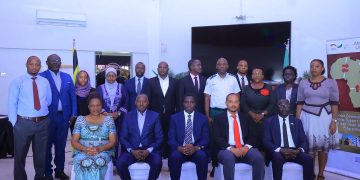




Uganda has reaffirmed its commitment to strengthening border governance and cross-border cooperation as government ministries, regional bodies, and development partners convened for a two-day consultative meeting on the ratification of the Niamey Convention.
The meeting, held from 2–3 December 2025 at Fairway Hotel in Kampala, marked a significant step toward aligning Uganda with continental frameworks on peaceful and productive border management.
Adopted in 2014, the Niamey Convention seeks to transform African borders from lines of division into engines of regional cooperation and development. It provides a legal framework for African Union Member States to promote socio-economic transformation in border communities, strengthen cross-border collaboration, support peaceful dispute resolution, and advance long-term stability. Priority areas include socio-economic development, security, institutional strengthening, border management, and cultural exchange.
Opening the meeting, Mr Abraham Pekelye, representing the GIZ Regional Coordinator for the African Union Border Programme (AUBP), highlighted GIZ’s long-standing support for African border governance efforts.
“Since 2008, GIZ support to the AUBP has focused on working closely with the African Union, Regional Economic Communities, and Member States to enhance border governance across the continent,” he said.
He noted that previous sensitisation workshops on the AU Border Governance Strategy—held in Uganda for EAC Member States in October 2023 and for IGAD Member States in May 2024—demonstrated strong regional commitment to integration. He reaffirmed GIZ’s continued support to the AU and its Member States in implementing the AUBP.
Representing the Permanent Secretary of the Ministry of Foreign Affairs, Ambassador John Leonard Mugerwa underscored Uganda’s readiness to move toward ratification. He outlined the legal procedures required to domesticate international instruments, emphasising Uganda’s treaty-making framework—which calls for transparency, Cabinet approval, and timely parliamentary engagement.
He noted that the Ministry of Foreign Affairs is responsible for signing, depositing, and serving as custodian of all treaties ratified by Uganda.
In her detailed presentation, Dr Edith Nsubuga, Acting Head of the Regional Peace and Security Department at the Ministry of Foreign Affairs, traced Uganda’s border evolution and highlighted the potential of borders as drivers of cooperation and development. She drew connections between the Niamey Convention, the AU’s Agenda 2063, and Uganda’s National Development Plan IV (NDP IV).
“The Convention is important in two respects,” she noted. “It provides a legal mandate that shifts focus from merely demarcating borders to jointly managing them, and it aligns with Agenda 2063’s vision of an integrated and peaceful continent.”
Day two featured a presentation by Ms Allen Bucyana from the Ministry of Justice, who outlined the steps required for Cabinet approval and constitutional alignment ahead of ratification. Ms Nelly Lodian from Kenya’s Office of the Attorney General shared Kenya’s experience with the ratification process, offering insights for Uganda’s roadmap.
The meeting underscored that effective border governance requires strong cooperation among government ministries, regional organisations, and development partners. Participants emphasised that treaty ratification must follow transparent legal processes, and that borders should be seen not as barriers but as opportunities for economic development, peace, and integration.
The consultations also highlighted the importance of aligning national policies with continental frameworks such as Agenda 2063, learning from regional experiences, and demonstrating political will to advance stability and development across Africa.