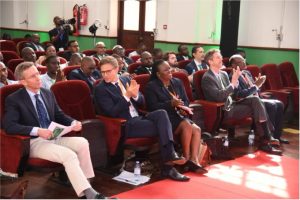



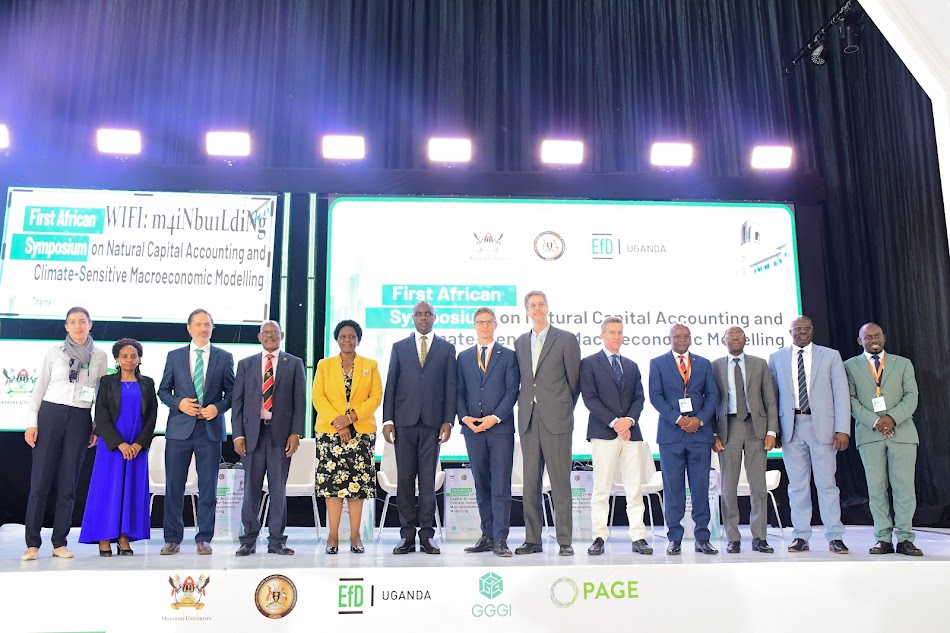
Uganda has positioned itself at the forefront of climate-sensitive economic planning in Africa after hosting the First African Symposium on Natural Capital Accounting (NCA) and Climate-Sensitive Macroeconomic Modelling at Makerere University.
The two-day symposium, held from February 12–13, convened at Makerere University Main Hall under the theme: “Climate-Sensitive Macroeconomics: Rethinking Growth in Africa’s Natural Resource Base.”
Balancing Today with Tomorrow
In his opening remarks, Minister of State for Finance (General Duties), Hon. Henry Musasizi, acknowledged the challenging trade-offs African finance ministers face between addressing immediate fiscal pressures and planning for long-term resilience.
“As Ministers of Finance, we are often confronted with difficult trade-offs. Our task is to balance the needs of today with sustainability for future generations,” Musasizi said, noting the interconnected challenges confronting African economies, including climate change, debt vulnerabilities, fiscal constraints, and the imperative for inclusive growth.
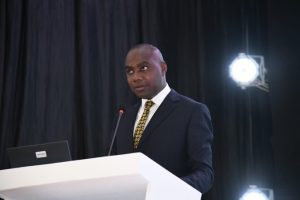
Musasizi, a Makerere alumnus, also paid tribute to the university’s role in national development. “Even twenty years after leaving this university, I remain deeply attached to Makerere,” he said, praising the Vice Chancellor, Prof. Barnabas Nawangwe, for acknowledging government support toward the institution.
A First-of-Its-Kind Continental Forum
Describing the symposium as a milestone for Africa, Musasizi highlighted its significance in demonstrating the continent’s growing unity on climate action. He referenced the formation of a continental climate financing platform by African finance leaders in 2025, noting that Kampala builds on that momentum.
“Building on this spirit of cooperation, we are calling upon countries, institutions, and partners to come together to share experiences, enhance collective capacity, and establish a cooperative way forward,” he said.
Musasizi also warned that traditional macroeconomic models focusing solely on growth, inflation, and fiscal balance are inadequate in the era of extreme climate shocks.
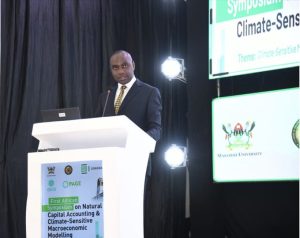
“Ignoring these risks is no longer an option. Natural Capital Accounting and climate-sensitive macroeconomic modelling are indispensable tools for policymakers,” he said, explaining that they allow governments to quantify natural resource values, assess environmental costs, and integrate climate considerations into planning, budgeting, and investment decisions.
The minister said Uganda is already implementing reforms to align economic policy with climate objectives, including strengthening climate-responsive public investment management and integrating climate change into national development plans.
However, he emphasised that success depends on institutional coordination and partnerships between government, academia, and development partners.
Africa’s Natural Capital Under Threat
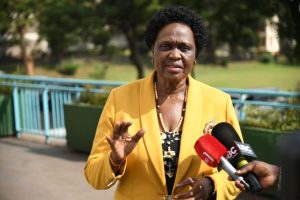
Minister of State for Environment, Hon. Beatrice Atim Anywar, delivered a stark warning on the continent’s natural asset depletion. “Africa stands at a defining crossroads. Our economies remain anchored in forests, water resources, biodiversity, land, and ecosystems, which sustain life, generate revenue, and underpin development,” she said.
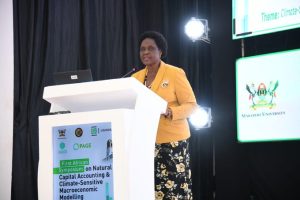
Anywar cautioned that climate-related shocks such as floods, droughts, land degradation, and water stress are already undermining productivity, public investment, and macroeconomic stability. She added that traditional planning models fail to fully capture the long-term costs of environmental degradation or the benefits of resilience investments.
Highlighting a partnership between Uganda’s ministries, Makerere University, and GIZ, she noted the development of a natural capital policy assessment tool. This tool helps rapidly evaluate natural resources for climate adaptation and energy transition, while also estimating the fiscal cost of depleted assets to improve budgeting.
“Water security, forest conservation, ecosystem restoration, and climate adaptation are not costs to the economy—they are investments in long-term stability, productivity, and prosperity,” Anywar said, earning applause from delegates.
Africa’s Wealth and the Cost of Inaction
In the symposium’s keynote address, Paul Jonathan Martin, Manager of Environment Operations Department Eastern and Southern Africa Region at the World Bank, warned that Africa’s overall wealth is under threat as renewable natural capital declines.
While produced capital and human capital have grown, renewable capital has fallen by 30% over the past three decades, weakening Africa’s overall wealth trajectory since 2010. “Climate change has deep, widespread, and cascading effects across all sectors,” he said.
Martin highlighted examples of progress in Ethiopia and Kenya, where natural capital tools are already informing public investment decisions. “In Ethiopia, there are payments for ecosystems. There is an investment prioritisation tool that has been developed. In Kenya, integration of natural capital accounting in the budget is already happening. This has strengthened public investments.”
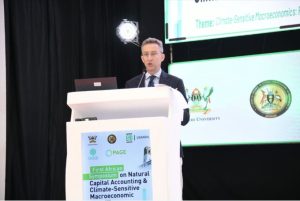
He also projected that resilience investments could have a positive long-term impact on Uganda’s GDP, while failure to act on climate change could cause significant deviations from projected growth. “From 2020-2050, the cumulative effect of adaptation on Uganda’s GDP is positive,” he said. “If no action is taken to address climate change, the impact on GDP can be felt. Under dry/hot climate future GDP will deviate.”
Climate Change as an Economic Challenge
Ambassador Jan Sadek, Head of the European Union Delegation to Uganda, underscored that climate change is no longer solely an environmental issue but a core economic challenge. “Climate change is no longer an environmental concern. It’s a fundamental economic challenge,” he said.
He praised Makerere University for its critical role in bringing together researchers and policymakers to develop practical solutions. “This University has defined the past, post-independence and is now defining the future,” Sadek said.
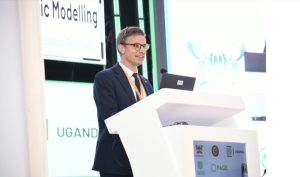
The symposium aims to modernise how African nations measure wealth by integrating climate risks, biodiversity loss, and ecosystem depletion into macroeconomic models.
Hosted by Makerere University through the Centre of Excellence for Africa Climate-Sensitive Macroeconomic Modelling and supported by partners including GGGI, UN PAGE, and the European Union, the event seeks to establish a continental knowledge platform to guide climate-informed economic planning.