




ENTEBBE – The Government of Uganda has officially launched the Uganda Anticipatory Action Roadmap (2025–2031) and the Uganda Multi-Hazard Integrated Early Warning System (U-MHIEWS), marking a major shift from responding to disasters after they occur to taking forecast-based action before they strike.
The twin initiatives were launched at the Imperial Resort Beach Hotel in Entebbe by Hon. Sam Engola, Minister of State for Relief, Disaster Preparedness and Refugees, together with Alex Kakooza, the Permanent Secretary in the Office of the Prime Minister (OPM), in the presence of representatives from the Intergovernmental Authority on Development (IGAD), the United Nations World Food Programme (WFP), the Food and Agriculture Organization (FAO), development partners and civil society organizations.
The roadmap seeks to institutionalise anticipatory action by enabling government and partners to act on early warning information before disasters escalate into humanitarian crises, while the U-MHIEWS provides an automated, open-source platform for monitoring multiple hazards and issuing timely warnings.
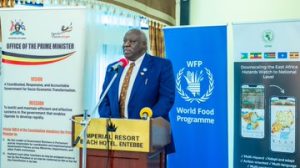
Launching the initiatives, Hon. Sam Engola said Uganda could no longer afford to rely solely on emergency response, noting that climate change and other emerging risks demanded a proactive approach.
“As we all know, disasters are inevitable. We know that there will be droughts, floods, strong winds, landslides and other hazards. The question is not whether these events will occur, but whether we are adequately prepared to respond before they become humanitarian crises,” Engola said.
He noted that prolonged drought, particularly in Karamoja, and forecasts of above-normal rainfall associated with El Niño underscored the urgency of strengthening preparedness. “The Anticipatory Action Roadmap provides a clear governance framework for shifting from reactive disaster response to proactive preparedness. It promotes early action to protect lives and livelihoods, reduce disaster losses, lower response costs and strengthen national resilience,” he said.
The minister urged development partners to invest in long-term resilience-building systems instead of focusing primarily on emergency interventions. “I would like to encourage all development partners and donors to continue supporting government priorities by investing in sustainable, long-term systems that strengthen national capacity and resilience rather than relying solely on short-term emergency interventions,” he added.
Permanent Secretary Alex Kakooza described the launch as a turning point in Uganda’s disaster risk management strategy, emphasising that success would ultimately depend on implementation.

“Today marks an important milestone in our efforts to strengthen disaster risk management. This programme represents a clear opportunity to shift from reactive disaster response to a proactive approach that anticipates risks and takes action to protect lives, livelihoods and development gains,” Kakooza said.
He stressed that the roadmap’s impact would be judged by outcomes on the ground. “Launching this Roadmap is only the beginning. Its true value will be measured not by the document itself, but by the lives protected, livelihoods preserved, and communities made more resilient through its implementation,” he said.
Kakooza also called for stronger coordination among stakeholders. “Let us strengthen coordination and avoid duplication, invest in prevention rather than response, and deepen partnerships instead of working in isolation,” he added.
Representing the Executive Secretary of IGAD, Joselyn Bigirwa, Head of Mission of the IGAD Office in Kampala, said the launch demonstrated Uganda’s growing commitment to building resilience through early warning and anticipatory action.
“This milestone strengthens resilience, promotes anticipatory action, protects lives and advances risk-informed development,” Bigirwa said.

She reiterated IGAD’s call for countries in the region to increase investment in early warning systems to improve preparedness for increasingly frequent disasters. “This milestone strengthens resilience, promotes anticipatory action, protects lives and advances risk-informed development.”
The FAO Country Representative, Ezana Kassa, said the roadmap built on years of investment in strengthening Uganda’s early warning systems and disaster preparedness.
“This roadmap builds on years of investment in strengthening Uganda’s early warning and anticipatory action systems,” Kassa said.
He revealed that since 2021, FAO’s disaster risk management programmes had reached more than 160,000 families, while over 400,000 households had directly benefited from related interventions.

“The Anticipatory Action Roadmap and the Multi-Hazard Early Warning System being launched today provide a strong foundation for transforming early warning into early action,” he said.
Kassa added that every investment made before disasters occur helps save lives, protect livelihoods and reduce humanitarian and economic losses. “Every investment made before a disaster strikes helps protect lives, safeguard livelihoods, preserve agricultural production and reduce humanitarian and economic losses,” he noted.
Speaking on behalf of the United Nations World Food Programme (WFP), Country Director Marcus Prior said anticipatory action had become one of the most effective ways of reducing humanitarian needs.
“The launch of this roadmap represents much more than the publication of a strategic document. It marks a national commitment to a new way of working—one that uses science, weather forecasts, risk information and preparedness systems to protect vulnerable people before crises escalate,” Prior said.

Drawing from WFP’s experience, he said evidence now clearly showed that investing before disasters struck produced better results. “The evidence is clear. Acting before a predictable shock is not only more humane; it is also far more cost-effective than responding after losses have already occurred,” he said.
Prior disclosed that WFP was already implementing anticipatory action programmes in Karamoja, where drought triggers had been activated, including cash assistance to about 35,000 beneficiaries, mainly women, to cushion communities ahead of worsening conditions.
Looking ahead, he said implementation would determine the roadmap’s success. “Implementation will be the true test of our collective ambition,” Prior said, adding that WFP remained committed to supporting Uganda through investments in early warning systems and anticipatory action planning.
The launch comes as Uganda continues to face increasingly frequent climate-related hazards, including droughts, floods, landslides and disease outbreaks, with government and its partners hoping that early warning linked to timely action will reduce disaster losses, protect livelihoods and strengthen national resilience.