


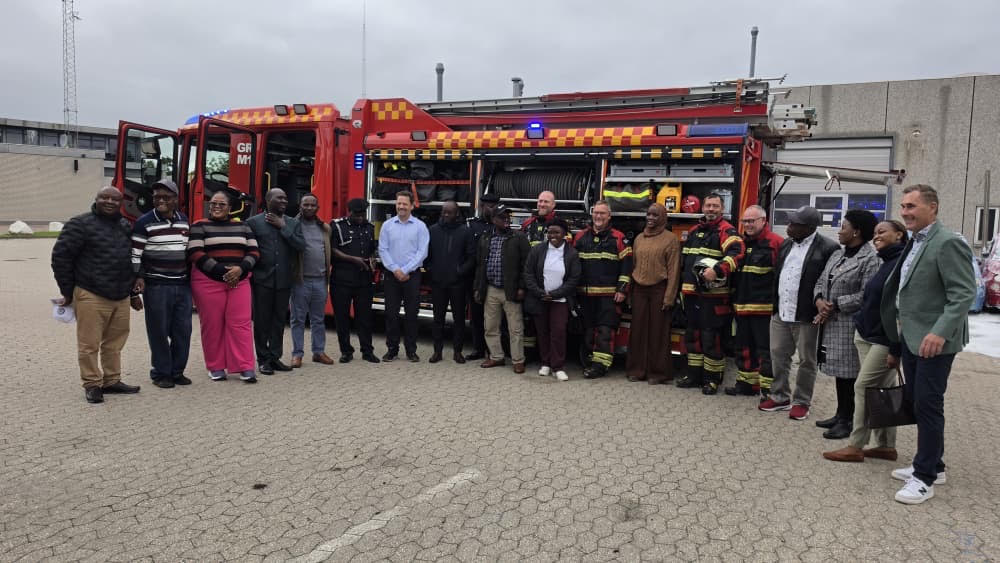
Uganda Embassy in Copenhagen has strengthened the Danish-Uganda partnerships through facilitating firefighting training Sessions with Danish Training Schools and Firefighting institutions from September 20-24.
The countries are exploring a potential Government-to-Government (G2G) cooperation framework aimed at strengthening firefighting, fire prevention and emergency rescue services in Uganda.
The visit, facilitated by the Embassy of Uganda in Copenhagen under the leadership of Ambassador Margaret M. Otteskov, forms part of efforts to strengthen Uganda’s emergency-response capacity as the country expands its industrial, infrastructure and petroleum sectors.
The Ugandan technical delegation undertook specialised demonstrations and learning sessions at Falck Fire Denmark, examining modern approaches to firefighting, rescue operations, emergency preparedness, specialised equipment, training and institutional organisation. The delegation also visited the Franck Fire Training School in North Zealand.
With more than a century of experience in firefighting and public emergency services in Denmark, Falck provides firefighting, rescue, high-altitude and other emergency-response services. The mission is intended to move beyond a conventional study tour by identifying practical areas for structured cooperation between Ugandan and Danish emergency-response institutions.
Among the areas under consideration are the modernisation of Uganda’s fire and rescue services, fire prevention and risk-management systems, professional training and skills development for firefighters, emergency command and coordination, and the acquisition and maintenance of specialised firefighting and rescue equipment.
The proposed cooperation could also cover industrial and petroleum fire-response preparedness, urban fire safety and emergency planning, high-rise and hazardous-material rescue, knowledge and technology transfer, and the development of sustainable institutional partnerships.
The initiative comes as Uganda advances towards commercial oil production and expands major infrastructure and industrial investments. Government plans identify fire prevention, health and safety, oil-spill preparedness and emergency response as important components of the country’s petroleum development agenda. The Tilenga and Kingfisher projects, together with the East African Crude Oil Pipeline (EACOP), form the core of Uganda’s initial petroleum production and export infrastructure.
The expansion of these projects increases the need for specialised emergency-response capabilities covering petroleum facilities, pipelines, storage installations, industrial parks, transport infrastructure and surrounding communities.
The Embassy said the firefighting initiative is part of a broader effort to align Danish technical expertise, technology and institutional experience with Uganda’s national development priorities.
Under Ambassador Otteskov’s leadership, the Embassy has facilitated engagements between Ugandan Ministries, Departments and Agencies (MDAs) and Danish institutions in areas including strategic infrastructure, emergency response, health, environmental protection, agro-industrialisation and investment.
In a recent high-level engagement facilitated by the Embassy, Uganda and Denmark also discussed fire prevention and rescue services, with Denmark expressing interest in exploring selected investments through Government-to-Government cooperation. The discussions included an indicative investment framework of EUR50–70 million, subject to feasibility studies and prioritisation.
The firefighting fact-finding mission therefore provides a technical dimension to the wider policy-level discussions.
“The Embassy is working to ensure that Uganda–Denmark relations translate into practical partnerships that strengthen Uganda’s institutional capacity, protect lives and property, and support investment. As Uganda enters a new phase of industrial and petroleum development, modern emergency-response systems are an essential part of national preparedness,” Ambassador Otteskov said.
As Uganda attracts investment into petroleum, manufacturing, transport, urban development and other strategic sectors, effective fire prevention and emergency-response systems will be increasingly important in protecting workers, communities, infrastructure and investors.
Following the mission, the Embassy will facilitate further technical engagements to map Uganda’s priority fire and rescue capacity gaps, identify Danish solutions that could be adapted to the Ugandan context, and develop possible training and institutional-capacity programmes. The follow-up process will also assess equipment and infrastructure requirements, explore financing and investment models, identify potential pilot areas and support discussions towards a structured Uganda–Denmark G2G framework.
The Embassy’s objective is to translate the technical knowledge gained during the Danish visit into practical programmes, investment opportunities and long-term institutional capacity for Uganda.
The Ugandan delegation included representatives from the Office of the Prime Minister, Ministry of Finance, Planning and Economic Development, Ministry of Works and Transport, Ministry of Local Government, Ministry of Internal Affairs, Ministry of Energy and Mineral Development, Office of the Inspector General of Police, Public-Private Partnerships Unit, Uganda Investment Authority and Stratus Medical Supplies Ltd.