


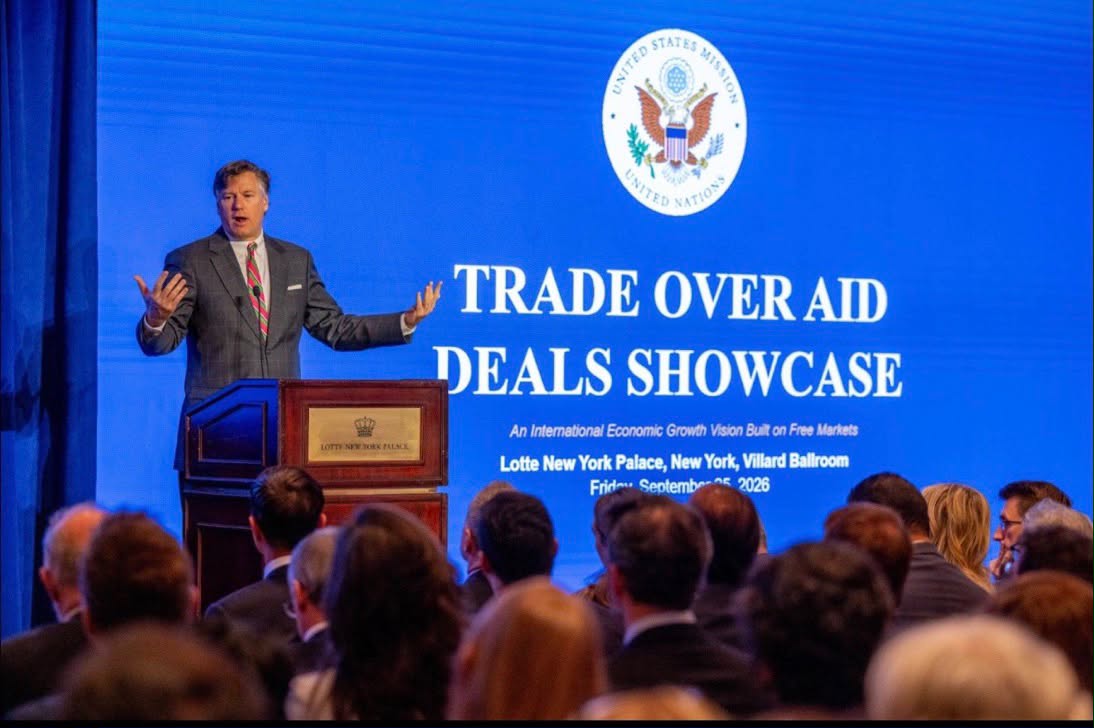
The United States has unveiled Uganda’s Roosevelt Africa Trail as the first deal under its new Trade Over Aid framework, placing an indicative $1.2 billion investment pipeline for Uganda before American investors, companies and financing institutions.
The announcement was made on September 25 during the Trade Over Aid Deals Showcase at the Lotte New York Palace on the sidelines of the 81st United Nations General Assembly High-Level Week in New York.
The showcase was hosted by U.S. Deputy Secretary of State Christopher Landau and co-hosted by U.S. Ambassador to the United Nations Mike Waltz and John Jovanovic, president and chairman of the U.S. Export-Import Bank (EXIM). Representatives of the U.S. International Development Finance Corporation (DFC) also attended.
The $1.2 billion is not a single investment or money already disbursed by the U.S. government. It represents an indicative pipeline of several proposed projects that must still undergo feasibility studies, due diligence, commercial structuring and formal financing approvals.
Among the proposed projects are a Roosevelt Africa Museum of History and Science, Library and Resort, tourism and hospitality developments, digital infrastructure and “Smart Monuments”, as well as the Roosevelt Africa Safari Coffee initiative.
The Roosevelt Africa Trail is built around former U.S. President Theodore Roosevelt’s 1909–1910 expedition through East Africa. Its promoters want to transform the historical route into a tourism and commercial corridor linking heritage sites, wildlife, technology, agriculture and investment opportunities.
In Uganda, the proposed trail runs from Lake Victoria and Entebbe through Kampala and Buganda, into Bunyoro-Kitara, including Hoima, Masindi and Butiaba, before continuing through Budongo Forest and Murchison Falls and along the Albert Nile towards Rhino Camp and Ajai Wildlife Reserve in West Nile.
The initiative also seeks to increase value addition in Uganda’s coffee sector through the proposed Roosevelt Africa Safari Coffee project, which would explore roasting, packaging, branded products and other finished coffee products for international markets.
Uganda was represented at the New York showcase by Foreign Affairs Minister Adonia Ayebare, Ambassador to the United States Robie Kakonge, officials from Uganda’s Permanent Mission to the UN and representatives of the Roosevelt Africa Trail.
The announcement follows a September 10 meeting at Uganda House in New York, where Ugandan, U.S., Kenyan and South Sudanese representatives discussed using the Roosevelt connection to promote trade, tourism, technology and investment.
The wider Roosevelt Africa Trail includes Kenya and South Sudan, but the $1.2 billion figure announced in New York applies to Uganda alone. The two other countries are expected to develop their own national projects and investment pipelines.
Under the Trade Over Aid approach, the proposed model shifts emphasis from traditional development assistance towards trade, private investment and commercially sustainable partnerships.
The next stage for Uganda will be to break down the $1.2 billion pipeline into individual projects, identify potential U.S. and Ugandan partners and determine which proposals qualify for financing through institutions such as EXIM and DFC or through private investors.