


State House and the Uganda Police Force have rejected claims that President Yoweri Museveni’s convoy caused the severe traffic gridlock that paralysed sections of the Kampala–Masaka Road overnight, describing the allegations as misleading and inaccurate.
In a statement shared by Kirunda Faruk, Special Presidential Assistant – Press & Mobilisation / Deputy Spokesperson on Tuesday, State House said it had taken note of “false claims” attributing the congestion to the President’s movements, emphasising that any road closures during presidential travel are limited, time-bound, and coordinated to minimise disruption.
“While delays are regrettable, it is inaccurate and misleading to place responsibility on the President’s convoy,” the statement said, adding that similar traffic delays were recorded during the same period last year when there were no presidential campaigns along the route.
According to the State House, the gridlock was largely caused by heavy end-of-month traffic as motorists returned from upcountry holidays, poor road discipline that led to the creation of illegal lanes, and heavy rainfall that reduced visibility and forced some drivers to stop temporarily.
The Uganda Police Force supported this position, with Directorate of Traffic and Road Safety spokesperson SP Michael Kananura stating that the congestion in Mpigi was driven by a high volume of vehicles travelling from Masaka toward Kampala, compounded by indiscipline among motorists.
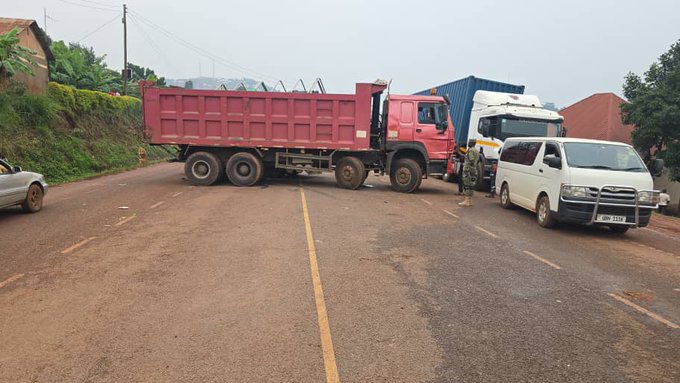
“The situation was worsened by a crash involving a truck and a lorry at Lungala that temporarily cut off the road completely, as well as a broken-down trailer around the Kamengo area,” Kananura said.
Police said traffic officers worked overnight to restore order, towing away the obstructing vehicles. ACP Norman Musinga, the Acting Deputy Director of Traffic and Road Safety, confirmed that normal traffic flow had since been restored.
However, opposition leader Robert Kyagulanyi, popularly known as Bobi Wine, blamed the disruption on President Museveni’s campaign activities in Mpigi. In a statement on X, Kyagulanyi claimed that sections of the road were blocked for hours as the President addressed supporters, forcing motorists to spend up to 20 hours on a journey that normally takes about two.
“Nobody should have the right to inconvenience citizens in this manner,” Kyagulanyi said, citing concerns for travellers transporting patients and other emergencies.
State House cautioned against politicising the incident and urged the public to consider the full context of traffic disruptions, especially during periods of heavy travel and adverse weather conditions.