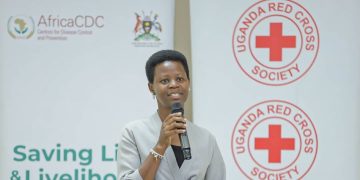




Key stakeholders recently gathered at Hotel Africana to deliberate on and evaluate the impact of the Saving Lives and Livelihoods Phase II (SLL II) project, set to conclude in December 2025. The meeting also served as a close-out session for the initiative.
Dr Josephine Okwara from Uganda Red Cross Society (URCS) explained that the project applied the Risk Communication and Community Engagement (RCCE) approach to boost vaccine uptake across communities.
She emphasised that RCCE goes beyond simply disseminating information; it enables a deeper understanding of why individuals accept or reject vaccines.
Through continuous monitoring, addressing rumours, and soliciting community feedback, RCCE ensures communication efforts are socially informed, culturally relevant and community-driven.
“Using this strategy, URCS and partners mobilised communities nationwide to embrace “life-course immunisation”, offering essential vaccines not only to children but to all age groups,” she said.
“In Greater Mubende, for instance, the project included integrated outreach services: beyond routine immunisations, communities were offered vaccinations for diseases such as hepatitis B, tetanus-diphtheria, HPV, and yellow fever, as well as maternal and child health services.”
According to recent reporting, the SLL project in Mubende has delivered hepatitis B vaccine to over 6000 individuals, including pregnant women, men and other high-risk groups, illustrating the value of combining immunisation with broader primary healthcare outreach.
Dr Okwara noted that in the earlier phase, outreach teams engaged entire households, employed mass media, and conducted door-to-door mobilisation to identify why some community members were not accessing vaccines.
Concerns ranged from a lack of information to logistical barriers. With this approach, they managed to reach many individuals. In some areas, vaccination coverage hit high percentages, especially during mass campaigns.
Dr Michael Baganizi, Assistant Commissioner for Health Services, observed that the SLL project ensured life-saving and preventive health services reached target communities across eight districts, including Mubende.
He commented that the project’s outreach model of reaching unvaccinated people through targeted campaigns was particularly effective for diseases like measles, polio and other vaccine-preventable illnesses.
The project was implemented by Amref Health Africa (Amref) in partnership with URCS, with support from Africa Centres for Disease Control and Prevention (Africa CDC) and funded by MasterCard Foundation.
Amref contributed to planning and integrating immunisation services into district health systems, while URCS mobilised communities, identified outreach areas, and supported grassroots delivery.
Dr Patrick Kamurasi, Country Director for Amref Uganda, commended the strong coordination that facilitated smooth implementation across the districts.
He noted that the success in Greater Mubende, where immunisation uptake was initially low, demonstrates how targeted outreach, community engagement, and integrated health services can significantly improve public health outcomes.