


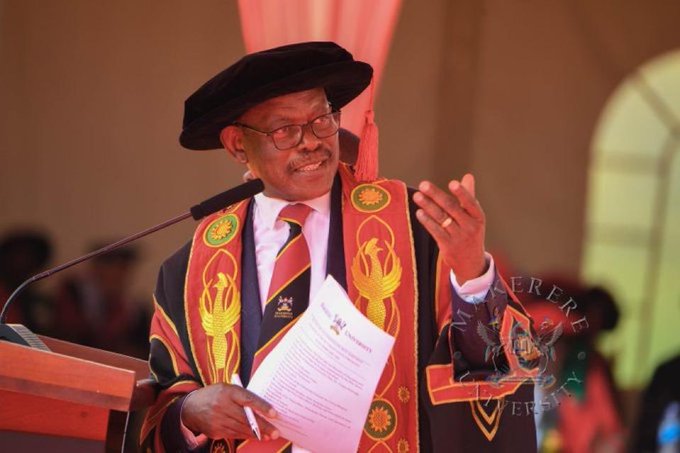
KAMPALA — Makerere University Vice-Chancellor, Prof. Barnabas Nawangwe, has hailed the institution as one of the best universities in Africa and the world, as Day Two of the 76th Graduation Ceremony saw 62 candidates conferred with PhDs.
In his opening remarks at the ceremony held at Freedom Square, Prof. Nawangwe said Makerere continues to rank top in the region, reaffirming its position as a continental leader in research, innovation and academic excellence. “Today, you are graduating from one of the best universities in Africa and the world,” he said. “Makerere has continued to rank top in the region.”
Over the four-day ceremony, the University is expected to confer a total of 213 PhD degrees across various disciplines. Ninety were awarded on the first day, bringing the total so far to 152 doctorates.
Graduands on Day Two were drawn from the College of Natural Sciences (CoNAS), the College of Veterinary Medicine, Animal Resources and Biosecurity (CoVAB), the College of Health Sciences (CHS), and the School of Public Health.
Driving Innovation and Research Impact
Prof. Nawangwe highlighted major strides in research and innovation, noting that through the Makerere Research and Innovations Fund (Mak-RIF), the University has supported more than 1,400 high-impact projects.
“I express appreciation to the Government of Uganda for entrusting Makerere with critical resources to support more than 1,400 high-impact research and innovation projects,” he said. “The Fund has deepened Makerere’s contribution to national development priorities by creating practical and innovative solutions to everyday challenges.”
He added that more than 200 PhD students have been supported through the initiative, while the University has provided evidence-based policy recommendations to the government in areas such as land management, energy and minerals, peace and security, and education.
Expanding Digital and Distance Learning
The Vice-Chancellor also underscored efforts to strengthen distance and online learning.
The College of Education and External Studies (CEES), through the Institute of Open, Distance and eLearning, in collaboration with the College of Engineering, Design, Art and Technology (CEDAT), is implementing a KOICA-funded project to enhance the distance education environment.
“This project has led to the development and approval of a 10-year Distance Education Master Plan (2025–2035),” Prof. Nawangwe said.
He added that Makerere is working with the Mastercard Foundation to finalise Phase II of its eLearning Initiative, after successfully completing Phase I. “These efforts demonstrate Makerere’s commitment to integrating online learning programs with face-to-face programs,” he said.
In 2025, CEES coordinated eight partner institutions and secured a €1 million ERASMUS+ grant to champion the institutionalisation of Competence-Based Education in East and West Africa — a move that positions Makerere as a continental leader.
AI Innovation Gains Continental Recognition
On the innovation front, the College of Computing and Information Sciences (CoCIS) gained continental recognition after one of its Computer Science finalists won the Best Pitch Award at the Africa Innovation Fellowship bootcamp in Johannesburg.
The student developed “FloralIntel,” an artificial intelligence-driven digital health solution that uses computer vision and machine learning to identify medicinal plants and connect users to certified herbalists.
By digitising indigenous knowledge traditionally passed down orally, the innovation bridges the gap between traditional medicine and modern healthcare systems.
Agricultural Breakthroughs
The College of Agricultural and Environmental Sciences (CAES) also registered a notable impact in 2025 through the Healthy Soy Initiative aimed at combating child malnutrition in the face of climate change.
Additionally, research led by Prof. Archileo Kaaya under the Department of Food Technology and Nutrition boosted Uganda’s cocoa industry through innovative technology and value addition during primary processing. “Over 70 percent of farmers across Uganda’s major cocoa-producing districts have adopted this technology,” the University reported.
Law Students Shine
In academic performance, 94 percent of Makerere Law students who sat the 2025 pre-entry examinations for the Law Development Centre’s Postgraduate Diploma in Legal Practice passed and were admitted.
Message to Graduates: Create Opportunities
Addressing the graduands, Prof. Nawangwe praised them for upholding discipline and scholarship. “You have been wonderful students, displaying the highest standards of discipline and scholarship, and we are proud of you,” he said. “You are all graduating with disciplines that are needed by society. We have equipped you with the knowledge and skills that will make you employable or create your own businesses and employ others.”
He urged them not to be discouraged by unemployment. “Do not despair if you cannot find employment. Instead, reflect on the immense opportunities around you and rise to the occasion as an entrepreneur,” he said.
He also invited graduates to participate in the University’s Careers Fair scheduled for March 11–13, 2026, aimed at connecting recent graduates and students with industry partners.
Excellence Must Be Empowered
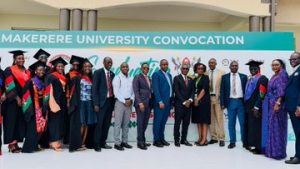
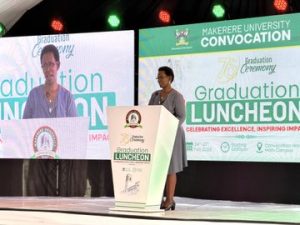
At the Makerere University Convocation Graduation Luncheon, Chief Guest and The Minister of State for Youth and Children Affairs, Balaam Barugahara Ateenyi, said the institution must not only celebrate excellence but empower it.
“These outstanding scholars represent the very best of scientific promise,” he said. “Excellence must not only be celebrated — it must be empowered.”
Dr Diana Atwine, Permanent Secretary, Ministry of Health, another speaker at the luncheon, reminded graduates that success in today’s world requires more than academic credentials.
“Today it takes more than a degree,” she said. “You must compete, innovate, go beyond the paper qualification, and intentionally build a strong personal brand.”
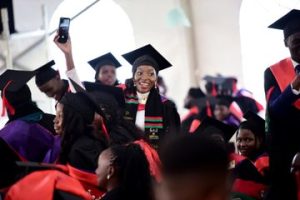
As celebrations continue at Freedom Square, the overarching message to the Class of 2026 remains clear: Makerere has equipped them with knowledge — the next step is to transform it into impact.