




The Uganda Bureau of Statistics (UBOS) has distributed 4,050 tablets and six computers to cultural and religious institutions, government agencies, and select universities, aiming to boost data collection, management, and evidence-based planning across the country.
UBOS Executive Director Dr Chris Mukiza revealed that this distribution marks the second batch of post-census redeployments, following the first allocation to public universities, charitable institutions, and local governments through the Ministry of ICT. Each parish in Uganda has now received two tablets to enhance grassroots administrative data systems.
“With these tools, we aim to enhance automation and ensure the timely production of statistics,” Dr Mukiza said. “When we all participated in the Census, we saw how technology reduced turnaround time. We produced the Final Report within six months and Area-Based Profiles within a year.”

The devices, some of which were used during the 2024 population census, include 3,050 tablets and three computers allocated to the Inter-Religious Council, with UBOS urging religious leaders to leverage them not only for spiritual guidance but also for research and economic development.
Earlier in June 2025, UBOS released 5,195 tablets to cultural institutions, kingdoms, and selected public universities, supporting capacity building across Uganda’s statistical domain.
For instance, the Kingdom of Buganda, under UBOS technical guidance, has published the ‘Manya Esaza Lyo’ series, enabling easier fulfilment of the National Statistical System mandate.
Leaders Laud the Initiative
Dr Ruth Aisha Kasolo Biyinzika, board member of the Presidential CEO Forum (PCF) Uganda, said the tablets strengthen dialogue and informed decision-making across public and private sectors:

“We can no longer ignore digitalisation. Apart from research, it is also about access to knowledge…These gadgets support learning and e-learning, faster decision-making, and enable us to be more forward-looking.”
Dr Rogers Matte, Director of Research & Development Performance at the National Planning Authority, emphasised the importance of reliable data for national planning:

“When data management is done well, it informs the planning process, enables us to set measurable targets, and helps monitor progress. These tools will strengthen our statistical ecosystem and support effective planning.”
Hon. Kule Baritazale Benson, Prime Minister of Obusinga Bwa Rwenzururu, highlighted the value of the devices for cultural and social programs:
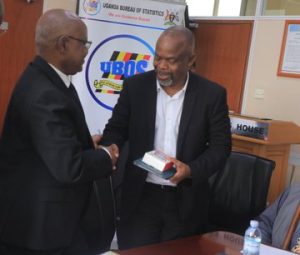
“We have a number of ongoing initiatives…We are certainly going to make good use of these tablets…With proper training and guidance, we shall be able to use these tablets much better and more efficiently.”
Dr Clarence Wan Kimasega Masiga, Deputy Prime Minister of the Bugisu Kingdom, said the tablets will support community development initiatives and data collection across the kingdom’s 457 clans:
“We now have the tools and equipment. The next step is technical support and training so that we can work hand in hand with UBOS and ensure we use these tools effectively.”

Strengthening Uganda’s National Statistical System
UBOS, through its Directorate of Methodology and Statistical Coordination Services, will continue engaging beneficiary institutions to develop Statistical Sector Strategic Plans (SSPs) with clear periodic inputs and outputs across the statistical value chain.
“UBOS remains committed to sustained technical support and coordination of the National Statistical System to ensure harmonised, automated, and efficient statistical systems nationwide,” Dr Mukiza concluded.
The tablet deployment is part of a broader effort to modernise Uganda’s data infrastructure, improve the production of high-quality statistics, and foster evidence-based decision-making at national and local levels.