




Uganda Airlines Chief Executive Officer Jenifer Bamuturaki has emphasised that aviation is ultimately about people—both passengers and professionals behind the scenes.
She was speaking during a high-level Aviation and Youth Seminar that brought together global aerospace leader Boeing, the national carrier Uganda Airlines, and the U.S. Embassy in Uganda to chart clear pathways for Ugandan students seeking careers in aviation and related fields, held at Makerere University on December 8, 2025.
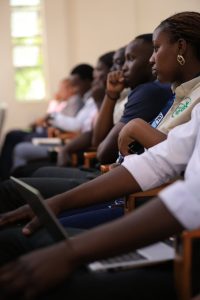
Held under the theme “The Future Starts With You: Aviation & Youth – Connecting Education, Tourism, and National Development,” the engagement drew hundreds of students from science, engineering, and technology disciplines, eager to learn what it takes to enter one of the world’s most dynamic industries.
Reliability, Safety, and People at the Centre
“Much of what we do at Uganda Airlines is driven by customer experience and service reliability, especially when disruptions occur,” Bamuturaki said. “When flights are delayed—particularly delays exceeding three hours—we follow established procedures to support passengers through rebooking, accommodation arrangements, and ensuring they are treated with dignity and care.”
She explained that while delays are sometimes unavoidable, safety remains non-negotiable. “Aviation machines are complex, and proper maintenance and checks are not optional,” she said. “While this may occasionally inconvenience passengers, it is essential for long-term reliability and safety.”
Beyond operations, Bamuturaki highlighted Uganda Airlines’ broader national role through partnerships with tourism stakeholders, insurers, government agencies, and the media.
“We work closely with the tourism sector to promote Uganda as a destination, supporting national parks, tour operators, and travel agencies,” she noted. “Ultimately, Uganda Airlines exists to serve Ugandans and the region, guided by the goal of building a reliable, trusted, and sustainable national airline.”

Global Skills Gap Presents Opportunity for Ugandan Youth
From the cockpit perspective, Captain Tonny Tebajanga, a pilot with Uganda Airlines, painted a clear picture of global demand for aviation skills.
“Industry projections show a global gap of about 2.37 million aviation professionals over the next 20 years,” he said, citing the Boeing Pilot and Technician Outlook. “Within the next five to ten years alone, the industry will require thousands of pilots and aircraft technicians.”
For a young airline like Uganda Airlines, he said, this reality demands deliberate investment in skills development. “We must move into skilling, reskilling, cross-skilling, and up-skilling,” Tebajanga explained. “Simply put, we must build a sustainable pipeline and nurture the next generation.”
He advised aspiring pilots to focus on cognitive skills, especially situational awareness. “Automation is powerful, but the cockpit is the aircraft’s brain,” he cautioned. “If incorrect data is entered, the aircraft will faithfully execute the wrong instruction. That is why validation, cross-checking, and situational awareness are critical.”

Engineering: From Classroom to Hangar
Uganda Airlines’ HR and Administration Lead, John Kasangaki, told Makerere students that pilots and engineers remain the most in-demand skills globally. “Where there is a pilot, there must be an engineer,” Kasangaki said. “They are inseparable.”
He revealed that Uganda Airlines has already introduced a Graduate Training Programme to grow licensed aircraft engineers and is planning long-term partnerships with aviation schools to develop a local pilot pipeline. “We want to identify young talent early, nurture it, and gradually integrate trainees into our workforce,” he said.
On the technical front, Eng. Joseph Lukwago, Head of Line Maintenance, stressed the importance of system-level thinking. “Modern aircraft are highly complex,” Lukwago said. “The most critical skill is structured troubleshooting—understanding systems deeply and isolating faults logically, not guessing.”
He encouraged students to embrace training and apprenticeship with humility. “In aviation, learning never stops,” he said. “Training builds discipline, teamwork, and competence—and that is what produces safe aircraft and reliable airlines.”

From Makerere to Boeing: A Career Journey
One of the most inspiring sessions came from Racheal Ssentongo, a Ugandan Mechanical Analysis and Design Engineer at Boeing in Seattle, who shared her journey from university internships to working on aircraft systems.
“I had the opportunity to do three internships while I was still in school,” Ssentongo said. “I worked in environmental control systems and airplane integration, learning how aircraft are sized—from fuselage to wings and tail.”
She explained her current work on cabin pressurisation systems, a critical safety component of modern aircraft. “At 36,000 feet, there is not enough pressure for human survival,” she explained. “Our systems maintain safe and comfortable cabin pressure, and my role involves verifying safety requirements, running simulations, and testing components under extreme conditions like lightning, dust, and sand.”
Philomena Nakyanja, Development Engineer at Uganda Airlines, shared her journey from mechanical engineering into aviation, explaining how early industry exposure led her to a career she is passionate about at Uganda Airlines. “I trained as a mechanical engineer and only discovered aviation when industry representatives came to our class, which completely changed my career path.”
She highlighted her role as a Development Engineer, where she tracks engine usage data to ensure timely maintenance and safe aircraft operations. “My role is to track engine usage and communicate upcoming maintenance needs so that our aircraft remain safe, reliable, and operational.”

Sustainability and Africa’s Youth Advantage
Speaking for Boeing, Regional Marketing Director Hamza Bunnya placed Africa’s aviation future in a global context, highlighting sustainability and demographics as key drivers.
“Fuel accounts for roughly 40 to 50 percent of airline operating costs, which makes efficiency and innovation critical,” Bunnya said. “Sustainability is not just philosophical—it is practical.”
He pointed to sustainable aviation fuels, new aircraft technologies, and green jobs as emerging opportunities, especially for Africa. “Africa has a young population advantage,” he said. “If properly harnessed, aviation can support thousands of jobs across engineering, operations, data, research, and technology.”
Education and Exchange at the Core
The U.S. Embassy’s Education and Culture Attaché, Lana Surface, linked aviation innovation to America’s long tradition of scientific leadership as the country approaches its 250th anniversary. “We went to the moon, broke the sound barrier, and now stand at the doorstep of Mars,” she said. “Innovation thrives when education and opportunity are accessible to all.”

Surface reaffirmed the Embassy’s commitment to Makerere University and Ugandan students through EducationUSA advising, exchange programs, and resources at the American Centre.
“Strengthening innovation and talent begins right here in the classroom,” she said. “That is why we are proud to stand alongside Boeing and Uganda Airlines to build pathways for students into aviation.”
Bridging Education and Industry
Welcoming the partners, Dr Julia Kigozi, Dean at Makerere University, said the engagement reflects the university’s commitment to preparing students for real-world careers. “Sometimes school can feel like a separate place,” she said. “But when students meet professionals here, they begin to see how everything connects.”
She added that such interactions help students confidently transition from lecture rooms to professional environments.
The forum underscored a growing partnership between academia, industry, and government to close skills gaps, prepare the next generation of aviation professionals, and position Uganda to benefit from global aviation growth.