


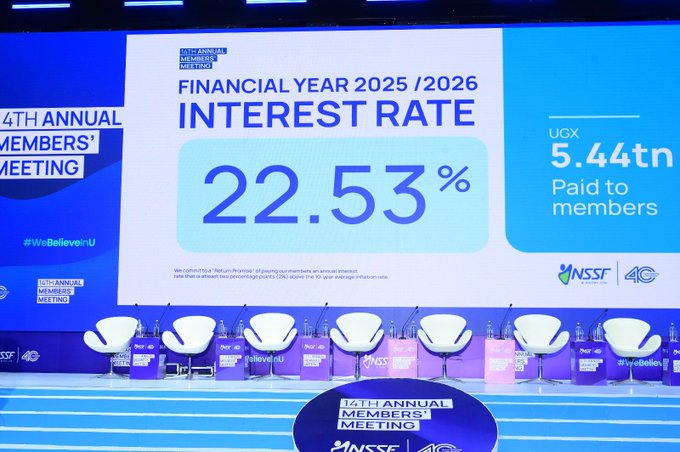
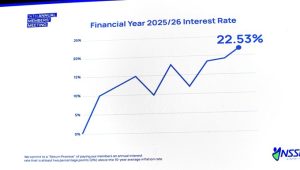
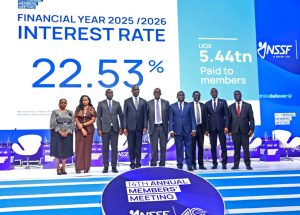
The National Social Security Fund (NSSF) has declared an interest rate of 22.53% for the financial year 2025/26, significantly increasing the return credited to members’ savings from the 13.5% declared for the previous financial year.
This is the highest interest rate in the 40-year history of the Fund, with a total of Shs 5.44 trillion to be credited to members’ accounts.
The rate was announced on Thursday by Finance Minister Henry Musasizi at the 14th NSSF Annual Members’ Meeting in Kampala, following the Fund’s financial performance for the year ended June 30, 2026.
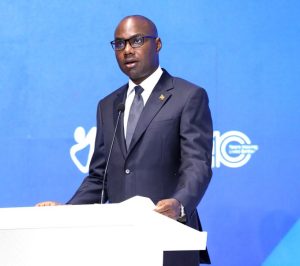
Musasizi said the rate is above the 10-year average inflation of 4.1% and the 3.7% inflation recorded at the end of June 2026, commending NSSF for its record performance and its position as the largest pension fund in East Africa, noting its growing contribution to long-term savings and Uganda’s socio-economic transformation.
“Uganda’s savings rate currently stands at 24% of GDP, but needs to rise to 40% by 2040 to match the level of investment required to support the country’s growth ambitions.”
Musasizi further commended NSSF for investing in strategic infrastructure and other projects, while stressing that members’ savings must remain protected to generate competitive, risk-adjusted returns through commercially viable, professionally appraised and prudently governed investments.
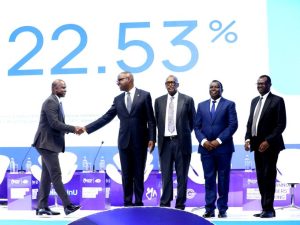
He encouraged farmers, market vendors, students, boda boda riders and other informal-sector workers to take advantage of NSSF savings products and build long-term savings.
The declaration follows strong growth in the Fund’s assets and investment income during the financial year.
NSSF Managing Director Patrick Ayota said the Fund’s total assets increased by Shs 6.86 trillion to Shs 32.87 trillion during the financial year, putting it on course towards its Vision 2030 target of Shs 80 trillion.
The Fund collected Shs 2.42 trillion in member contributions, up from Shs 2.13 trillion in 2024/25. The Fund’s total income rose sharply during the year from Shs 3.51 trillion to about Shs 6.51 trillion.
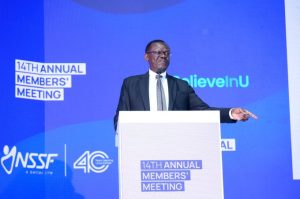
According to Ayota, NSSF aims to increase coverage to 15 million savers, equivalent to 50% of working Ugandans, while growing the Fund to Shs 88 trillion and achieving 95% stakeholder engagement.
During the year, NSSF attracted 311,000 new members, taking coverage to 24.1% by June 2026. Additionally, 55,000 dormant members were reactivated, and the Fund paid Shs 1.5 trillion in benefits to 50,499 members.
Ayota said NSSF deployed Shs 4.54 trillion in investments during the year, with Shs 4.32 trillion invested in Uganda. About 76% of the domestic investments were in bonds, alongside investments in equities and real estate.
The Fund also held Shs 10.2 trillion in regional investments across Kenya, Tanzania and Rwanda as part of its diversification strategy. “We impact the nation in three ways: through our investments, our operations, and our payouts to members,” Ayota said.
Ayota also highlighted the Fund’s wider economic contribution, including Shs 301 billion in taxes. The average turnaround time for benefit payments also fell to about 4.5 days, compared with nearly two weeks in 2021/22.
The Auditor General, Edward Akol, said KPMG Certified Public Accountants had audited the Fund’s financial statements on his behalf. Akol said the audit covered NSSF’s financial position as at June 30, 2026, its changes in net assets and reserves, cash flows and accompanying notes.
“In my opinion, the accompanying financial statements present the true and fair view of the financial position of the Fund,” Akol said.
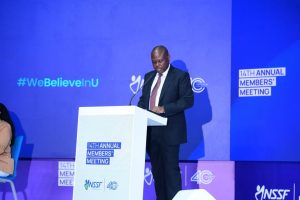
The Minister of Gender Minister Gen Henry Tumukunde, challenged NSSF to move beyond safeguarding workers’ savings and position the Fund as a stronger catalyst for Uganda’s economic transformation.
“NSSF must increasingly see itself not simply as a custodian of savings but a catalyst for economic transformation.”
He said the Fund manages workers’ private savings and must ensure the resources are protected from erosion of value, prudently invested and deployed in initiatives that generate measurable value. “This is a financial institution. It must run on the rules and competitiveness of a proper financial institution,” he said.
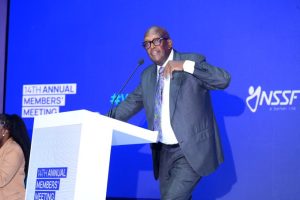
NSSF unveils Vision 2035
At the meeting, Ayota also unveiled NSSF’s Vision 2035, which he said is built around increasing both Ugandans’ willingness and capacity to save.
“Our Vision 2035 strategy is built on two pillars: creating a willingness to save and creating the capacity to save. It’s not enough to tell people to save. We must also give them the ability to do so,” he said.
The Fund said more than 575,000 people have participated in its financial literacy programmes since 2019, including more than 137,000 during 2025/26. Its digital financial-literacy content reached more than 14.4 million people during the year.
NSSF has also been expanding its reach beyond traditional salaried workers, including through voluntary savings products and plans targeting Ugandans in the diaspora.
The Fund is Uganda’s mandatory social-security scheme for employees in the private sector who are not covered by the government pension scheme.
The 22.53% declaration surpasses the previous record of 15% set in FY2017/18.