



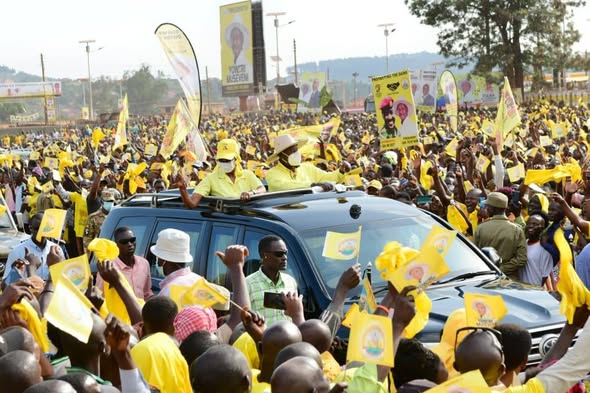
President Yoweri Kaguta Museveni has assured Ugandans that the long-awaited minimum wage will be established once the government completes key interventions aimed at enabling investors to operate sustainably and profitably.
Speaking on Saturday, 3rd January 2026, during a campaign rally in Lugazi Municipality, Buikwe District, President Museveni said the government is deliberately sequencing reforms to avoid harming businesses and job creation.
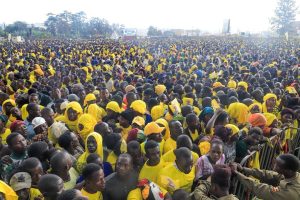
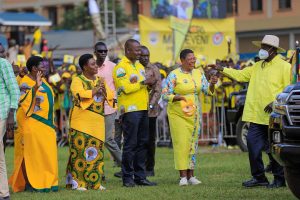
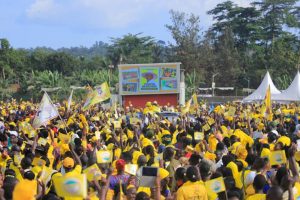
President Museveni, who is also the National Resistance Movement (NRM) flagbearer for the 2026 general elections, was accompanied by the First Lady and Minister of Education and Sports, Maama Janet Kataaha Museveni, as he addressed thousands of supporters who braved a heavy downpour to attend the rally.
The President acknowledged growing public concern over low wages, especially among workers in factories, farms, and service industries, but emphasised that introducing a minimum wage prematurely could backfire. “We are still handling the issues of salaries, and we have not concluded. Why? It is because we are still organising the manufacturing sector, and our job has been to attract more investors,” he said.
He explained that Uganda’s strategy has focused on first creating conditions that reduce the cost of production, allowing investors to remain competitive while paying workers better in the long run. “These different forms of wealth — commercial agriculture, factories, hotels, and ICT — have created jobs and wealth for our people, but there is the issue of wages or salaries for workers,” he said.
President Museveni cited peace and regional market access as the foundation of Uganda’s industrial growth, noting that the East African Community (EAC) market provides a ready destination for locally manufactured goods. “First of all, we created peace. Secondly, we created the East African Community market so that when we produce, we have somewhere to sell,” he said.
Lowering production costs:
The President outlined three major areas the government is prioritising before implementing a minimum wage: electricity costs, transport infrastructure, and access to affordable credit. “One of the things we must do is to get enough electricity so that investors can have low electricity costs,” President Museveni said, adding that energy affordability remains a key determinant of factory profitability.
He also pointed to transport costs, particularly the movement of goods between Uganda and the Kenyan port of Mombasa. “That’s why our solution is the railway, which has lower transport costs than road transport,” he said, noting that cheaper logistics would allow manufacturers to save costs and improve worker pay.
On access to finance, President Museveni said the government is working to reduce interest rates so that businesses can borrow at affordable terms. “The cost of money in the banks must come down so that investors can borrow at a low interest rate,” he said.
According to President Museveni, once these structural challenges are addressed, the government will proceed with setting and enforcing a minimum wage. “When you hear people talking about the minimum wage, we are planning for it, but we have not implemented it because we still have assignments on our side,” he explained.
The NRM candidate cautioned that imposing wage regulations too early could push investors out of the country. “If we become harsh on them now, they will make losses and take their business elsewhere or collapse and go away from Uganda,” he said.
The President also clarified the division of responsibility between the government and investors. “The assignment of the investor is to set up the factory using their money and create jobs. Ours is to make sure there is peace in the country, make electricity affordable, provide low-cost transport, and reduce the cost of money in the banks,” he said.
Drawing from his guerrilla warfare background, President Museveni likened the government’s approach to military strategy. “We are guerrillas. While in Luwero, we did not attack Kampala immediately, even though it was very near. We could not do it until we were ready,” he said, adding that patience and timing are critical in economic transformation.
President Museveni also addressed land disputes, particularly on Mailo land, which have increasingly affected communities in central Uganda. He announced that Attorney General Kiryowa Kiwanuka would be tasked to clarify the matter publicly. “I will ask the Attorney General to clarify the issue of land on TV so that people understand their rights,” President Museveni said.
Turning to the NRM’s manifesto, President Museveni outlined what he described as the party’s seven key contributions to Uganda over the last four decades. “The first one is peace. Development is the second — roads, health centres, schools, electricity, and water,” he said, adding that government records demonstrate tangible progress in these areas.
The third pillar, he said, is wealth creation at the household level. “The NRM insists on wealth per family and household. You don’t sleep on the tarmac road; you sleep in your house,” President Museveni said, revisiting the Four-Acre Model, first introduced in the 1996 NRM manifesto, which allocates land for coffee, fruits, pasture, and food crops, supported by backyard enterprises such as poultry, piggery, and fish farming.
He cited success stories under the Parish Development Model (PDM), including that of Harriet Nampa from Mangaliba village in Mukono District. “This lady feared the Shs1 million PDM money because she had never touched one million in her entire life. She received Shs500,000 and invested in piggery,” he said.
According to the President, Nampa’s piggery business grew to over Shs4 million, enabling her to buy a cow and venture into dairy farming. “These are small-scale people who are just starting, and many more are doing well,” he said.
President Museveni also cited large-scale agricultural success stories, including Kalera Phillip of Gomba District, who operates a demonstration farm that began in 2003.
He said Kalera diversified into Friesian dairy cows, coffee on 50 acres, poultry, and other ventures after initially struggling with poor rearing methods. “He harvests coffee twice a year, earning between Shs18 million and Shs20 million per acre, and Shs9 million from matooke alone per harvest,” President Museveni noted.
The farmer reportedly earns over Shs1.5 billion annually in profit. On employment, the President emphasised that jobs are generated through commercial agriculture, manufacturing/artisanship, services, and ICT.
He cited Johnson Basangwa of Jeka Poultry Farm in Kamuli District, who earns about Shs20 million daily from egg production and employs over 300 people. “You here in Lugazi have testimonies of sugar factories where many of your children are working,” President Museveni said.
He highlighted industrial parks such as Sino-Mbale, which hosts 75 factories employing about 12,000 workers, and Namanve Industrial Park, with 273 factories employing over 24,000 people. “Mukono also has many factories employing our youths,” he added.
President Museveni urged citizens to actively monitor PDM funds to prevent misuse. “All of you should ask the SACCO committee where the PDM money is. You need to learn to follow up on what belongs to you,” he said.
He acknowledged past challenges with earlier programs such as Entandikwa, NAADS, and Operation Wealth Creation, which were criticised for benefiting a few individuals. “That’s why we decided to work directly with the poor people at the parish level,” President Museveni said.
On her part, while addressing the crowd, the First Lady, Maama Janet, praised residents for enduring the rain to attend the rally. “Sometimes we stand in the sun, sometimes in the rain, to build Uganda,” she said, crediting Uganda’s progress to peace, stability, and unity, urging voters to renew NRM’s mandate. “We must stretch out our hands and vote for NRM so that our children and grandchildren can be proud of the Uganda we are building,” she said.
NRM Second National Vice Chairperson and Speaker of Parliament, Rt. Hon. Annet Anita Among informed the President that Buikwe District faces challenges of absentee landlords and alleged theft of PDM funds. She called for investigations into the misuse of public resources.
The rally marked his final campaign stop in greater Mukono after canvassing Buvuma, Kayunga, and Mukono districts.