



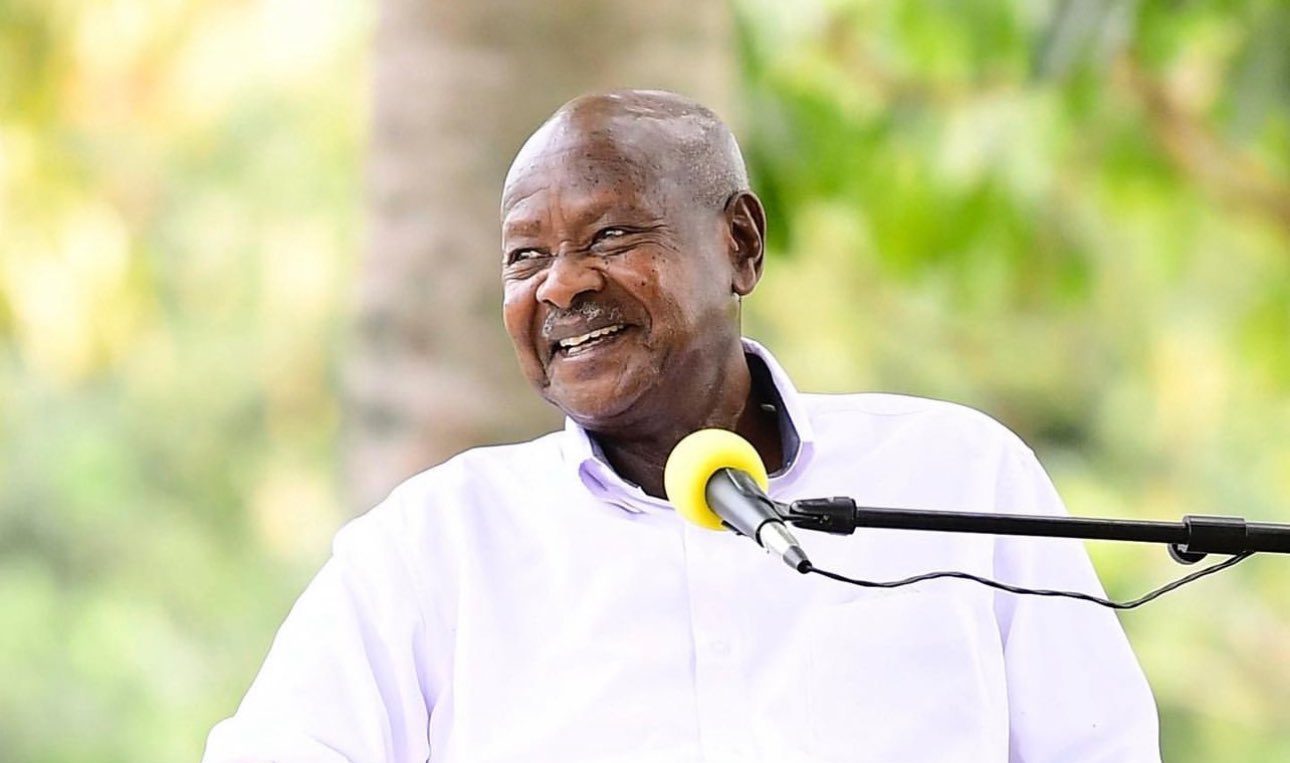
President Yoweri Kaguta Museveni has outlined what he described as Uganda’s steady economic transformation over the past four decades, saying the country has moved through five key phases of development and is now firmly in lower-middle-income status.
In his Presidential End-of-Year Address delivered on December 31, 2025, Museveni said Uganda’s economy has evolved from post-conflict recovery to a knowledge-based economy, driven by export growth, value addition, industrialisation and expanded access to education and health services.
“The economy has progressed through five phases: the minimum recovery phase, expansion of the small colonial economy, diversification by converting more products into cash commodities, value addition, and finally the knowledge economy,” Museveni said.
According to the President, Uganda’s economic size is projected to reach USD 68.4 billion by June 2026 using the exchange-rate method and USD 194.2 billion by purchasing power parity (PPP), marking a dramatic increase from USD 3.92 billion in 1986.
“In other words, the economy has grown 17 times in size since 1986,” Museveni said. “The GDP per capita will be USD 1,399, meaning that Uganda is now firmly in the lower middle-income status and out of the Least Developed Countries status.”
Museveni pointed to export growth as a key indicator of progress, noting that Uganda is now earning more from exports than it spends on imports.
“We have even entered a new phase when our export earnings for goods and services are exceeding our import bill of USD 11.03 billion,” he said. “The export earnings are USD 13.4 billion per year now. This means our balance of payment surplus is 2.37 billion.”
He cited major gains in agriculture, tourism and manufacturing, highlighting increases in production volumes since 1986.
“In quantitative terms, coffee exports were 3 million 60-kilogram bags in 1986 and now 8.2 million,” Museveni said. “Bananas have grown from 6.6 million metric tonnes to 11 million; maize from 322,000 metric tonnes to 4 million; milk from 200 million litres to 5.4 billion litres.”
The President added that Uganda has grown from having almost no tourist arrivals to about 1.6 million visitors annually, and from fewer than 1,000 hotel beds to about 150,000.
Museveni also said industrial growth has accelerated, with factories now spread across the country. “Have you heard that Uganda has now got more than 50,000 factories employing over 823,000 people?” he asked. “The services sector has created 6.03 million jobs, commercial agriculture employs 3.8 million people, and the ICT sector employs 2.3 million.”
Despite the progress, Museveni acknowledged that challenges remain. “We still have poor people, unemployed graduates, bad roads, and corruption,” he said. “All these will be solved. We have already brought 70% of homesteads into the money economy.”
He noted that at Independence in 1962, only 9 percent of households were part of the money economy, compared to 32 percent in 2013. “We have already moved 70% of the homesteads into the money economy,” Museveni said, contrasting this with what he described as subsistence living in earlier decades.
On education, Museveni said free primary and secondary education introduced in 1997 has benefited about 20 million children, but warned that corruption and commercialisation at local levels had undermined the gains.
“A total of 20 million children have benefited from free education for Primary and Secondary Schools,” he said. “Then the local elite came and started extracting money from the poor families… That has led to the children dropping out of school.”
He said the government would address the problem through increased teacher recruitment, better funding and a renewed focus on practical skills. “The whole education system will emphasise the issue of skills (emyooga),” Museveni said, adding that his government’s skilling hubs were already providing fully funded training.
Museveni linked skills training to Uganda’s pre-colonial economic structure, arguing that communities traditionally thrived through specialised trades.
“The pre-colonial Uganda was of communities of emyooga — cattle-keepers, cultivators, blacksmiths, shoe-makers, bark-cloth makers, surgeons and healers,” he said. “It is, therefore, correct that the educational system goes back to the strategy of modernised emyooga.”
The President also defended government wealth-creation programs such as NAADS, Operation Wealth Creation, Emyooga, the Youth Fund and the Parish Development Model (PDM), saying those who embraced them were seeing results.
“Those who listened are doing very well,” Museveni said, citing beneficiaries from Butambala, Lira, Abim, Serere and other districts.
Reflecting on agricultural transformation across the country, Museveni said visible progress could be seen from the air. “When I fly over the Cattle Corridor and see the well-fenced farms… over Masaka, Rakai and Ssembabule with coffee gardens… over Kalangala with palm trees… You realise that our efforts have not been in vain,” he said. “Anybody who downplays these achievements is an enemy of Uganda.”
On governance, Museveni said corruption remains a concern but vowed firm action. “We will continue bringing corrupt government officials to Jesus Christ and Mohammad to save them from corruption,” he said, “and also axe the incorrigible ones.”
The address capped a year in which the government has emphasised economic growth, industrialisation and wealth creation, even as public debate continues over inequality, service delivery and governance ahead of the 2026 general elections.