


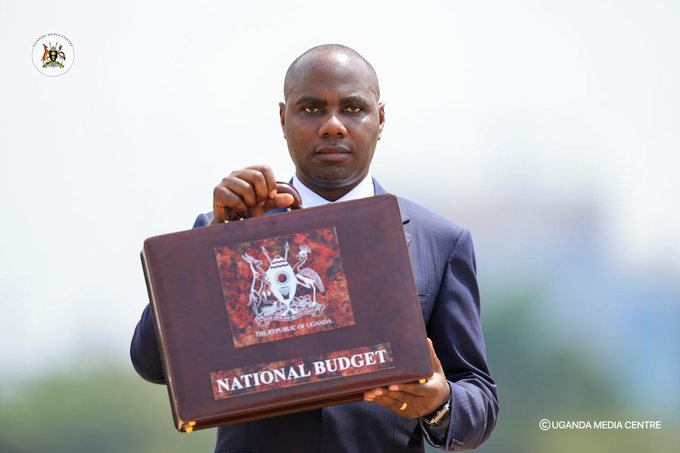
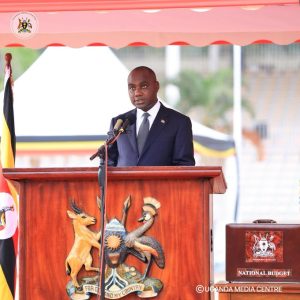
KAMPALA — Finance Minister Henry Musasizi on Thursday presented the national budget for the 2026/27 financial year, unveiling a spending plan focused on wealth creation, industrialisation, infrastructure development, human capital development and job creation.
Delivering the Budget Speech during the Fifth Sitting of the First Meeting of the First Session of Uganda’s 12th Parliament, Musasizi said the government’s strategy remains anchored on transforming Uganda into a modern and prosperous economy under the National Development Plan IV and Vision 2040.
The minister told Parliament that the government had registered significant economic progress despite global and regional challenges.
“Mr. Speaker, Uganda’s economy remains resilient and is projected to continue growing strongly. Our focus remains on creating wealth, expanding jobs, increasing household incomes and improving the quality of life of all Ugandans,” Musasizi said.
He noted that government investments in agriculture, tourism, minerals and science and technology, collectively known as the ATMS strategy, were beginning to yield results across the economy.
Health Sector Gets Shs5.23 Trillion
Musasizi announced that the health sector had been allocated Shs5.23 trillion in the 2026/27 financial year to improve healthcare delivery and strengthen specialised medical services.
“Mr. Speaker, Government has allocated Shs 5.23 trillion to the health sector in FY 2026/27,” he said. “The funding will focus on maternal and child health, nutrition improvement, expanded immunisation, prevention and treatment of non-communicable diseases, provision of essential medicines, strengthening specialised healthcare services, improving emergency response systems and exploring feasible pathways towards Universal Health Coverage.”
The minister highlighted ongoing investments in specialised health infrastructure, including the Uganda Heart Institute Cardiac Hospital in Naguru and the International Specialised Hospital of Uganda in Lubowa.
“The Cardiac Hospital in Naguru is 44 percent complete and expected to be completed by June 2027, while the International Specialised Hospital of Uganda at Lubowa is 75 percent complete and will be completed in December 2027,” he said.
He added that the Nuclear Medicine PET Centre for cancer treatment was nearing completion and that regional cancer centres were under construction in several parts of the country.
More Funding for Education and Teachers
The education sector received one of the largest allocations in the budget, with Shs6.66 trillion earmarked for improving access and quality.
Musasizi said government would continue supporting Universal Primary Education (UPE) and Universal Secondary Education (USE), while strengthening science, technology, engineering and mathematics (STEM) education.
“Approximately 9.52 million learners benefited from UPE, while about 995,116 learners benefited from USE and Universal Post O-Level Education and Training,” he said.
He announced a major boost for teachers.
“Beginning FY 2026/27, an additional Shs568.65 billion has been allocated to enhance salaries for primary school teachers and arts teachers in secondary schools and BTVET institutions,” Musasizi told Parliament.
The minister also reported progress on sports infrastructure ahead of the 2027 Africa Cup of Nations (AFCON).
“In preparation for AFCON 2027, Hoima Stadium has been completed, upgrades to Namboole Stadium are progressing well, and other required tournament facilities remain on schedule. Further, construction of Akii-Bua Stadium is on schedule,” he said.
Water and Sanitation Expansion
Government allocated Shs1.013 trillion to expand access to clean water and sanitation services.
Musasizi said access to improved water sources had reached 71 percent nationally, with coverage standing at 68 percent in rural areas and 74.5 percent in urban areas.
“During FY 2025/26, safe water access was extended to 553 villages. Over 200 large solar-powered water and sanitation systems, several public sanitation facilities and faecal sludge treatment plants were completed in several districts,” he said.
Social Protection and Older Persons
The minister said government would continue supporting vulnerable populations through targeted social protection programmes.
“Government has continued to support older persons through the Social Assistance Grant for Empowerment (SAGE), which has cumulatively reached 489,673 beneficiaries with a total of Shs836.1 billion,” Musasizi said.
He added that the Special Enterprise Grant for Older Persons had supported more than 17,000 beneficiaries with approximately Shs13 billion.
For the next financial year, government allocated Shs173.55 billion to social protection programmes focusing on youth employment, women’s economic participation, labour standards and social protection systems.
Industrialisation and Manufacturing
Musasizi said industrialisation remained central to Uganda’s development agenda.
“Mr. Speaker, nations achieve prosperity not by exporting raw materials but by transforming them into high-value products. For this reason, Government places high priority on industrial development, manufacturing and value addition,” he said.
He reported that the number of formal factories in Uganda had risen to 10,437, with 690 located within industrial parks.
To accelerate industrial growth, government allocated Shs1.03 trillion to the manufacturing sector.
“Priority interventions include additional capitalisation of Uganda Development Corporation, industrial infrastructure development, value addition to agricultural raw materials and minerals, supporting market access for Ugandan manufactured products and strengthening Special Economic Zones,” Musasizi said.
He also highlighted the growth of Presidential Industrial Hubs, saying 82,790 youth had so far received vocational and industrial skills training.
Boosting Exports and Market Access
Musasizi said Uganda was pursuing deeper regional integration and strengthening access to international markets.
“Export growth requires deeper regional integration to access larger markets within the East African Community, COMESA and the African Continental Free Trade Area,” he said.
He revealed that automation and reforms at the Uganda National Bureau of Standards had significantly improved certification services.
“Following automation, the turnaround time for imports inspection reduced from three weeks to four hours. Product testing reduced from 30 days to 14 days, and product certification reduced from 180 days to 45 days,” Musasizi said.
Environment and Climate Action
The minister announced that Shs494.08 billion had been allocated to environmental protection and climate adaptation programmes.
“These funds will protect 1.26 million hectares of forest reserves and wetlands, restore 10,000 hectares of degraded wetlands and demarcate critical riverbanks and lakeshores,” he said.
Government has also set aside Shs361.88 billion for the Contingency Fund to strengthen disaster preparedness and response mechanisms.
Focus on Human Capital Development
Musasizi said government had allocated a combined Shs13.56 trillion to health, education, water, sanitation and social protection.
“This investment reflects Government’s conviction that people are Uganda’s greatest asset,” he said.
As he concluded the budget presentation, the minister reaffirmed government’s commitment to economic transformation, saying investments in wealth creation, industrialisation, infrastructure and human capital would continue driving Uganda towards middle-income status and long-term prosperity.