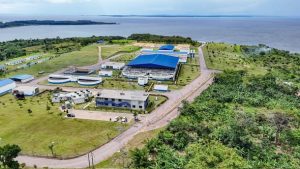



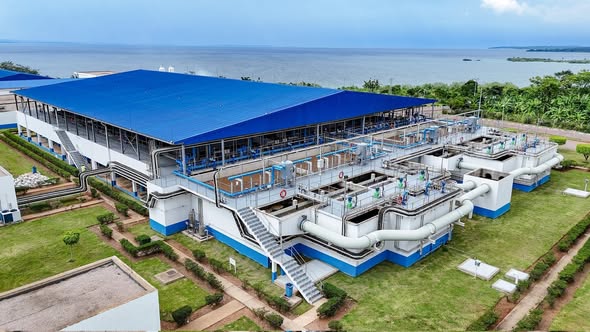
KATOSI — Millions of residents in the Greater Kampala Metropolitan Area are expected to gain improved access to clean and reliable water after the National Water and Sewerage Corporation (NWSC), with support from the French Development Agency (AFD), entered the final stages of a major distribution network expansion linked to the Katosi Water Treatment Plant.
The development was highlighted on Thursday during a site visit by French Ambassador to Uganda Virginie Leroy, who toured the project and described it as a strategic investment aimed at ensuring that the high production capacity at Katosi translates into actual water delivery to households, particularly in North and West Kampala.
NWSC officials said the project, known as Package 2B, is addressing long-standing distribution gaps that have limited utilisation of the Katosi plant.
According to Katosi Plant Manager Joseph Tweheyo Baine, the plant is capable of producing 160 million litres of water per day, but is currently operating at only about 52 percent capacity due to inadequate transmission infrastructure.
To close the gap, the project—launched in February 2025—includes installation of 70 kilometres of primary pipelines and construction of new reservoirs at Kanyanya, Kabulengwa and Mutungo, aimed at boosting supply to high-demand areas across the metropolitan region.
Once completed, the upgraded network is expected to provide more stable water services to rapidly growing communities including Kira, Kasangati, Gayaza, Matugga, Kawempe, Nansana and Wakiso.
NWSC reported that pipe laying has already commenced along the Mpererwe–Kawempe–Nansana corridor, with the overall project expected to be substantially completed by August 2027.
Ambassador Leroy praised NWSC for its performance and value-for-money approach, noting that the project includes an inclusive component targeting vulnerable populations. NWSC said a pro-poor initiative co-funded with Germany’s KfW has already delivered 1,400 standpipes fitted with prepaid meters and 64 public sanitation facilities, benefiting about 450,000 people living in informal settlements.
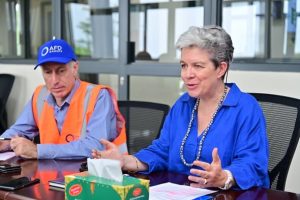
Leroy said France’s support, estimated at €480 million through AFD, reflects a long-term commitment to Uganda’s water and sanitation sector and aligns with national development goals under Vision 2040.
Project inspections included works at the Kungu pumping station and the Kanyanya reservoir, where excavation for a 10-million-litre reservoir has been completed. NWSC also said foundation works at the Kungu and Kabulengwa booster stations are already done.
NWSC engineering adviser Alex Gisagara described the expansion as the missing link required to ensure the large investment at Katosi reaches consumers.
Following progress under the initial funding phase, NWSC said the AFD Board in December 2025 approved additional financing to expand Katosi’s production capacity by 80,000 cubic metres per day and extend the network by an extra 50 kilometres. The project is also supported by the European Union, European Investment Bank (EIB) and KfW.
The development comes amid continued growth of NWSC, which says its operational footprint has expanded from 23 towns in 2013 to 287 towns by early 2026, while water connections have surpassed one million, serving an estimated 22 million people nationwide.
Under its 2024–2027 Corporate Plan, NWSC targets reaching 1.1 million connections and expanding services to 24 million people.
The corporation said that although the overall project completion timeline is July 2027, the bulk transmission pipeline serving Kira–Kasangati is expected to be ready by December 2026, benefiting areas such as Namugongo, Kira, Buwaate, Bulindo, Mulawa and Kasangati.