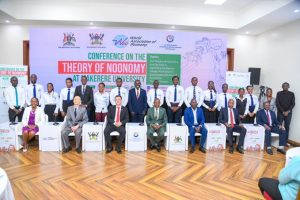



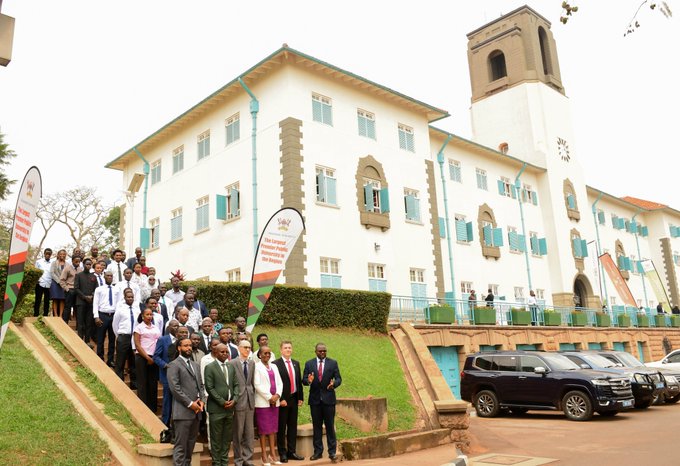
KAMPALA — Makerere University has hosted the inaugural conference on the Theory of Noonomy, bringing together academics, policymakers and researchers to debate a new approach to economic development based on knowledge, technology, human potential and humanistic values.
The conference sought to contextualise the theory, developed by Russian economist Professor Sergey D. Bodrunov, within Africa’s development challenges and explore how its principles could inform policy, education and research.
It also laid the groundwork for a proposed Centre of Excellence in Noonomy at Makerere’s School of Economics, under the College of Business and Management Sciences.
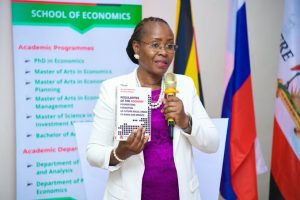
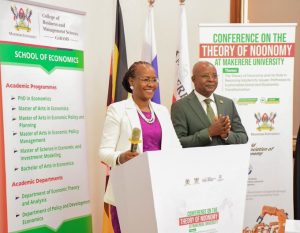
Representing Vice Chancellor Professor Barnabas Nawangwe, Deputy Vice Chancellor for Academic Affairs Professor Sarah Ssali said the world had reached a critical point requiring a rethink of established development models.
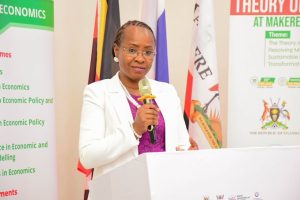
Ssali urged Africans to examine development approaches centred on knowledge, innovation and human potential rather than relying solely on conventional economic measures.
“We need collective action to establish an African development agenda built around research, innovation and sustainability,” she noted, urging participants to “think boldly, collaborate deeply and act decisively.”
The argument comes at a time when African countries are confronting several pressures simultaneously: climate change, technological dependence, unemployment, inequality and the difficulty of transforming economies that remain heavily dependent on primary commodities.
Africa needs new pathways
Presenting the Theory of Noonomy, Bodrunov said the theory examines the historical transformation of society and the changing relationship between production, technology, knowledge and human development.
“The world is moving towards a new phase of industrial development in which knowledge and human creativity become increasingly important to production,” he said.
The theory envisions what Bodrunov calls the New Industrial Society of the Second Generation (NIS.2), where knowledge, advanced technology and human potential drive economic progress.
Bodrunov praised Makerere’s intellectual leadership and called on the university to take an active role in developing the theory through research and teaching. “We look forward to having a Faculty and courses on Noonomy at Makerere.”
His call comes after Makerere and the S.Y. Witte Institute of Noonomy and New Industrial Development held discussions on expanding cooperation in Africa. The institutions have explored joint research and other forms of academic collaboration.
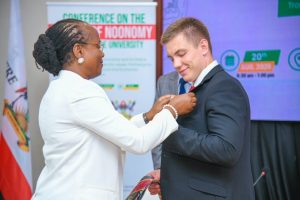
Makerere Vice Chancellor Professor Barnabas Nawangwe also received Professor Nikolay D. Dmitriev on the sidelines of the conference.
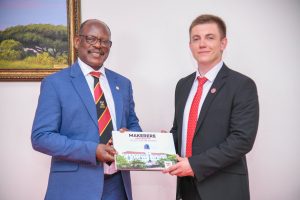
Nawangwe thanked Bodrunov and Dmitriev for selecting the university as an African partner for future research collaboration, including the proposed Centre of Excellence in Noonomy.
Russia-Uganda scientific cooperation
The conference also brought a diplomatic dimension to the academic debate.
Sergey Lobanov, Head of Mission at the Russian Embassy in Uganda, commended Makerere for its role in strengthening cooperation between Uganda and Russia in science and education.
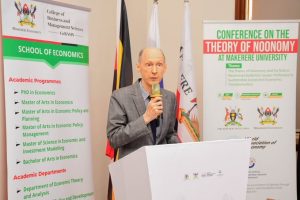
Lobanov described the Theory of Noonomy as an important platform for sustainable social and economic development.
The proposed cooperation between Makerere and the S.Y. Witte Institute places the university within a broader network of Russian-African discussions about industrial development, technological transformation and the future of economic systems.
But the question for Uganda is not simply whether another economic theory can be imported. It is whether such a theory can survive contact with African realities.
Technology must remain human
Artificial intelligence and automation were also central to the conference, particularly the question of whether technological progress necessarily translates into human progress.
Dr Peter Babyenda, Policy Engagement Coordinator at Makerere’s College of Business and Management Sciences, moderated the conference and challenged participants to embrace AI while keeping humanity at the centre of technological advancement.
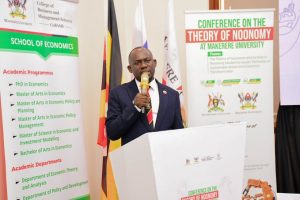
His intervention reflected one of the central tensions in the Noonomy debate: technology can increase productivity, but productivity alone does not answer the question of who benefits.
Professor Edward Bbaale, Principal of the College of Business and Management Sciences, offered three criteria for judging technological adoption.
“Technology should be assessed according to productivity, human development and inclusion,” he said, stressing that technological advancement should complement human potential.
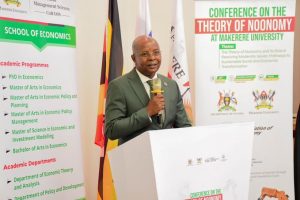
“We explored how Uganda can move from consuming knowledge to producing it, and how AI and digitalisation can serve human development rather than deepen exclusion,” said Dr Bbaale who chaired the panel discussion.
He added: “Our debate focused on five critical questions: 1. How does Uganda move from consuming knowledge to producing it? 2. How do we make AI & digitalisation serve human development? 3. How do we industrialise without sacrificing inclusion & sustainability?”
The argument is particularly relevant to Africa, where governments are pursuing digital transformation while facing pressure to create jobs for young populations.
If machines become more productive but fewer people can participate in the economy, is that development?
And if artificial intelligence is imported without the knowledge systems needed to produce and control it, has technology reduced dependence — or merely changed its form?
Noonomy as a lens for Uganda
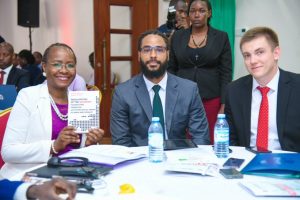
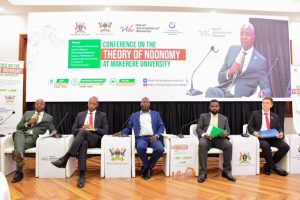
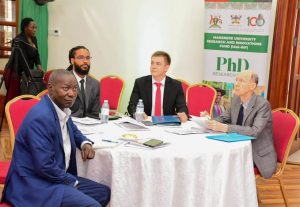
The conference brought together a panel moderated by Bbaale, with participants including Dr Robert Ngobi Kiwanuka of the National Planning Authority, Associate Professor Robert Wamala of Makerere University, Professor Nikolay D. Dmitriev of the World Association of Noonomy and Davis Vuningoma of the Ministry of Finance, Planning and Economic Development.
The panel examined technological change, knowledge production and economic transformation.

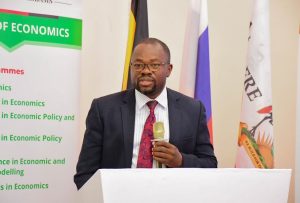
Closing the conference, Associate Professor Ibrahim M. Okumu, Dean of the School of Economics, described Noonomy as a lens for Uganda’s development and reaffirmed the School’s commitment to research on automation and knowledge-driven growth.
For Makerere, the proposed Centre of Excellence could provide an institutional home for this research and potentially connect economists, policymakers and researchers around questions of technology, industrialisation and human development.
The university says its research agenda seeks to narrow the gap between Africa’s enormous potential and the poverty, climate vulnerability, technological dependence and weak integration of knowledge that continue to constrain development.