



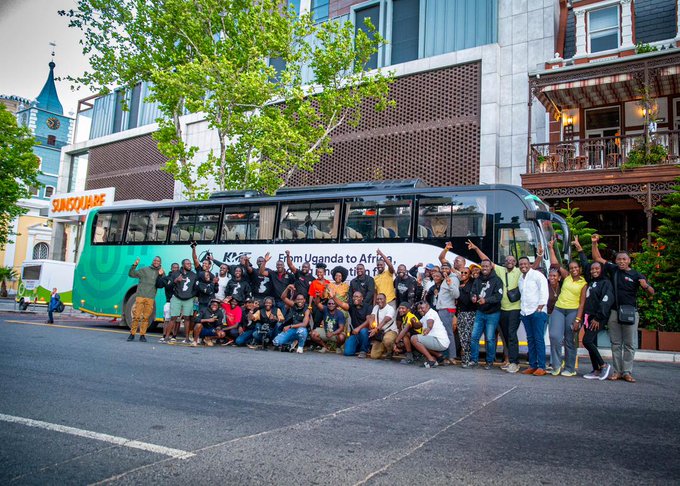
Cape Town, South Africa — Kiira Motors’ groundbreaking African Electric Expedition concluded in triumph as the team arrived in Cape Town, South Africa, after covering 7,125 kilometres across seven African countries in a historic demonstration of sustainable, homegrown mobility.
The expedition was officially welcomed by Hon. Dr Monica Musenero Masanza, Minister of Science, Technology and Innovation, who described the moment as “a proud statement on Africa’s capacity to innovate for its own future.”
“We’ve been through six countries, and here we are,” said Science, Technology and Innovation Secretariat on X.
Kiira Motors noted that her presence “added honour and inspiration” to the expedition, marking the final chapter of the journey dubbed “From the Pearl to the Cape.”

From Jinja to Cape Town: A Pan-African Journey
The expedition began in Jinja, Uganda, with hundreds of spectators witnessing Uganda’s first-ever continental electric mobility mission. The convoy included Kiira EV prototypes and the Kayoola EVS electric bus, with engineers briefing the public on the route, charging strategy, and data collection plans.
CEO Paul Isaac Musasizi emphasised that the mission would validate Uganda-built EVs’ durability, efficiency, and economic viability, while Minister Musenero flagged off the team, stating that the journey would “rewrite Africa’s technological story.”
Crossing Uganda: Kampala – Masaka – Mbarara
SoftPower News extensively covered the expedition’s stops through Uganda:
Kampala: Public demonstrations at the National Innovation Hub showcased regenerative braking systems and low operating costs. Masaka: Local boda boda leaders explored electric motorcycle adoption.

Mbarara: Engineering students at MUST engaged in workshops on EV powertrains and battery management, hailing the expedition as “a new era for automotive engineering in Uganda.” The team exited Uganda via the Mutukula border, officially beginning the continental leg.
Tanzania: Demonstrating Clean Mobility
In Dar es Salaam, the team was warmly received by Tanzania’s Ministry of Energy, highlighting the country’s EV charging plans. This included demonstration drives through Moshi, Dodoma, and Mbeya, where vehicles were tested on hilly terrain and high temperatures, charging exclusively at renewable-energy stations.
Zambia: Hydropower-Powered Charging
Crossing into Zambia, the expedition visited hydroelectric-powered stations at the University of Zambia, underscoring climate-friendly energy use. The team also engaged in technical and policy discussions with Lusaka officials, reinforcing the need for cross-border EV charging corridors.
Testing African Roads: Zimbabwe and Botswana
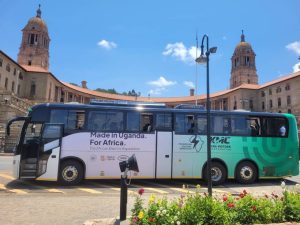
The journey’s most challenging terrain came in Zimbabwe, where long, dry stretches between Chirundu, Harare, and Bulawayo tested battery durability and suspension systems. The vehicles performed flawlessly, demonstrating their robustness for African conditions.
Botswana: Range and Efficiency Trials
In Botswana, the expedition tackled ultra-long drives with sparse charging points. Optimised driving and regenerative braking demonstrated the EVs’ range efficiency, impressing Botswana’s Transport Safety Board and local observers.
Eswatini: Continental Collaboration in Action
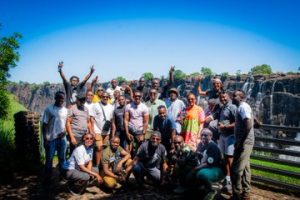
Arriving in Eswatini, the team engaged government officials, who expressed interest in partnership and collaboration on e-mobility initiatives.
On Day 17, the team crossed the Ngwenya Border, clocking 5,377 km, having used 4,511 kWh of energy and avoiding 2,481 kg of CO₂ emissions.
Kiira Motors hailed the stop as a symbolic example of “what happens when innovators, leaders, and partners move with one vision.”
South Africa: Final Stretch to Cape Town
By Day 18 in Bloemfontein, they had surpassed the 6,000 km milestone: Mileage: 6,108 km Energy Consumed: 5,123 kWh CO₂ Avoided: 2,817 kg.

Kiira Motors celebrated the endurance of both the vehicles and the team as they pushed through the final South African leg toward Cape Town.
The final South African leg drew attention from universities, innovation hubs, and local authorities, with the expedition showcasing the durability of Uganda-built EVs over long distances.
Cape Town Arrival: A Historic Moment
Crossing the finish line at Cape Town marked the culmination of 7,125 km, one of Africa’s longest-ever EV journeys.
Why the Expedition Matters
The expedition is proof that African-built EVs can handle diverse continental terrains, a demonstration of sustainable, green energy integration for mobility, and evidence that African innovators can scale solutions regionally.
It also serves as an inspiration for governments, investors, and the private sector to accelerate e-mobility adoption and blueprint for a harmonised, Pan-African electric mobility ecosystem.
The African Electric Expedition connected innovators, governments, students, engineers, and development partners across seven countries. Beyond mileage and technical data, the expedition symbolised Africa’s capacity to build its future, proving that sustainable mobility is not just aspirational—it is already underway.
Showcasing Africa’s Electric Mobility Potential
The journey has been widely praised across the continent as one of Africa’s most ambitious demonstrations of sustainable mobility. By solely using electric power for more than 7,000 km, the expedition avoided several tonnes of carbon emissions, reinforcing Uganda’s leadership in homegrown climate-friendly automotive innovation.
The data collected will inform: future EV design and battery optimisation, charging ecosystem models, regional infrastructure planning, and harmonised e-mobility policies across Africa.