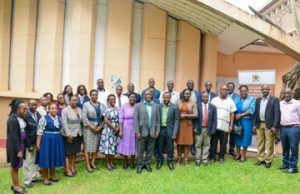



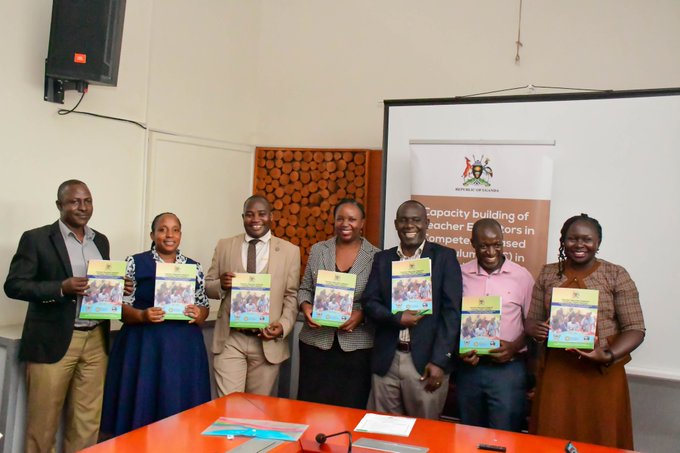
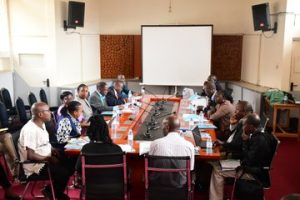
Makerere University’s College of Education and External Studies (CEES) on May 7, 2026, hosted a high-level dissemination workshop on the Competency-Based Curriculum (CBC), bringing together academics, policymakers, researchers and education stakeholders to assess Uganda’s ongoing education reforms.
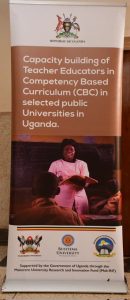
The workshop, held under the Capacity Building of Teacher Educators in Competency-Based Curriculum (CBC) project, focused on strengthening teacher preparedness and reviewing the implementation of competency-based education across selected public universities.
CBC is here to stay
Opening the workshop, Prof. Gyaviira Genza Musoke, Head of the Department of Foundations and Curriculum Studies at Makerere University CEES, said the curriculum reform had moved beyond experimentation and was now a national requirement.
“CBC started in Senior One in 2020. Many of us thought it was a pilot, but it has now been rolled out step by step,” Prof. Musoke said.
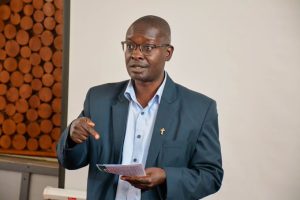
He warned that higher education institutions had been formally directed to align with the reforms. “The Ministry of Education and Sports has made it clear that by the 2027/2028 academic year, universities must align their programmes to CBC. Any institution not aligned will not be licensed,” he said.
Prof. Musoke noted that the reform had created mixed reactions within academia. “There are those for CBC and those still against it. But those who support it are those who have taken time to learn it,” he observed.
He urged stakeholders to use the workshop as a platform for reflection. “This is the future of our education system. We are here to listen, question and move our country forward with CBC,” he said.
We must ask serious questions
The Principal of CEES, Prof. Anthony Mugagga, challenged academics to critically interrogate the assumptions behind the curriculum reforms. “If we want CBC to succeed, we must be sincere and ask serious questions that positively impact its future,” Prof. Mugagga said.
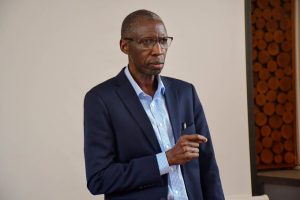
He questioned early reactions to the reform, noting elite behaviour at its inception. “Why did elites begin transferring their children to international schools when CBC started?” he asked.
Prof. Mugagga also raised concerns about learning outcomes and infrastructure. “Do schools have functional libraries? Do students have enough computers for research? Students are in school, but many are not learning,” he said.
He warned that curriculum success depends on harmonisation and proper funding. “Once curriculum, teaching and assessment are not aligned, there is confusion on the ground,” he noted.
CBC needs research, inclusion and teacher capacity building
Speaking on behalf of the MAKRIF Grants Management Committee, Juliette Nabirye, Acting Deputy Coordinator, praised government support for research but called for stronger inclusion in curriculum implementation.
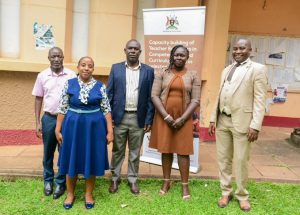
“We thank the Government of Uganda for sustaining research funding for the past seven years,” she said.
Representing the Chairperson, Prof. Fred Masagazi-Masaazi, she added: “We have gained a lot of knowledge today. I now know more about the competency-based curriculum than when I came in.”
However, she raised concerns about inclusion. “How is CBC being adapted for learners with disabilities, especially those who are visually impaired? This is an area we need to strengthen in future research,” she said.
She also emphasised the importance of continued collaboration. “Every journey begins with a single step. Let us ensure this discussion does not end in this room,” she said.
We must rethink teaching materials and publishing systems
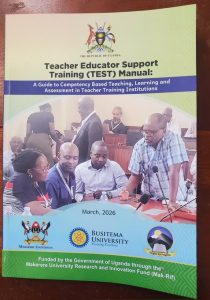
Presenting findings from the project, Principal Investigator Dr Julius Shopi Mbulankende said CBC implementation required structural changes in teaching resources and policy direction.
“We are exploring how competency-based curriculum can be integrated into teaching and learning in Ugandan schools,” Dr Mbulankende said.
He highlighted the role of an EU-supported initiative, DROOS, valued at nearly €1 million and implemented across Eastern and Western Africa.
He proposed the establishment of a national Centre for Competency-Based Education. “Should we now consider establishing a centre for competency-based education to support universities and schools?” he asked.
Dr Mbulankende also raised concerns about teaching materials. “Unlike before, when one textbook was recommended nationally, now different publishers produce different learner books. How do we build teacher capacity to author their own materials?” he said.
He warned that universities must also rethink their role. “Even at university level, we must move beyond articles and begin producing textbooks and learning materials for schools,” he said.
Participants agreed that CBC represents a major transformation in Uganda’s education system, requiring continuous dialogue, research and capacity building.
The workshop concluded with a call for stronger partnerships between universities, government agencies, private institutions and development partners to ensure effective implementation of competency-based education across all levels.